A series that has already seen more swings and roundabouts than a Milton Keynes parks department lorry continues to enthral, undeterred by weather that has shifted from sun to rain and back to sun again and always with a brisk chill breeze.
It is a shame then that the prospect of it failed to attract anything other than a sparse Sunday crowd. Those that did turn up sat huddled and swaddled but such has been the pace at which this match has been played, it is virtually a day ahead of where it might have been expected to be, enough to warm the cockles.
Shortly before lunch on the third day England, after some real tribulations against the second new ball, were finally all out for 350, which meant that the sides had tied on first innings, something of a rarity, and the match had therefore become a one-innings game. This, of course, is a format in which New Zealand excel and England do not. Even if they could not literally do so, the Black Caps could mentally don their one-day uniforms (perhaps they did, beneath their whites) and play accordingly.
It was exhilarating stuff once more from them as they overcame the loss of two early wickets to Stuart Broad, enjoying an oddly successful match, and rattled along at a rate that for a while reached 10 runs per over and barely less than five throughout.
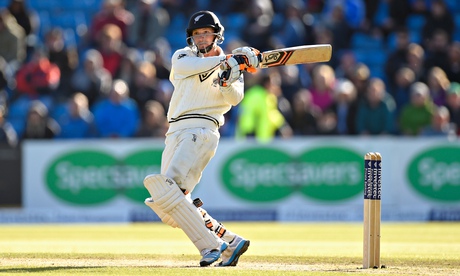
By the end of a day extended almost to half past seven because of time being made up following previous rain, it was New Zealand, on 338 for six, who held the upper hand. BJ Watling, the wicketkeeper who is playing in this match as a specialist batsman because of a knee injury sustained at Lord’s, completed his fifth Test hundred shortly before stumps on Sunday evening and resumes on the fourth day on precisely 100, from 137 balls with 13 fours and a six.
No New Zealand player has made a century on this ground before. Long before he reached that the statistical columns were being perused for precedents in the fourth innings of a Headingley Test.
The omens are not good as far as England are concerned for, although New Zealand have to win this match to draw the series, their enterprise has given them time both to put the game out of England’s reach while allowing themselves the necessary overs to complete the job.
Already it can be said that there has been only one score made in the fourth innings at Headingley in excess of that which England would require now – albeit in a winning cause, when in 1948, Australia made 404 for three, thanks largely to a second-wicket stand of 301 between the opener Arthur Morris and, inevitably, Don Bradman. Brendon McCullum may have once described Alastair Cook’s run scoring as Bradmanesque but neither he nor anyone else in the team is another Bradman. In a series that has already seen records broken, another may well now be required for England to win the match and series. Only the weather can help secure a draw.
Chasing now will be tricky, though, no matter how long England are given to bat. The pitch has largely played well when the sun has been out, becoming capricious only when low cloud has pressed down on the ground.
Then the ball has swung, to be used superbly by Trent Boult and Tim Southee. But even when the sun was out in the final session there were signs of erratic bounce with some deliveries from the seamers squatting and one off-break from Moeen Ali that bounced alarmingly from a length to flick the glove of Watling, then 50, and provide a difficult chance for Jos Buttler which he spilled. Far from winning the match, it is no exaggeration to say that England could lose it by 150 runs or more.
At times England have had the game within their grasp and let go. In making 350 New Zealand certainly got more than they ought, not least because of some unfathomable England bowling that eventually brought Broad a five-wicket haul that he might not wish to tell his grandchildren about.
Even then, when Adam Lyth and Cook added 177 for the first wicket, they looked in control until the second new ball cost them six wickets for 33 runs, offset only at the end by some hearty, often agricultural, hitting from Broad that brought him 46 of the 83 runs squeezed out of the last two wickets.
After more overnight rain and another delayed start, the gloomy conditions were perfect first thing for pace bowling, which Southee in particular exploited beautifully, getting rid of Ian Bell immediately (since his Antigua century, he has made 11, 1, 0, 0, 1, 29 and 12), followed by Buttler and Moeen, all to smartly taken slip catches, an area in which New Zealand – unlike England, who have dropped too many catches – have capitalised fully when the chances have come their way.
Once again, the new ball did some early damage, although by now the cloud that had contributed to the England batting collapse had disappeared. But Broad found the inside edge of Tom Latham’s bat and the outside of that of Kane Williamson before Martin Guptill, coming into the innings with successive noughts to his name, and Ross Taylor counterpunched so strongly that their eventual partnership of 99 came from only 87 balls before Taylor became one of three victims for Mark Wood.
Guptill followed, well taken at third slip by Joe Root to leave New Zealand 141 for four and the innings was in the balance. McCullum and Watling restored the equilbrium with a fifth-wicket stand of 121, of which McCullum made 55, from 99 balls, (relatively sedate for him) before Wood had him lbw.