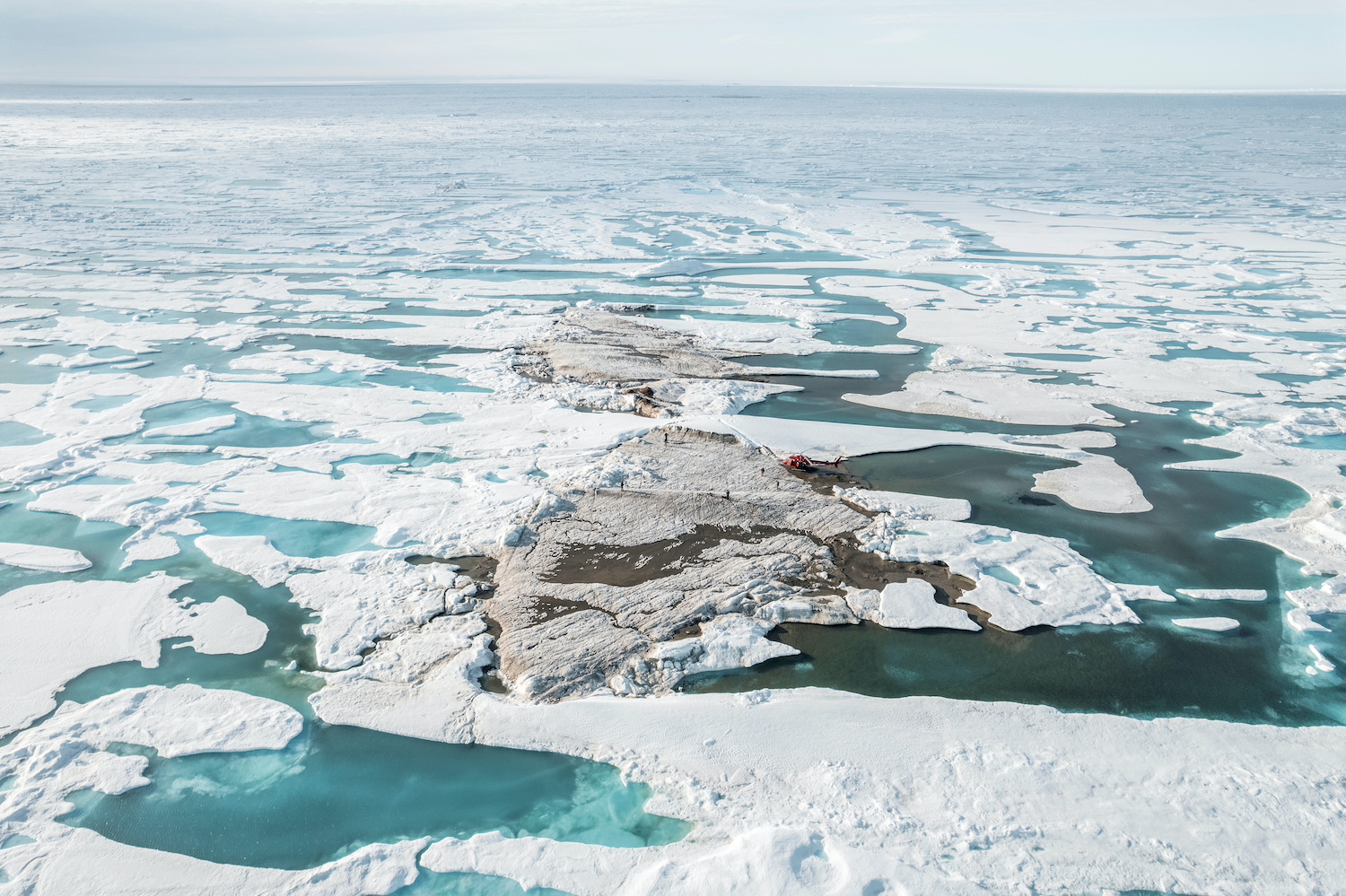
COPENHAGEN: Scientists have discovered what is believed to be the world’s northernmost landmass — a yet-to-be-named island north of Greenland that could soon be swallowed up by seawater.
The discovery comes as a battle is looming among Arctic nations — the United States, Russia, Canada, Denmark and Norway — for control of the North Pole some 700 kilometres to the north, and of the surrounding seabed, fishing rights and shipping routes exposed by melting ice due to climate change.
“It was not our intention to discover a new island,” polar explorer and head of the Arctic Station research facility in Greenland, Morten Rasch, told Reuters. “We just went there to collect samples.”
The scientists initially thought they had arrived at Oodaaq, an island discovered by a Danish survey team in 1978. Only later, when checking the exact location, they realised they had visited another island 780 metres northwest.
“Everybody was happy that we found what we thought was Oodaaq island,” said Swiss entrepreneur Christiane Leister, creator of the Leister Foundation that financed the expedition.
“It’s a bit like explorers in the past, who thought they’d landed in a certain place but actually found a totally different place.”
The small island, measuring roughly 30 metres across and a peak of about three metres, consists of seabed mud as well as moraine — soil and rock left behind by moving glaciers. The team said they would recommend that it be named “Qeqertaq Avannarleq”, which means “the northernmost island” in Greenlandic.
Several US expeditions in the area have in recent decades searched for the world’s northernmost island. In 2007, Arctic veteran Dennis Schmitt discovered a similar island close by.
Though it was exposed by shifting pack ice, the scientists said the island’s appearance now was not a direct consequence of global warming, which has been shrinking Greenland’s ice sheet.
Rene Forsberg, professor and head of geodynamics at Denmark’s National Space Institute, said the area north of Greenland has some of the thicket polar sea ice, though he added it was now 2-3 metres thick in summer, compared with 4 metres when he first visited as part of the expedition that discovered Oodaaq in 1978.
Any hope of extending territorial claims in the Arctic depends on whether it is in fact an island or a bank that may disappear again. An island need to remain above sea level at high tide.
“It meets the criteria of an island,” said Forsberg. “This is currently the world’s northernmost land.”
But Forsberg, an adviser to the Danish government, said it was unlikely to change Denmark’s territorial claim north of Greenland.
“These small island come and go,” he said.
The discovery was first reported earlier on Friday by the Danish newspaper Weekendavisen.