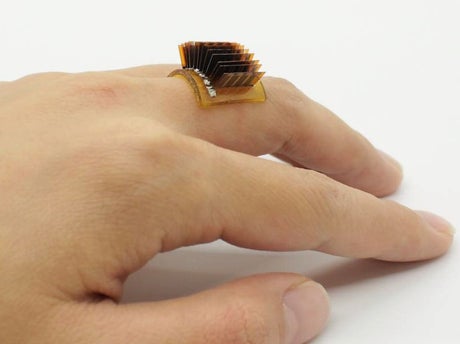
Scientists have figured out a way to turn the human body into a battery through a low-cost wearable device.
Through a small thermoelectric generator that can be worn as a ring or bracelet, researchers at the University of Colorado Boulder were able to convert body heat into enough electricity to power an electronic device.
Producing roughly 1 volt of energy for every square centimetre of skin, the device would be enough to power wearable electronics like smart watches or fitness trackers.
“In the future, we want to be able to power your wearable electronics without having to include a battery,” said Jianliang Xiao, a lead researcher in the technology, and an associate professor at CU Boulder.
“Whenever you use a battery, you’re depleting that battery and will, eventually, need to replace it. The nice thing about our thermoelectric device is that you can wear it, and it provides you with constant power.”
The gadget could also be adapted to provide power and eliminate the need for batteries in pacemakers, drug delivery pumps and other medical devices, according to the researchers.
If necessary, the device could even be made to cover an entire sleeve in order to produce even more power. Its flexibility and durability means all it needs is close contact with the skin in order to transform a person’s body heat into electricity.
“Our design makes the whole system stretchable without introducing much strain to the thermoelectric material, which can be really brittle,” Associate Professor Xiao said, adding that any additional heat generated through exercise could also be captured and transformed into electricity.
“The thermoelectric generators are in close contact with the human body, and they can use the heat that would normally be dissipated into the environment.”
The material that the wearable is made of is also self-healing, meaning if it tears it can be pinched together and it will seal back up in just a few minutes.
The researchers predict the device could appear on the market within five to 10 years once certain kinks in the design are worked out.
A study detailing the wearable generator was published in the journal Science Advances.