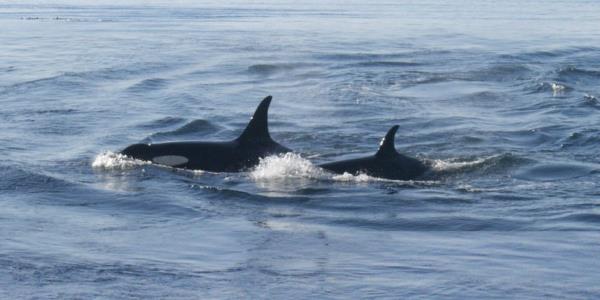
Researchers at the University of British Columbia (UBC) have identified a new population of killer whales that exhibit unique hunting behaviors. This group of 49 killer whales was observed hunting sperm whales in the open ocean off the west coast of the US, leading scientists to believe they represent a previously unknown type of orca.
The researchers have classified this new group as a potential subpopulation of transient killer whales or a distinct oceanic population found in waters off the coast of California and Oregon. This discovery adds to the three established ecotypes of orcas in the region, known as 'residents,' 'transients,' and 'offshores.'
Transients, also known as Bigg’s killer whales, are known for preying exclusively on marine mammals and are genetically and culturally distinct from other orca populations in the Pacific Northwest. The recent observations of the new group of killer whales provide valuable insights into their movements and behaviors in the open ocean, a habitat that is rarely studied.
The encounters with this mysterious pack of orcas revealed their unique characteristics, including distinctive bodily features and hunting strategies. The orcas were observed attacking various marine species such as sperm whales, pygmy sperm whales, northern elephant seals, Risso's dolphins, and even scavenging a leatherback turtle.
Physical evidence, such as bite marks from cookiecutter sharks, suggests that these killer whales primarily inhabit deep waters far from the coast. The researchers also noted differences in the shapes of their dorsal fins and saddle patches compared to other orca ecotypes, indicating a distinct physical appearance.
The team plans to continue studying this new population of killer whales by documenting more sightings and collecting data on their calls and genetic information. This research will help further understand the unique characteristics of these orcas and how they differ from known populations.