American scientists have developed a new 'Tree of Life', which sheds fresh light on the sheer diversity of life on Earth.
The tree of life, first described as we know it by Charles Darwin in On the Origin of Species, is the name given to a diagram which shows the relationships between all organisms, living and extinct.
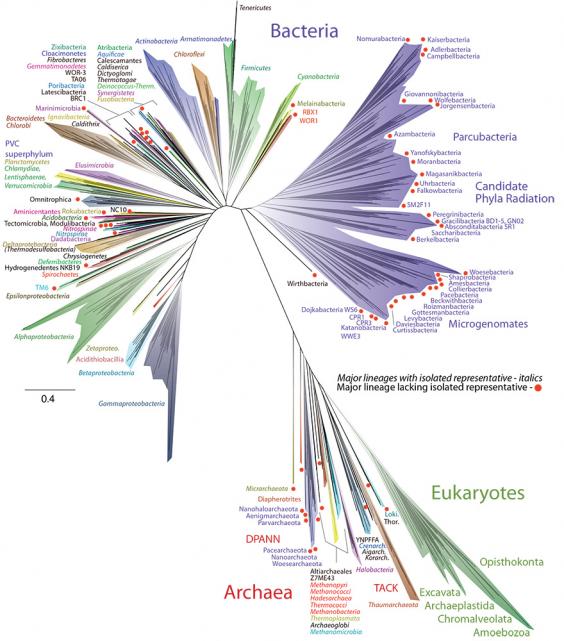
Researchers at the University of California, Berkeley, have now given this important diagram a major overhaul, by including a wealth of newly-discovered bacteria and other microorganisms.
As earth science professor Jill Banfield said: "The tree of life is one of the most important organising principles in biology."
"The new depiction will be of use not only to biologists who study microbial ecology, but also biochemists searching for novel genes and researchers studying evolution and earth history."
Traditionally, trees of life are built on three main trunks - eukaryotes, the group which includes plants and animals, bacteria, and archaea, tiny organisms which live in extreme environments.
Scientists looking to add new branches to the tree have often failed due to the difficulty of producing some of the more exotic microorganisms in laboratories.
However, by sequencing their genomes, rather than trying to isolate them individually, the team managed to accurately include thousands of new types of bacteria, which exist tentatively in inhospitable environments like Chile's Atacama desert and boiling hot springs in Yellowstone National Park.
The revised tree visualises the enormous number of organisms on Earth - the branch representing all known animals and plants is isolated in the bottom-right, while the rest of the detailed diagram depicts only invisible bacteria and microorganisms.
As Banfield says: "This new rendering of the tree offers a new perspective on the history of life."
Brett Baker, who co-authored an article on the tree recently published in the Nature Microbiology journal, said: "This incredible diversity means that there are a mind-boggling number of organisms that we are just beginning to explore the inner workings of that could change our understanding of biology."