KYOTO -- As sunlight filters through the sides of the landmark glass pyramid at the Louvre in Paris, visitors can't fail to notice the shimmering gold sculpture at the main entrance of the museum, where one of the latest works by Japanese artist Kohei Nawa is currently on display. On a recent visit to Nawa's atelier in Kyoto, I learned more about the artist and the distinctive piece.
Titled "Throne," the sculpture is made with fiber-reinforced plastic and stainless steel and is coated with gold foil. Measuring 10.4 meters high, 4.8 meters wide, 3.3 meters deep and weighing 3 tons, the piece was inspired by festival floats, Nawa said, and it curiously includes a seat.
"Pyramids symbolize the power and authority of kings in ancient Egypt, so I thought about what I should place there," Nawa said. "The Louvre is also an authority in its own right. Its building served as a palace for many French kings; it is one of the centers of the Western art world. But the kings are no more, so I decided to create an empty throne."
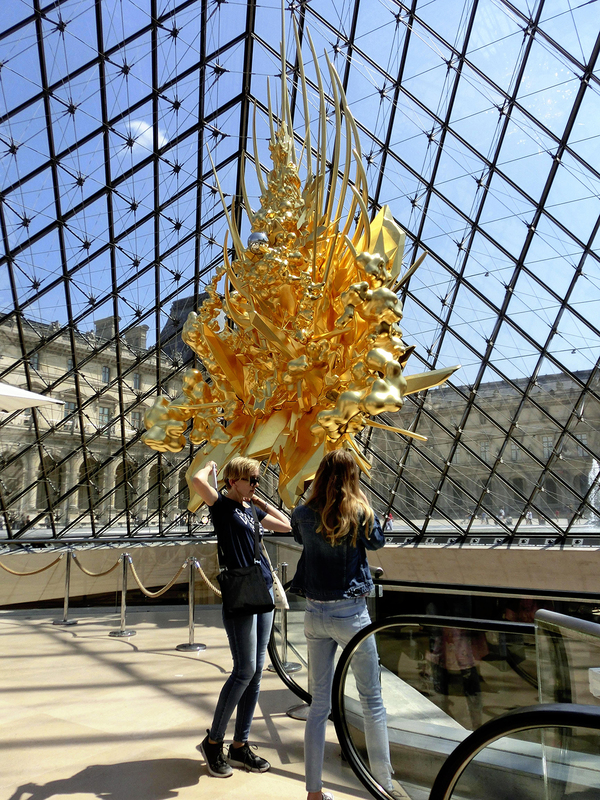
The seating area in the center of the work is as small as a child's car seat, Nawa said. "This doesn't project an image of a place for real kings or politicians to sit. It's not for me, either. Then, who's it for?" he pondered aloud.
"AI, perhaps. Artificial intelligence is still in its infancy, but I think in the near future it'll have a huge impact on politics and the economy."
The work will be on display until Jan. 14, 2019, as part of "Japonismes 2018," a series of events showcasing Japanese culture currently under way in Paris and other parts of France.
Two ball-shaped pieces covered with shining platinum foil can be seen on the front and rear of Nawa's "Throne." Representing the eyes of the piece, the forward-facing sphere observes the present and future and the rear observes the past, Nawa said.
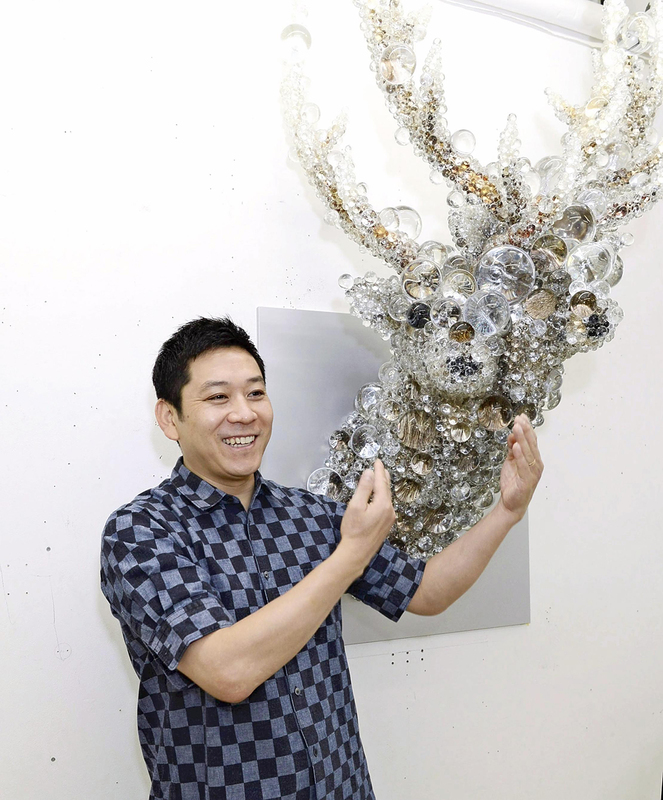
One of Nawa's signature works, the "PixCell-Deer" series, features transparent globes of various sizes adhered to a stuffed deer -- the word PixCell coming from a combination of the words pixel and cell. Nawa has produced similar pieces, sticking globes onto a variety of objects.
"I get stuffed animals mainly through internet auctions," he said. "Despite the abundance of deer in Japan, the first thing I bought was a stuffed sheep. When it arrived, it smelled so bad and felt too real when I touched it. It was so different from what I saw on my computer screen. So I thought about covering it with lenses."
"Today, digital cameras and smartphones are ubiquitous -- people carry them around to take photos, record video and post things on the internet. And we all look at these things online," Nawa said. "It's as if the entire world today is covered with [camera] lenses."
According to Nawa, we are experiencing an era in which there is an overemphasis on visuals -- everybody shares what they observe with others.
"A deer observed through a camera lens ceases to be a real deer, but something that has been processed into an image or a piece of information," he said.
Nawa first came across stuffed animals at Ibaraki High School in Ibaraki, Osaka Prefecture, where he was a member of the school's art club. Oddly, the school had many weird, old stuffed animals, which he used to sketch.
Born in 1975 in Takatsuki, Osaka Prefecture, he studied at the Royal College of Art in London as an exchange student and then acquired a Ph.D. of fine art sculpture at Kyoto City University of Arts' graduate school. He also serves as a professor at Kyoto University of Art & Design's graduate school.
There was a period when he thought he wouldn't progress if he stayed in Japan. He felt that he couldn't be active as an artist unless he was in the West, where contemporary art is part of society. However, he eventually returned to Japan.
Since 2009, he has been active in his studio -- named Sandwich -- in Fushimi Ward.
"I use various materials for each piece," he said. "A company in Kyoto I have had a long relationship with supplies blended resins that are the optimum conditions for molding." Through trial and error he repeatedly experiments with different materials, he added.
As his team of staff includes certified architects, the studio also functions as an architectural firm. Nawa said the process of making things on a computer is the same whether designing a sculpture or architecture.
About 40 people work at the studio, including part-timers -- there are also young artists from overseas staying there. Currently, they are working on about 100 projects .
"This studio used to be a sandwich factory, so I named it Sandwich and also made it my company name," he said. "I became an artist because I didn't want to be a company employee," he added, acknowledging the irony. "But I'm aware that working in a team is important to flourish in the global art scene."
-- A solo exhibition of Nawa's works is being held at Scai The Bathhouse gallery in the Yanaka district of Taito Ward, Tokyo, until Dec. 8. The show's central installation is an electronically controlled pool filled with a liquid compound of silicon oil and other substances whose surface features endless cycles of erupting cell bubbles.
Visit: www.scaithebathhouse.com/en
Read more from The Japan News at https://japannews.yomiuri.co.jp/