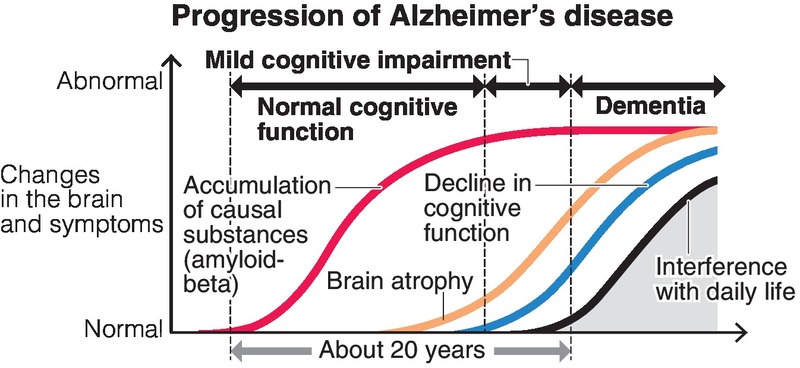
A protein that causes Alzheimer's disease (see below), the most common form of dementia, when it accumulates in the brain can now be detected by testing a small sample of blood, a research team has announced.
The simple new test is expected to boost the development of fundamental drugs for treating people before they exhibit symptoms of Alzheimer's.
The test examines amyloid-beta, a protein thought to gradually accumulate in the brain for up to about 20 years before symptoms of the disease become apparent. It was developed by a team including researchers from the National Center for Geriatrics and Gerontology in Obu, Aichi Prefecture, and Kyoto-based Shimadzu Corp.
The team announced its findings in the online edition of the British science journal Nature on Wednesday.
Current tests for amyloid-beta require sophisticated brain imaging scans that can cost from well over 100,000 yen to several hundred thousand yen per person. A sample of cerebrospinal fluid must be acquired by inserting a needle between vertebrae.
The high cost and heavy physical burden the tests place on patients are partly why large-scale research in this area has been difficult.
Blood contains only small traces of amyloid-beta, so it was considered difficult to check for it in blood tests. However, the research team developed technology for measuring the degree of amyloid-beta buildup in the brain based on the ratio of several related substances that change due to the accumulation of amyloid-beta. The team's method can take the required measurements from 0.5cc of blood.
Alzheimer's is asymptomatic, but as amyloid-beta gradually accumulates, the disease progresses to mild cognitive impairment followed by the appearance of symptoms.
The research team worked in cooperation with a world-leading dementia research institute in Australia.
The research involved comparing the results of blood tests and brain imaging examinations conducted on 121 Japanese and 111 Australians aged from 60 to 90, including some cognitively normal individuals.
In both countries the researchers were able to correctly identify the presence or absence of amyloid-beta in about 90 percent of the cases.
Katsuhiko Yanagisawa, director general of the center's Research Institute, said research on fundamental drugs for treating Alzheimer's has in recent years focused on medicines that can be used at the stage before symptoms become evident.
This research is expected to accelerate if a simple blood test can help select people who need treatment.
"If a treatment method is developed and society gives its approval, it might be used in medical examinations for elderly people before they show signs of the disease," Yanagisawa said.
Nobel laureate among researchers
Shimadzu Corp. Senior Fellow Koichi Tanaka, who won the Nobel Prize in Chemistry in 2002, was a member of the research team.
"We conducted our research because we wanted to create something useful for medical treatment and developing new drugs," Tanaka said. "I'm deeply moved that we've reached a point where the analytical technique we developed has prospects for being used for researching drugs for treating dementia. I think we must keep up our efforts."
University of Tokyo Prof. Takeshi Iwatsubo, an expert in neuropathology, said: "It was widely believed that it would be difficult to use a blood test to examine the buildup of amyloid-beta, but the team's findings appear highly credible because they could replicate their accuracy in samples in Japan and also overseas. This will be a huge step forward in the development and research of drugs for treating Alzheimer's in people who are not yet showing symptoms."
-- Alzheimer's disease
Estimated to account for 60 percent to 70 percent of cases of dementia. The disease damages neurons in the brain and many brain regions shrink, causing memory loss and making sufferers unsure of things such as where they are and what the time is, preventing normal daily life. Drugs designed to slow the disease's progression are available, but there are currently no medicines that can fundamentally cure Alzheimer's.
Read more from The Japan News at https://japannews.yomiuri.co.jp/