Tony Blair stocks up on supplies of passionate sincerity and deploys them liberally in front of MPs who question the wisdom of granting immunity to IRA suspects on the run. We haven’t seen much of him lately. He gets substantial coverage – though that’s still submerged, obviously, by the Charlie Hebdo deluge. But wait a minute: mass murder, attacks on the press, religious fundamentalism, ancient hatreds, terrorism… We’re talking Paris, Europe and the world. But why do we, so damnably easily, forget Belfast and Armagh? Why did The Great Danger only start on 9/11?
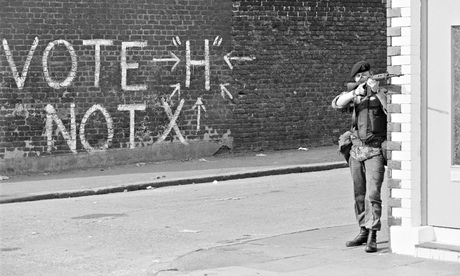
Some 1,879 ordinary men and women died in the Troubles from 1969 onwards. So, directly or subsequently, did 1,117 military personnel (as well as more than 550 Republican and Loyalist paramilitaries). Remember 1972, when 249 civilians and a 148 soldiers perished in one year. Remember the Birmingham pub bombings – 21 souls extinguished in a single blast, 162 innocents injured. Remember Guildford and the spread of terror far across the Irish Sea. Remember the snipers of Crossmaglen.
The final total of British servicemen killed in or by the Korean war was 1,078. The Troubles top that. And Afghanistan – 453 dead Brits – seems somehow modest by comparison. Why, Spain’s struggle against Basque groups saw 829 murdered in ETA attacks. Did the “War on Terror” begin only when George Bush picked his script? Is the berserk fringe of Islam somehow in a different media and political league?
It’s a question for journalists to pause over because comparisons are stark. The Irish bloodshed was here in Britain, threatening security year after year. Our land, our citizens, our challenge. Yet, as this ex-editor through many of those years can attest, readers and viewers outside Northern Ireland itself weren’t absorbed by the struggle day by day. To the contrary. Sales and ratings zipped up after some mainland atrocity but otherwise circulation went down when your paper led on Belfast shootings, marchings, assassinations (and, of course, negotiations).
It was all too grisly to contemplate, readers said, and, crucially, politicians agreed. Margaret Thatcher denounced editors and broadcasters for pumping out “the oxygen of publicity”. She didn’t want bomb blasts in Britain reported much, if at all. She thought the IRA were destroying her political allies, her hotel, her conference in order, in part, to use headlines as weapons of first resort.
Government weapons of first resort included the Prevention of Terrorism Act, the Emergency Powers Act, the Official Secrets Act and the Police and Criminal Evidence Act – plus insistent PR, heavy hands on collars and, in the Dublin government’s case, the ability to control what was broadcast. For a shameful while in the UK, no representative of Sinn Féin (a still legal party) could be heard speaking on TV. One way or another, the oxygen was pumped from the system.
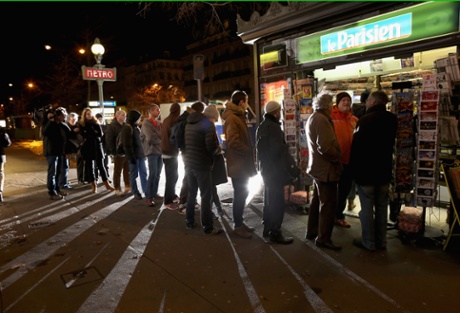
But note today how everything is changed. Paris is political and media oxygen blended. We see some of the killing live on our screens. We join the hunt for the assassins. Every TV presenter of weight lays anchor in a Parisian street. We watch millions march in protest, led by assembled presidents and prime ministers. We buy millions of copies of Charlie Hebdo. Zillions of tweets ring the globe. Belgium rates headlines for the first time in months. And, of course, the bosses of M15 past and present (now as visible as they were invisible during the Troubles) are on their feet, promising more surveillance, more restrictions, more control.
Terror shifts newsagent copies, fuels unique user numbers, boosts Barb ratings. Yet the number of deaths in Britain since Islamic terrorism erupted here is well under half of those who died in a single IRA year.
With massive media attention, inevitably enough, comes predictable media debate. The resounding press freedom verdict of week one soon begins to fray as broadcast reporters scour French suburbia in search of angry Front National men or angry Muslims. Stephen Glover in the Daily Mail turns familiar turtle. (“I abominate the Charlie Hebdo murderers. I also believe the magazine is malign and bigoted.”) David Aaronovitch (“The weasels of free speech need strangling”) and Mehdi Hasan resume columnar crossfire. And the tsunami of words and images buries issues and awareness. Who’s bored? Confused? Who’s chicken, who’s frit?
Of course, because this is a contrast of crises without pat conclusions, there are significant differences: over digital reaction, technology, global linkage and the rest. Islam, Shia or Sunni, is one religion. Christianity, Protestant or Catholic, is another. But Blair in the Westminster chair reminds us of a very recent past – a past that reminds us how, one way or another, politicians always seek to try to control the debate. And the raft of restrictions that stop policemen, let alone security staff, talking to journalists, plus open house on tracking journalists’ sources via the Regulation of Investigatory Powers Act, has an archetypal Thatcher ring – even before the new Cameron notions hit the statute book.
We can be brave, like Charlie, or frit. But those academics who think the Troubles would have been over far sooner if they had been reported fully, if the British government had been able to read the Sinn Féin runes, have a point: just as when I read great analysis of Isis – say Patrick Cockburn in the Indy or Martin Chulov in the Guardian – I wonder whether we needed to be so surprised over what happened to Syria and Iraq. Somewhere, floating between the rivers Lagan and Seine, there’s something precious called perspective. Needed now, more than ever.