There are fears that the new system to expand the acceptance of foreign workers will further undermine the ideal of the existing technical intern training system, which aims to transfer technology to trainees' home countries, as the new system enables such trainees to work in Japan for an extended period.
Under the new system, which will create new residence statuses that will start in April next year, it is expected that about half of the foreign nationals accepted as holders of category 1 certificates for specific skills under the new system will be those who switch from their status as technical intern trainees.
Companies nevertheless are welcoming the new system, because it can contribute to increasing their workforces and business opportunities.
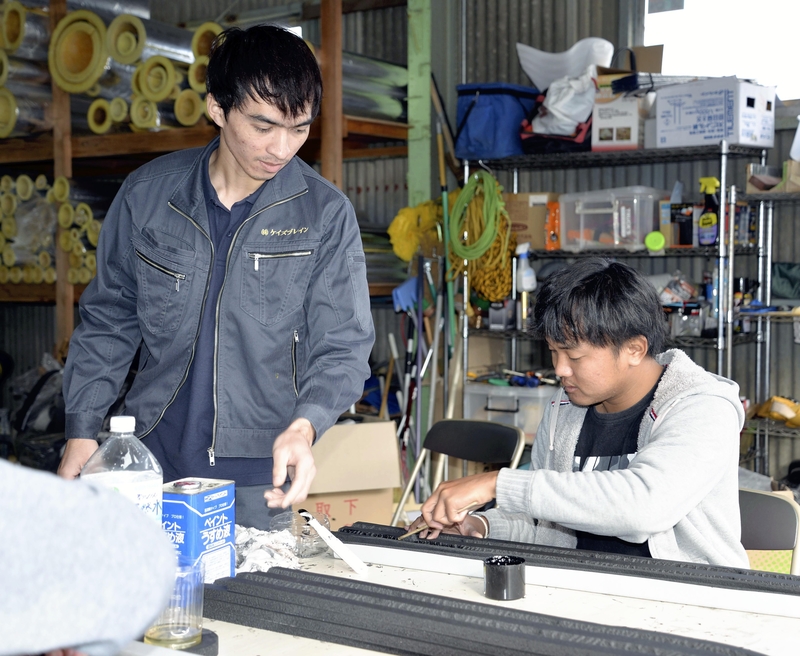
At KS' Brain, a heat insulation work company in Oyama, Tochigi Prefecture, three Thai intern trainees in their 20s to 30s engage in cutting rubber heat insulation material that is to be attached to the piping of air-conditioning equipment.
"They work well and seriously. They much contribute to our company," said the smiling 50-year-old manager of the heat insulation work department.
The company started to accept foreign intern trainees in 2014. Currently, about 50 workers of the company include seven Thai trainees. Although the company invites Japanese, it sometimes receives only one application a year.
Since it started accepting trainees, the company has been able to get more work orders. Its sales this year have already increased 2.5 times the level of the previous year.
Yet the system's maximum training period is five years, which means that trainees are supposed to return to their home countries just when they have become adept in their work. Thus, businesses need to teach the job to new trainees from scratch, which has been a cause of distress.
Under the new system, foreign nationals who have undergone at least three years of technical training in Japan can switch to the new residence status granted to non-Japanese having specific skills without taking a test, which qualifies them to work in Japan for an additional five years.
"I want capable foreign people to work at our company for as long as possible," said the department manager. He also said that the new system has the merit of the company handling these workers as part of its workforce, not as trainees.
A 23-year-old Thai trainee at the company said: "This company has warmth. I want to keep working in Japan if possible."
Koei Suisan, a company that cultures oysters at the Sakoshi fishing port facing the Seto Inland Sea in Ako, Hyogo Prefecture, has three Vietnamese trainees. Those trainees are in Japan for training in fish farming. Trainees accepted at the company return home after the end of the oyster farming season, which lasts around from November to May the following year. Then, another batch of trainees arrives for the next season.
The company is considering to start fish farming in summer as well, which could create a year-round work system. In this respect, the company has high expectations for the new system to enable long-term work for foreign nationals.
150,000 trainees may get new status
The Justice Ministry estimates that the number of foreigners converting from technical intern trainees to category 1 certificate holders will amount to about 120,000 to 150,000 in five years. The number accounts for about 45 percent of all category 1 certificate holders.
The intern training system was set up in 1993 envisaged as being an international contribution aimed at providing trainees from overseas Japanese technology that could be used to develop their home countries. Yet there is no denying that the system in reality has been used to help eliminate the labor shortage.
If foreign people who initially come to Japan as intern trainees are to work longer in Japan, the training system's ideal will turn into a mere shell.
A senior Justice Ministry official defends implementing the training system and the new system together, saying: "The longer they work [in Japan], the more proficient they become in their work fields. We hope they will use their proficiency after they return to their home countries."
In fact, the very purpose of the new system is to "eliminate the labor shortage."
"It is unreasonable that the two systems that have different purposes are linked together," said Prof. Eriko Suzuki at Kokushikan University, who is a labor sociology specialist. "The training system should be abolished as its ideal has already totally failed."
Regarding the intern training system, a new scheme was introduced as recently as November 2017 to extend the maximum training period to five years from the initial three years.
Unlike people acknowledged under the new system as having specific skills who can switch to the new resident status without taking a test, people under the training system need to pass an examination of their practical skills if they want to extend their training periods.
As of the end of June, about 1,500 trainees had extended their training periods.
A source associated with the Japan International Training Cooperation Organization, which supports the training system, said: "It is difficult to pass a test examining trainees' practical skills. Almost no trainees will probably want to extend their training periods in the future. The central government seems to make systems only in a hit-and-miss manner."
Read more from The Japan News at https://japannews.yomiuri.co.jp/