Experts have voiced doubts over the health ministry's proposals for a draft bill, released Tuesday, that would revise the Health Promotion Law to strengthen regulations against passive smoking.
The government will coordinate with the ruling parties, aiming to submit the revision bill to an ordinary Diet session as early as March. To maintain consistency, the Tokyo metropolitan government will delay submitting an ordinance bill to the Metropolitan Assembly in February. This ordinance would ban smoking indoors and include penalties for infractions.
The government wants to implement the regulations in stages, in preparation for the 2020 Tokyo Olympics and Paralympics.
"Considering the Tokyo Olympics and Paralympics, it's important to make progress in this ordinary Diet session. I want a thorough debate," said Gaku Hashimoto, director of the ruling Liberal Democratic Party's Health, Labor and Welfare Division, at the outset of a Tuesday meeting of the division's executives.
Some lawmakers said the Health, Labor and Welfare Ministry's proposal for revising the law represented a retreat from a proposal the ministry made in March. Still, the discussion at the meeting was generally favorable to the latest proposal, sources said.
The ministry is now expected to coordinate with the ruling parties over the specifics of the bill.
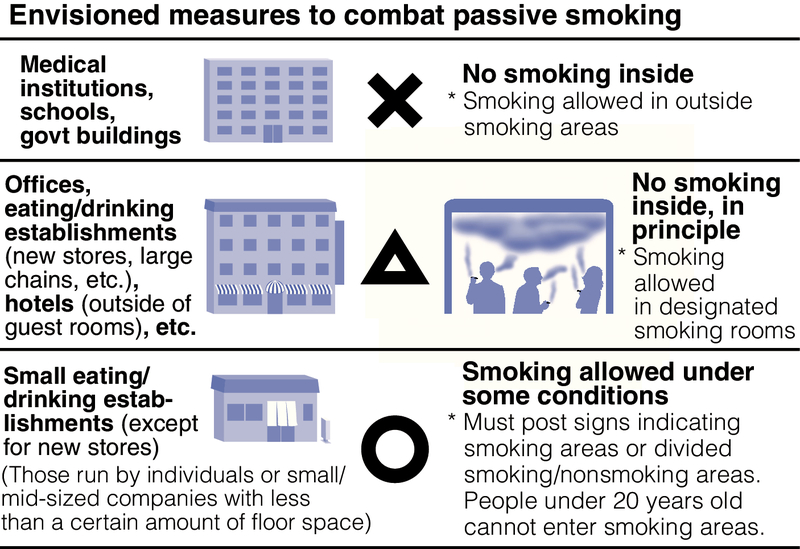
The proposal would ban smoking at eating and drinking establishments in principle, allowing smoking only in dedicated smoking rooms.
Smoking would be allowed in existing "small" eating and drinking establishments run by individuals or small or midsize firms, though they would be required to post signs alerting customers before entering whether the business allows smoking or has separate smoking and nonsmoking sections.
However, the exceptions for small businesses would only be for a limited time.
The proposal would also ban people younger than 20 years old from entering smoking rooms and other such areas inside stores, and subject "electronic tobacco products" to the same rules.
Greater leeway
The proposal made by the ministry in March would have allowed smoking only in small bars with shop floor area of less than 30 square meters.
The latest proposal does not define "small," but would grant exceptions to stores that are 150 square meters or smaller and those run by small or midsize companies that do not have capital exceeding 50 million yen.
Essentially this would allow smoking in a larger range of businesses. A survey by the metropolitan government found that 90 percent of eating and drinking establishments in Tokyo could allow smoking if the 150-square-meter limit is adopted.
The ministry relaxed the regulations from its original proposal to coordinate with the LDP after discussions stalled.
The government initially planned to submit the bill to last year's ordinary Diet session. However, LDP lawmakers and others, who are cautious about a complete smoking ban, expressed their concern that businesses would lose customers or be burdened by having to build dedicated smoking rooms. As a result, the government gave up on submitting the bill.
The process was also influenced by the desire of previous health minister Yasuhisa Shiozaki for strict regulations, and continuing conflict inside the LDP between those in favor of regulations and those wanting a more cautious approach.
Katsunobu Kato, who replaced Shiozaki as health minister in a Cabinet reshuffle in August last year, began looking for middle ground by placing importance on a basic view of eliminating "unwanted passive smoking."
Kato is sticking to a total smoking ban in new establishments and preventing people younger than 20 years old from entering smoking areas.
"Even if we compromise elsewhere, definitely get these two points in," he was quoted as saying in instructions to ministry officials.
Based on this, the stipulations requiring businesses to post signs was included, while consideration was shown to the LDP's calls to relax the shop floor area limit.
Far from international standards
In 2010, the International Olympic Committee agreed to work with the World Health Organization to promote a "Tobacco Free Olympics."
At the London and Rio de Janeiro Games, after the agreement was made, indoor smoking was totally banned for businesses such as eating and drinking establishments.
As for Japan, if the current proposal is implemented, it would only raise the country one spot on the WHO's passive smoking classification. Its current rank is four, the lowest on the scale.
Hiroshi Yamato, a professor at the University of Occupational and Environmental Health in Kitakyushu who specializes in passive smoking, said: "If smoking is still allowed in most eating and drinking establishments, the countermeasures will be meaningless. The government should eliminate passive smoking, as well as 'unwanted passive smoking.'"
Medical field opposed
The health ministry's proposal for revising the Health Promotion Law contains significantly looser rules on eating and drinking establishments compared to an original proposal made in March.
The new proposal has elicited criticism from medical circles and others, which have demanded stricter regulations.
"It's been shown that totally banning smoking at eating and drinking establishments reduces diseases of the circulatory and respiratory systems," said Hisayoshi Fujiwara, head of the Tobacco Control Medical-Dental Research Network, which comprises 26 academic societies including the Japanese Society of Internal Medicine and the Japanese Circulation Society.
"Anti-smoking efforts are becoming commonplace overseas. [The ministry's proposal] is severely out of step with the times."
Read more from The Japan News at https://japannews.yomiuri.co.jp/