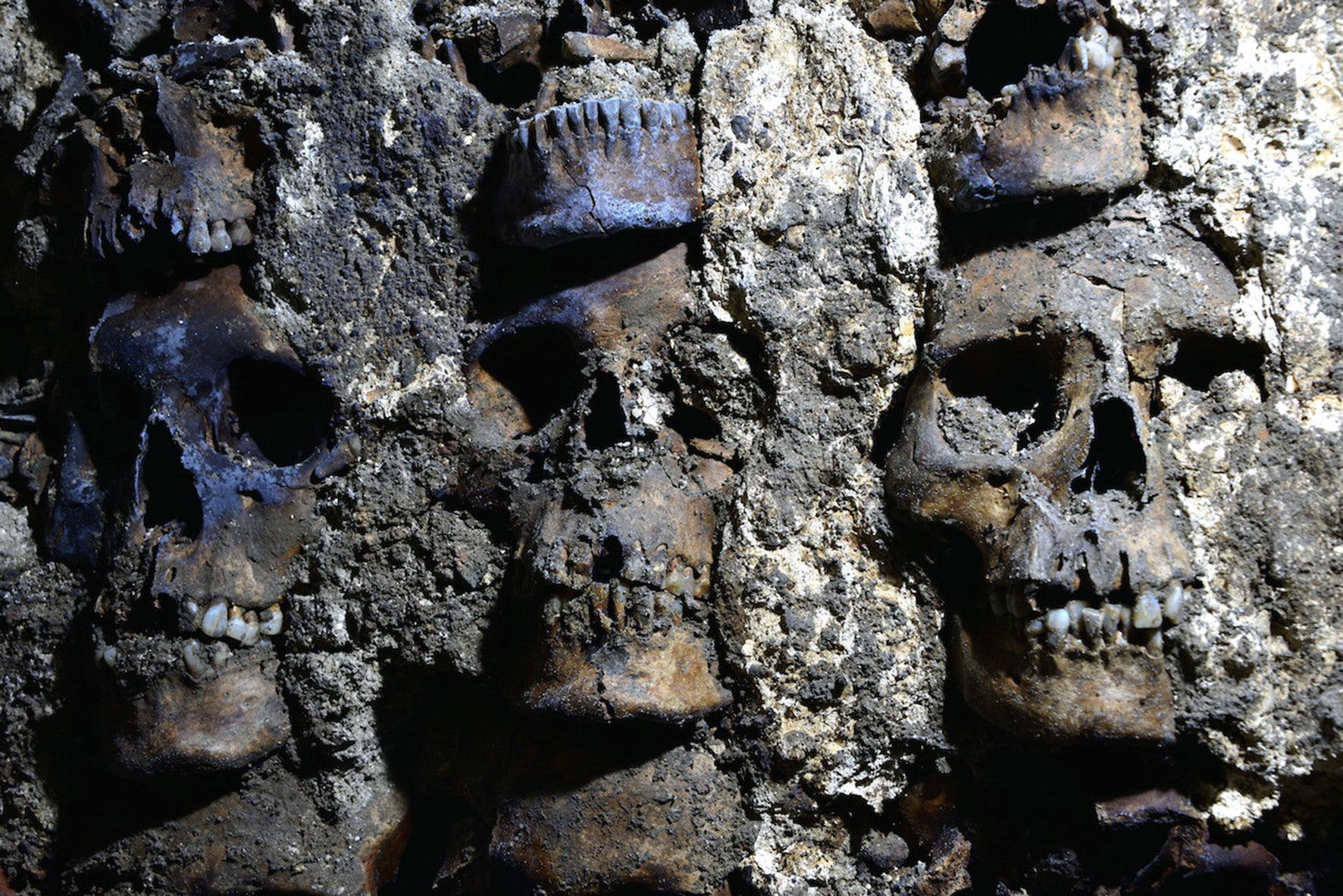
Archaeologists in Mexico have discovered the skulls of more than 100 men, women and children in newly unearthed sections of an Aztec tower of human remains.
The skull tower, which is said to date to between 1486 and 1502, was found five years ago in the centre of Mexico City by the National Institute of Anthropology and History (INAH).
In March, another 119 skulls were uncovered on the eastern side of the tower by a team from the institute’s Urban Archaeology Programme, according to a statement released by the INAH last week.
At least three were children’s skulls, identifiable because of their size and underdeveloped teeth.
This brings the total number of skulls found so far at the site – located near the Aztec Templo Mayor – to 603.
It is thought that the cylindrical structure, called the Huey Tzompantli, was one of seven displays of human skulls in the Aztec capital of Tenochtitlan, modern-day Mexico City.
Speaking about the new discovery, Mexico’s culture minister, Alejandra Frausto, said: “The Templo Mayor continues to surprise us, and the Huey Tzompantli is without doubt one of the most impressive archaeological finds of recent years in our country.”
Although it is unclear exactly who the individuals were, they are presumed to have been killed during sacrifices to the gods.
Archaeologist Raul Barrera told Reuters: "Although we can't say how many of these individuals were warriors, perhaps some were captives destined for sacrificial ceremonies.
“We do know that they were all made sacred. Turned into gifts for the gods or even personifications of deities themselves.”
The Huey Tzompantli struck fear into the Spanish conquistadors and as a result appeared in the writings of Hernán Cortés y Bernal Díaz del Castillo, the statement said.