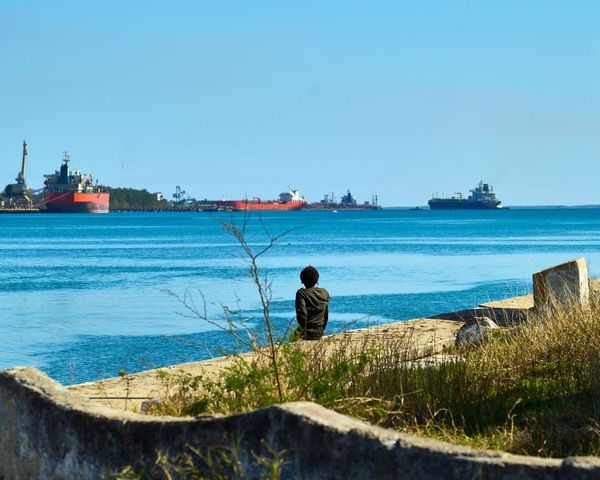
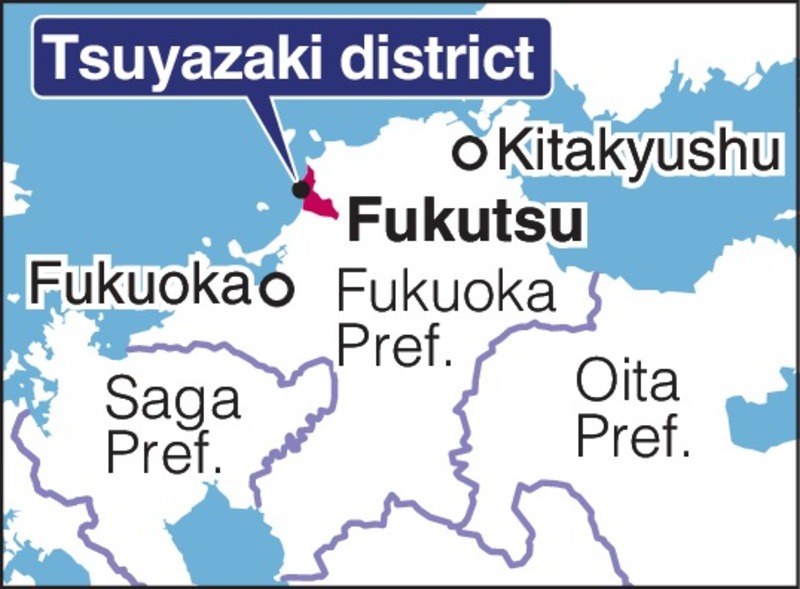
FUKUTSU, Fukuoka -- The Tsuyazaki district, in what is now Fukutsu city in Fukuoka Prefecture, flourished as a salt production and maritime trade center from the Edo period (1603-1867) through to the Taisho era (1912-1926).
The district is home to Tsuyazaki sengen, an area of narrow streets lined with old homes. A project to vitalize Tsuyazaki sengen by repairing and restoring empty houses in the area to their former glory is in full swing -- and achieving impressive results.
A growing number of people have moved to the district in the past 10 years. In fact, at times there is a waiting list for people seeking to move into one of these houses.
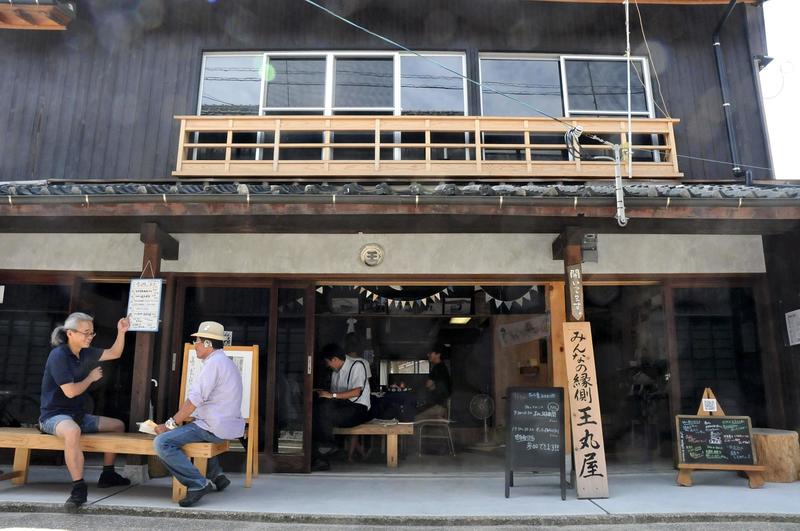
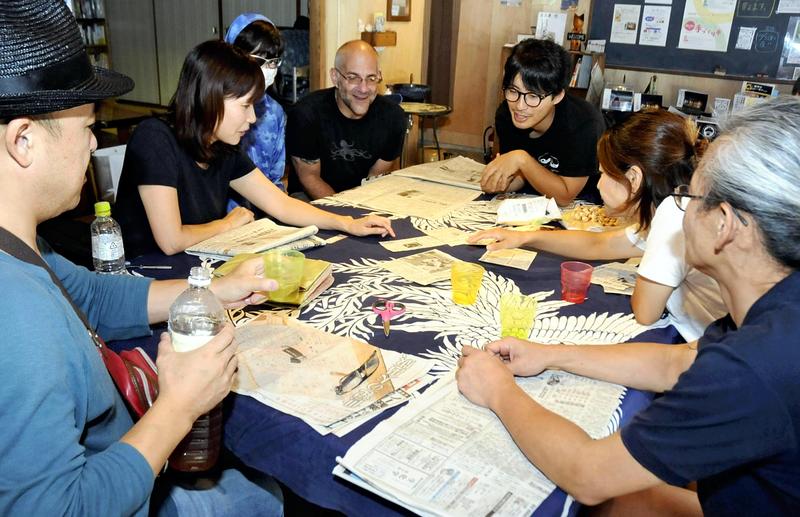
In late September, shopowner Toru Tominaga, 31, and eight other people sat around a table in an earthen-floored room at Minanoengawa Ohmaru-ya, a venue for local events and social gatherings in Tsuyazaki.
"Let's cut out articles that catch your interest and present them to the group," Tominaga said at this meeting of a newspaper-reading group that gathers every Wednesday. The attendees introduced themselves and enjoyed a pleasant time chatting with each other.
This venue also was previously one of the district's empty homes.
The two-story wooden building built about 140 years ago lost its occupant after Tominaga's grandmother died in 2014. Tominaga's mother, who lives in Chiba Prefecture, initially was torn over what to do with the house. She decided to seek the advice of Noriaki Furuhashi, 36, who runs a real estate business in Tsuyazaki.
In 2015, Furuhashi established a group, together with a local subcontractor and other entities, to promote the use of empty buildings in Tsuyazaki. Since then, he has offered free advice and consultations for people considering breathing new life into these buildings.
Tominaga, who was an elementary school teacher in Fukuoka Prefecture at the time, became involved in the talks, which made him more interested in the project. He decided to leave his job and move over to the district in the spring of 2016 to fulfill his mother's ambition: use the premises to let the locals and visitors have social gatherings.
At first, Tominaga struggled to come up with a development plan. "I had no idea what I should do," recalled Tominaga. But by actively becoming involved in the community, such as by joining the committee in charge of running a local festival, Tominaga developed a clear picture of how the house could be transformed to serve the area.
In the summer of 2017, Tominaga removed the door from the entrance of the Ohmaru-ya building to make it easier for people to stop by. This seems to have worked. A growing number of events are being held there, including gatherings in which participants drink coffee or sing. Elementary school students on their way home also use the building as a space to do homework.
The newspaper-reading group also shifted here from a different venue. "This is an ideal place for events in which people interact," said Takao Fukui, 30, who heads the group.
Ceramic artist Kensuke Fujiyoshi, 51, who moved to Tsuyazaki six years ago, is a regular participant in the group.
"[Tominaga's] grandmother was very kind to me. Now I want to do my bit to help this area," Fujiyoshi said with a smile.
This summer, Tominaga registered the property to be a minpaku private accommodation facility. Japanese-style rooms on the second floor have been available for travelers and other people to stay in since October.
"I hope this will be a place that brings people together, so visitors can meet and interact with the locals before they leave," Tominaga said.
Tsuyazaki Branch, an organization that seeks to boost Tsuyazaki's local economy by supporting people who move to the district, was launched in 2009. Since the organization started assisting people wishing to move to the district and use the vacant homes, the population of Tsuyazaki sengen – which had been dropping due to the closure of a private railway line and other reasons -- has increased by about 200 people over nine years.
Furuhashi also moved to Tsuyazaki five years ago. "Seeing the lights on again in what were empty homes inspires me to keep doing this," he said.
To repay the kindness of people who welcomed him into the district, he now wants to offer support by helping others settle in. People interacting with people will attract even more people. This virtuous cycle is taking root in the Tsuyazaki district.
Govt supports restoration
The number of empty houses and buildings across Japan is rising as the nation grapples with an aging population and chronically low birthrate. In 2013, there were 8.2 million unoccupied dwellings, an 80 percent increase from 20 years earlier.
This has sparked the rise of projects aiming to find ways to make use of these buildings across the nation. Some notable successes have been achieved in areas including Tsuyazaki sengen, and a network established in Kyoto is ensuring old buildings are maintained and handed down to future generations.
The central government also has drawn up various assistance measures to spur the use of vacant dwellings. This fiscal year, the Land, Infrastructure, Transport and Tourism Ministry launched a model project to strengthen cooperation among entities devising steps to make practical use of these buildings. The ministry provides subsidies to organizations engaged in activities such as nurturing human resources and crafting consultation systems regarding empty houses.
The group dedicated to promoting the use of empty buildings in Tsuyazaki is among the organizations using this system.
Fukutsu, Fukuoka Pref.
A city created through the merger of Fukuma and Tsuyazaki towns in 2005. Located between the cities of Fukuoka and Kitakyushu, Fukutsu has convenient transport links and as of Aug. 31 had a population of about 64,000 -- about 8,500 more than when the city was formed.
Fukutsu has a rich natural environment and a long history. The west side of the city faces the Genkainada sea and is a spawning site for loggerhead turtles, which local groups are working hard to protect. A cluster of ancient burial mounds in Fukutsu forms part of the Sacred Island of Okinoshima and Associated Sites in the Munakata Region, which was inscribed on UNESCO's World Heritage list in 2017.
Read more from The Japan News at https://japannews.yomiuri.co.jp/