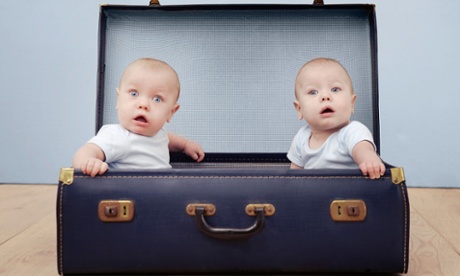
A New Jersey woman will receive child support for just one of her twins after a court ruled the two sisters have different fathers.
Passaic County superior court judge Sohail Mohammed made the discovery in a child support case brought by the county on the woman’s behalf. The judge ordered a hearing after a routine paternity test found that the man in question had fathered only one of the girls, born in January 2013.
In his 22-page legal opinion, Mohammed said, based on the testimony of experts, if a woman has “coitus with either one man or with different men during a single poly-ovulatory period, superfecundation [two eggs fertilized at the same time] could result and the twins could have either the same father or different fathers, respectively”.
In other words, if a woman’s ovaries release two eggs during a single menstrual cycle, both could be fertilized. That would make the resulting children dizygotic twins, a phenomenon more familiar as a type of fraternal twins – siblings born at the same time who look different.
But when the woman has sex with two different men in the same cycle, as the Passaic County woman said she did, and the two eggs are fertilized, the twins with different fathers are called “heteropaternal” or “bipaternal” twins.
Researchers say that such occurrences of surprise parentage are not only underreported, but likely on the rise.
One 1997 research paper, Indisputable Double Paternity in Dizygous Twins, found that about one in every 13,000 paternity cases includes twins from different fathers, most discovered during DNA tests in paternity cases.
“Today, it is believed that the incident of bipaternal twins is increasing at a higher rate compared to 50 years ago mainly due to assistive reproductive technologies, ovulation induction, promiscuity and other factors,” Mohammed wrote.
Mohammed called the case the first of its kind in New Jersey, and found that “only a handful of reported cases exist nationwide”. In fact, the judge found only two more cases in America, one in New York City and the second in Denver, Colorado.
Before releasing his ruling Monday, Mohammed explored a range of other explanations for the “rare” result. He explored the lab sample’s chain of custody, whether the lab had erred and the reliability of the test itself (99.99% accurate).
Ultimately, the twins’ mother was awarded $28 per week in child support from one of the fathers.
Boards of social services may sue on behalf of women on public assistance, as happened in this case.