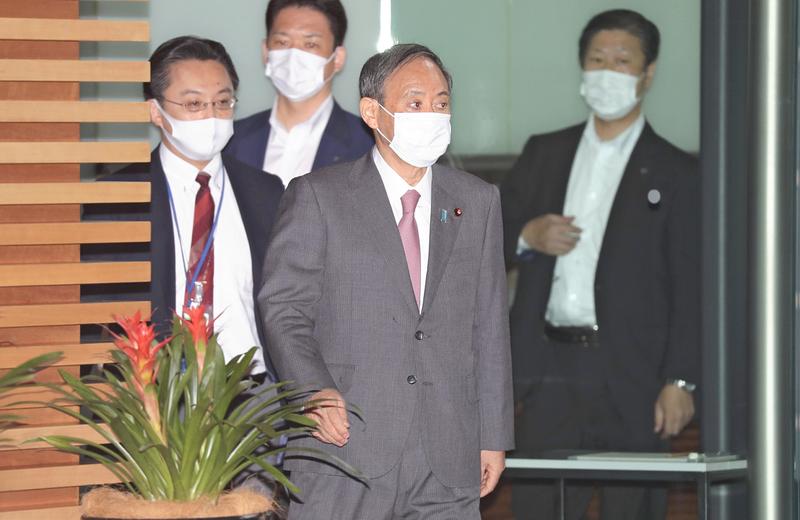
Ministers officially started their work Thursday morning, a day after Prime Minister Yoshihide Suga launched his Cabinet.
"I want to launch a cabinet that will work for the people and live up to their expectations by achieving solid results," Suga told reporters at the Prime Minister's Office.
He arrived at the office at about 6:40 a.m., after leaving the residence compound for House of Representatives members in Tokyo's Akasaka area. Suga walked around the premises of the Prime Minister's Office instead of taking his regular morning walk.
He then had breakfast at a nearby hotel and returned to the office. In the afternoon, the prime minister was to attend the opening ceremony of an extraordinary Diet session.
Suga became Japan's 63rd prime minister on Wednesday. He succeeded former Prime Minister Shinzo Abe, who served for a record seven years and nine months (2,822 days) from December 2012.
On Wednesday night, Suga held his first press conference as prime minister at the Prime Minister's Office, after the inauguration of his Cabinet. He addressed his administration's intention to prioritize COVID-19 countermeasures and economic recovery, while also working to change the government's vertically integrated structure and promote regulatory reform.
Suga stressed that his Cabinet will "break down bureaucratic sectionalism, vested interests and excessive adherence to precedents, and be committed to regulatory reform." As part of such efforts, he said the government would set up a "sectionalism emergency line" that the public can use to report specific examples of such practices via phone calls and emails. Taro Kono, the minister in charge of administrative and regulatory reform, tweeted on Thursday that the line was operational.
Suga also spoke at the Wednesday press conference about a digital agency that will be established as a symbol of the "departure from sectionalism." The agency is expected to promote the cross-ministerial digitization of government services, the insufficient state of which has been highlighted amid efforts to contain the novel coronavirus.
Regarding regulatory reform, Suga spoke about mobile phone bills, saying, "Japan's three [major] cell-phone carriers have maintained a 90% oligopoly for many years, aided by the provision of radio waves, a public asset, and have generated operating profits of 20% or so with the highest fees in the world."
Takuya Hirai, the minister in charge of digital reform and who is well versed in information technology, will take the lead in tackling these issues, along with Kono.
As for COVID-19 countermeasures, Suga said the government "aims to secure an adequate amount of vaccine to inoculate all citizens by the first half of next year."
On the possibility of an early dissolution of the House of Representatives for a general election, Suga said, "There will be a dissolution of the lower house and a general election within a year, so we will consider the time constraints."
The new prime minister also said: "My mission is to continue the efforts of the Abe administration and move forward." He added that he would carry on with the Abenomics economic policy package of the previous administration.
On the issue of Japanese nationals abducted by North Korea decades ago, Suga said, "The government will continue to work closely with the United States, and I will take the lead in the matter with unwavering resolve."
On Thursday morning, newly appointed Chief Cabinet Secretary Katsunobu Kato told reporters when leaving home, "I want to carry out reform measures one by one that the prime minister has advocated."
"I am in a crucial position to support the prime minister," Kato said. "I want to play my role thoroughly, through such measures as coordinating various matters, handling Diet affairs and holding press conferences."
Health, Labor and Welfare Minister Norihisa Tamura gave his first press conference on Thursday at the ministry after assuming the post.
"I've been instructed [by the prime minister] to strive to maintain a system that allows people to receive medical examinations even after the novel coronavirus is brought under control," Tamura said. The instruction indicates that Suga intends to work toward permanently allowing online medical examinations. Online examinations, including initial checks, are currently being allowed as a special measure in the wake of the pandemic.
Digitization minister Hirai, stated his intention to speed up preparations for laying the legal foundation at a press conference early Thursday. "I want to work on the matter swiftly," Hirai said. "We need to rush to revise the IT basic law and establish a law to set up the digital agency by next year's ordinary Diet session."
Read more from The Japan News at https://japannews.yomiuri.co.jp/