It has been one month since the Cabinet of Prime Minister Yoshihide Suga was formed on Sept. 16. This is the fourth installment in a series analyzing Suga's brand of politics.
"Raising incomes and stimulating consumption in rural areas is essential to making Japan healthy as a whole."
Prime Minister Yoshihide Suga made such an emphatic statement during an online meeting with the heads of regional organizations, including the president of the National Governors' Association, on Oct. 13.
After graduating from high school, Suga left his hometown in Akita Prefecture -- some might say fled -- and although he would win a number of elections to the House of Representatives from a Yokohama base, he always has a soft spot in his heart for rural Japan.
When the elementary school that he attended was shuttered in 2015, Suga sent a message to be included in a commemorative publication. "I have always been proud to be from Akita as I walk on the path of politics," he wrote.
Helping out the hometown
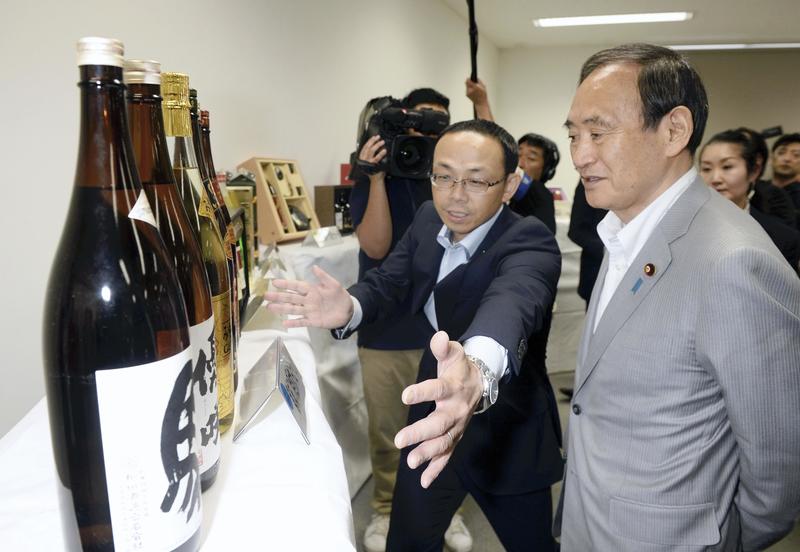
One example of a Suga policy idea coming to fruition is the furusato nozei (the hometown tax payment) system, which he proposed while internal affairs and communications minister in Shinzo Abe's first Cabinet. This system, which was set up in fiscal 2008, allows taxpayers to reduce their income tax (national tax) and individual residential tax (local tax) by making a donation to a municipality they wish to support.
The system had its detractors because the basic principle of local taxes is that burden for public services should be on those who directly receive them. However, aware of the problem of a widening gap in local tax revenues between prefectures, Suga moved to create the system.
"We can't let the situation, in which local vitality is fading, to become permanent," Suga said. "It is extremely critical to change the flow of people and money."
The system has taken root just as Suga intended. After the Liberal Democratic Party returned to power and Suga became chief cabinet secretary in 2012, he pushed for further expansion of the system, including the introduction in fiscal 2015 of a "one-stop exception system" that allows people to receive the tax deductions without having to file a tax return.
As a result, total donations grew from 8.1 billion yen in fiscal 2008 to 487.5 billion yen in fiscal 2019.
At the same time, however, negative aspects came to the forefront, such as escalating competition between local governments to offer expensive gifts in return for donations. The Internal Affairs and Communications Ministry was forced to make revisions and, in March last year, amended the law to limit the value of gifts to no more than 30% of the donated amount, and to allow only locally made products.
Purging of dissenters
The hallmark of Suga's political approach is strong leadership. He will not hesitate to "purge" any bureaucrat whose views do not align with his, and has said so in no uncertain terms, "If they oppose the policy, they will be transferred out."
There is one clear case of a bureaucrat sent on his way by Suga. In 2014, when Suga was chief cabinet secretary, Akihide Hirashima was director-general of the Local Tax Bureau at the internal ministry. The two had a falling out over the hometown tax payment system.
Suga wanted to increase the maximum amount of donations that could be deducted in order to increase the overall amount donated. At the time, more and more taxpayers were going against the original intent of "supporting their hometown," and there was even a book on living the high life with the gifts obtainable by high-income individuals.
Hirashima visited the Prime Minister's Office to talk directly with Suga, demanding that the deduction for high-income individuals be limited. Hirashima handed Suga a copy of the book and explained it to him, but Suga wasn't hearing any of it.
"Not all people are like this," Suga said as he thrust the book back into Hirashima's hands. "There are also people who donate with pure intentions."
The system was amended just as Suga wanted, and the following year, Hirashima was removed from his post as director-general.
"What we need from politicians is for them to face up to reality and have the guts and insight to order a review," said Hirashima, who is now a specially appointed professor at Rikkyo University.
Seeds of confusion
"I'll do what needs to be done with speed and without hesitation," Suga said on Oct. 16, which marked his first month in office.
Suga has set high standards for his Cabinet. That can be seen in his push to achieve his signature policy of establishing a digital agency. He instructed Takuya Hirai, the minister for digital transformation, to get the agency up and running "within the next year." Hirai responded by gathering staff from the relevant ministries and agencies for a study group held during the four-day holiday weekend in September, barely after the Cabinet was formed.
But such a need for speed can lead to confusion.
One example is the "Go To Travel" campaign, spearheaded by Suga when he was chief cabinet secretary, as a way to stimulate demand for tourism hit hard by the coronavirus outbreak.
A public offering for contractors had to be redone after the project was criticized for its high outsourcing costs, and the start was at one point pushed back to August.
With the lifting of the national state of emergency on May 25, the speed-obsessed Suga had instructed the Land, Infrastructure, Transport and Tourism Ministry to push up the schedule and get the campaign ready in time for the four-day holiday weekend of July 23-26. It began nationwide on July 22.
However, there had been a major surge of infections in early July, centered on Tokyo, and governors in rural prefectures one after another criticized the campaign as premature. Eventually, there was a change in policy and on July 17, right before the launch of the campaign, travel to and from Tokyo was abruptly excluded. Many parts of the campaign were designed in haste with insufficient details, such as cancellation fees and eligibility, and travelers and travel agencies were left in a state of confusion.
Suga is determined to break from precedent and, in his own way, work toward his signature policies of establishing a digital agency, lowering mobile phone fees, and breaking up the vertical divisions of ministries and agencies.
He must also deal with the side effects that arise from his efforts.
Read more from The Japan News at https://japannews.yomiuri.co.jp/