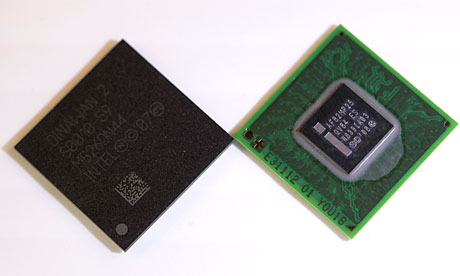
Intel has launched a new version of its Atom processor that uses far less power and "prepares the company to target a range of computing devices, including high-end smartphones, tablets and other mobile handheld products," said Intel.
Belli Kuttanna, chief Intel Atom processor architect, said: "After we delivered the first-generation Intel Atom processor with 10x thermal power reduction, we challenged ourselves to achieve 50x power reduction at the platform level."
The Z6xx system-on-chip (SoC), formerly codenamed Lincroft, includes 3-D graphics, video encoding/decoding and memory and display controllers. Intel says it can support "HD 1080p high-profile video decoding and 720p HD video recording", bringing "a rich, PC-like visual experience to powerful handheld computers".
The mobile phone and smartphone markets are dominated by ARM designs, and it is expanding into tablets (such as the Apple iPad) and netbooks. ARM doesn't make chips: it designs processor cores that can be used to create system-on-a-chip designs such as Tegra and Snapdragon. This allows for lots of innovation and customisation.
Intel, in contrast, has traditionally made all its own chips, but it has an SoC deal with TSC (Taiwan Semiconductor Company). I asked Jose Maiz, Intel's director of Logic Technology Quality and Reliability, about the scope for non-Intel sourcing and he told me: "We will give them as much flexibility as they like."
It still seems unlikely that the new Z6xx Atom chip will have much impact on the ARM chip's dominance. However, Intel has made extraordinary progress in moving its x86 architecture from large power-hungry Pentium-type chips to very small low-power Atoms. It has narrowed the gap to ARM, and it's not stopping. Christian Morales, director of Intel Europe, says: "My view is that next year we will really see a breakthrough in the [smartphone] market."
Today's Atom chips are more suitable for netbooks and media tablets than smartphones. The next design, code-named Medfield, could take the fight into ARM's home ground.