New images from a rejuvenated Hubble space telescope
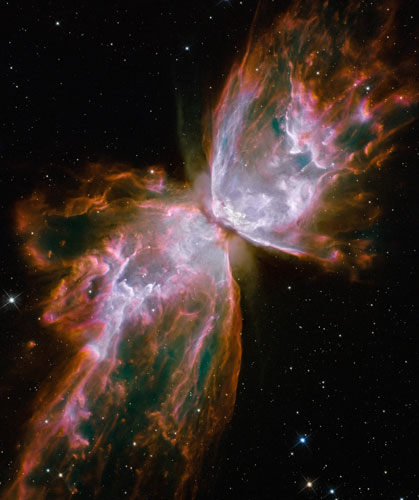
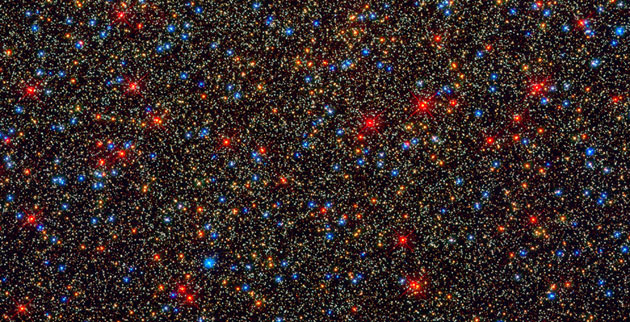
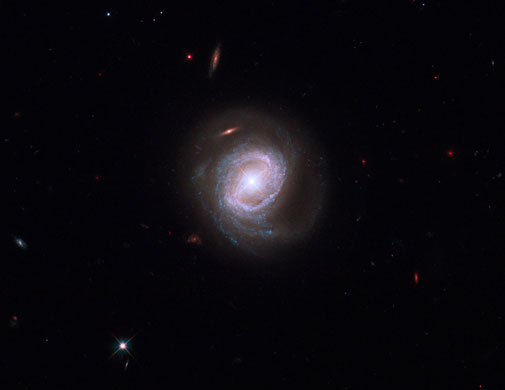
Despite it resemblance to a dainty butterfly, this image actually shows roiling cauldrons of superheated gas tearing across space at almost a million kilometres an hour – the death throes of a star, planetary nebula NGC 6302Photograph: Nasa handout/EPAHundreds and thousands: Colourful stars inside globular star cluster Omega Centauri. The image is just a small region inside the cluster, which contains nearly 10m stars between 10bn and 12bn years oldPhotograph: Nasa/EsaRings of brilliant blue stars encircle the bright, active core of this spiral galaxy. The galaxy, called Markarian 817, shows intense star-forming regions and dark bands of interstellar dust along its spiral arms. Observations by the new Cosmic Origins Spectrograph captured the powerful outflow of materialPhotograph: Nasa/Esa
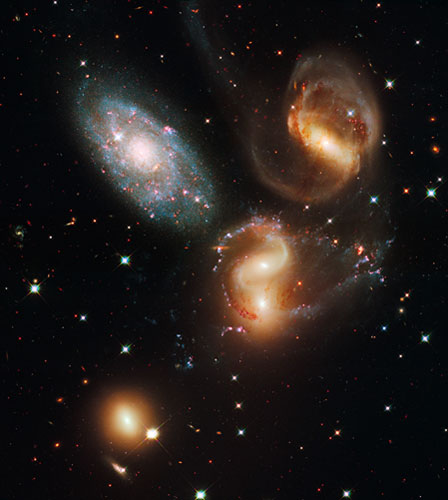
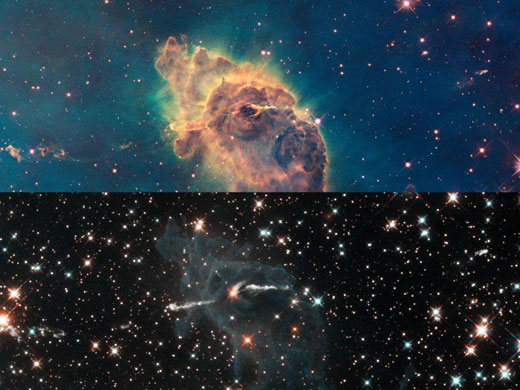
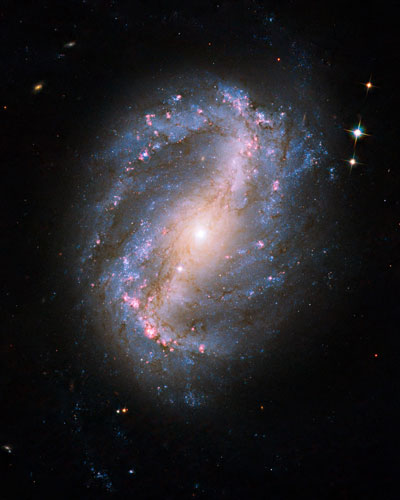
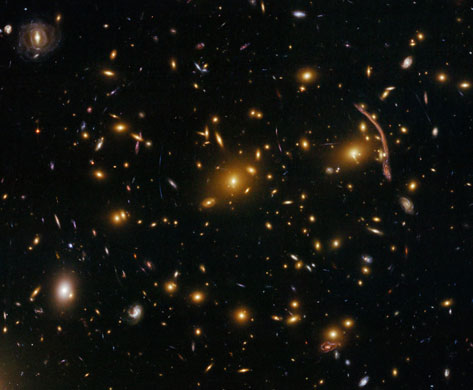
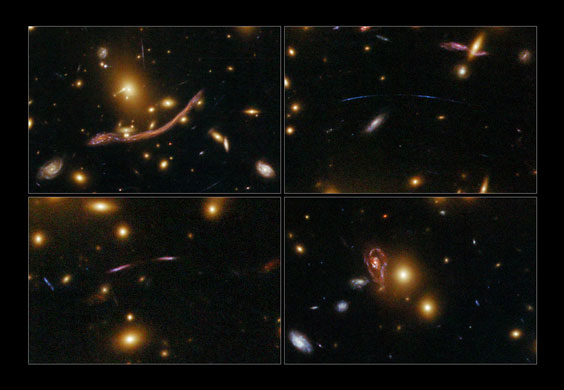
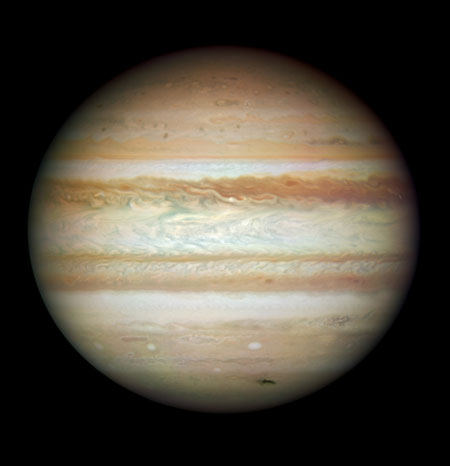
Stephan's Quintet: A group of five galaxies containing stars across a wide colour range, from young blue stars to ageing red stars. This image was captured by the newly installed Wide Field Camera 3 aboard Hubble. 'Stephan’s Quintet' is a bit of a misnomer ... galaxy NGC 7320, upper left, is actually about seven times closer to Earth than the rest of the groupPhotograph: Nasa/EsaThese two images of the stellar nursery that is the Carina Nebula demonstrate how observations in visible and infrared light reveal dramatically different views of an object. The pictures show the broad wavelength range of Hubble's new Wide Field Camera 3, extending from ultraviolet to visible to infrared. Details not seen at visible wavelengths are uncovered in near-infrared lightPhotograph: Nasa/EsaThe barred spiral galaxy NGC 6217 was the first celestial object snapped by the newly repaired Advanced Camera for Surveys aboard Hubble. The galaxy lies 6m light-years away in the north circumpolar constellation Ursa MajorPhotograph: Nasa/EsaHubble's newly repaired Advanced Camera for Surveys has peered nearly 5bn light-years away to resolve intricate details in the galaxy cluster Abell 370. This was one of the first galaxy clusters in which astronomers observed 'gravitational lensing', where the warping of space by the cluster’s gravitational field distorts the light from galaxies lying far behind it. This is seen as arcs and streaks in the picture – the stretched images of more distant galaxiesPhotograph: Nasa/EsaAnother image highlighting the phenomenon of gravitational lensing in galaxy cluster Abell 370. Gravitational lensing is a vital tool for measuring the distribution of dark matter in galaxy clusters, because its position can be deduced from its gravitational effectsPhotograph: Nasa/EsaThis picture, taken on 23 July, is the first full-disc, natural-colour image of Jupiter made with Hubble's spanking new Wide Field Camera 3. It is the sharpest visible-light picture of Jupiter since the New Horizons spacecraft flew by the gas giant in 2007. The dark smudge, bottom right, is debris from a comet or asteroid that plunged into Jupiter's atmosphere and disintegratedPhotograph: Nasa/Esa
Sign up to read this article
Read news from 100’s of titles, curated specifically for you.







.png?w=600)