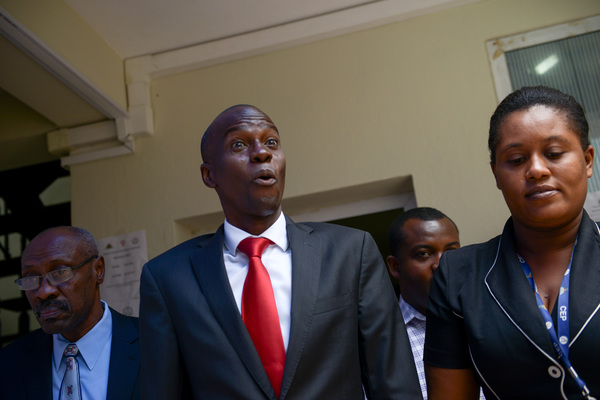
PORT-AU-PRINCE, Haiti _ After a year and a half of political crisis, Haiti is finally set to hand over power to an elected president.
Jovenel Moise, a businessman at the center of a government money-laundering investigation, is expected to assume the country's presidency Tuesday, ending nearly a year of transitional rule by interim President Jocelerme Privert.
More than 2,000 people, including Haitian members of Parliament, foreign ambassadors and heads of states, have been invited to the transfer of power, which will include the taking of the oath of office at the Parliament and a ceremony on the grounds of the National Palace.
The guest list includes at least four foreign presidents _ Danilo Medina, of the Dominican Republic; Venezuela's Nicolas Maduro; Trinidad and Tobago's Anthony Carmona and Guyana's David Granger _ and a U.S. delegation led by Ambassador Thomas A. Shannon, Jr., undersecretary of state for political affairs. Also part of the U.S. delegation is Omarosa Manigault, the former reality TV star, now assistant to President Donald Trump and director of communications for the Office of Public Liaison.
"Haiti is a member of the Caribbean community and it's my duty to welcome the new president," said Granger, who is pulling double duty, also representing the 15-member Caribbean Community as its incoming chairman. "It's not just a matter of showing solidarity with a country that has suffered more than any other CARICOM member state in terms of environmental disasters, but it's also an important statement in terms of our confidence in the democratic process in this country."
As delegations began arriving on Monday, municipal authorities in Port-au-Prince and Petionville were hastily cleaning main roads, police were removing old cars near major hotels, and workers were putting tiny flags around the fence protecting the grounds of the National Palace. The route from the airport to many hotels was decorated with red-and-blue flags bearing Moise's image and the number 58 _ he is to be the 58th president.
Lucien Jura, a spokesman for Moise's transition team, said Tuesday's ceremony will cost less than those of Michel Martelly and Rene Preval, which cost $2 million and $4 million, respectively.
"The president-elect does not want the expenses to exceed $1 million," Jura said during a press conference.
Port-au-Prince Monday lacked excitement, despite the impending inauguration of a new president after nearly two years of political turmoil.
"I just came to look, but there is nothing about the swearing-in that interests me," Mackenson Pierre said as he walked past the palace.
Echoing the apathy that brought Moise to power in one of the lowest voter-turnout elections, Pierre said he has no hope that anything will change in Haiti after Tuesday: "These people will not bring change to Haiti. They are a cancer that destroys the country. I don't believe in them."
A banana farmer from northern Haiti, Moise, 48, was relatively unknown when Martelly backed him to succeed him as president. Moise's presidential victory was confirmed Jan. 3, 15 months after fraud allegations in the October 2015 presidential election plunged Haiti into an electoral crisis and forced Martelly to leave office without an elected successor in place.
Since his victory, Moise has been on a countrywide tour, celebrating his victory, endorsing candidates for local elections _ and battling money-laundering suspicions.
Moise has dismissed the suspicions as the work of political opponents. The investigation began in 2013 under Martelly's administration when the anti-financial crimes unit was tipped off about a suspicious bank transaction, the current head of the unit, Sonel Jean-Francois, has said.
Over the weekend, an investigative judge assigned to the case sent his findings to the government prosecutor, but the judge's order was noty made public. Government prosecutor Danton Leger has yet to say whether he will dismiss the case, send it back to the judge for further review, or prosecute Moise.
Should he seek to prosecute, Haiti could enter an even deeper crisis than the one triggered by the annulled October 2015 presidential election. Complicating matters, a former presidential candidate, Jean-Charles Moise, last week filed as a plaintiff in the pending case against Jovenel Moise, ensuring that the issue won't go away easily.
The case risks crippling Moise's presidency and the country's stability.
Lacking political experience, Moise comes into the office with the support of less than 10 percent of the Haiti's 6.1 million registered voters. Still, expectations are high, especially among Haitians who believed Moise's campaign promise to reinvigorate the country's agriculture sector.
Moise's top three presidential competitors, including Jean-Charles Moise, have continued to challenge Moise's victory and have asked supporters to remain mobilized in street protests. Several opposition senators also have signaled their intentions to boycott Tuesday's swearing-in, citing the money-laundering suspicions.
Another unresolved issue is whether Moise's presidency will be four or five years. While he has referred to his as a "five-year presidential mandate," Haitian constitutional experts say he lost a year because of the electoral crisis. Citing several articles in the Haitian Constitution, the experts say the term started Feb. 7, 2016, and thus Moise's presidential term ends Feb. 7, 2021.