The latest film in the Thomas the Tank Engine series is currently in theaters in Japan, and broadcasts of the new animated TV series started on NHK Educational TV this spring. With the 75th anniversary of the first Thomas picture book's publication next year, the series has introduced some significant changes: globalization and more female train characters.
The saga of Thomas, the little boy locomotive, and his friends is set on the imaginary Island of Sodor. The series got its start in stories that British author the Rev. Wilbert Awdry told to his then 2-year-old son. The first picture book was published in 1945, and eventually grew into a series of 26 volumes by 1972. The story features the central character, Thomas, and other train engines with various personalities, including playful Percy, swaggering Gordon and conceited James.
The TV series has been aired in about 160 countries and regions across the world. Broadcasts in Japan started in 1990.
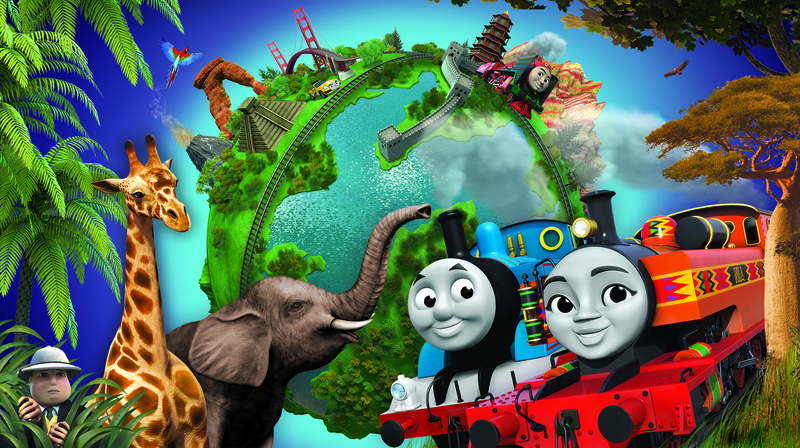
Thomas has always wanted to travel far and explore the world. The mischievous locomotive gets off the island for the first time in the new film "Thomas & Friends: Big World! Big Adventures! The Movie" (Japan title: Eiga: Kikansha Thomas Go! Go! Chikyu Marugoto Adventure).
In the film, Thomas travels through five continents and meets locomotives in various places. His traveling companion is a train engine named Nia, a new character in the series. A girl from Kenya, Nia is cheerful and strong-minded.
The new TV series, "Thomas & Friends" (Kikansha Thomas to Nakamatachi), shows adventures that the film does not cover, as well as what happens to Nia after the events of the film. The lineup of six engines using the Tidmouth sheds has changed, including the introduction of another girl engine named Rebecca,
The only girl among the six used to be Emily, but Edward and Henry have gone elsewhere, replaced by Nia and Rebecca.
Atsushi Nishioka, chief producer of Sony Creative Products Inc., which owns the exclusive license to Thomas contents and products in Japan, welcomed these developments.
"[The new works] will help children learn about diversity in the world," he said. According to Nishioka, 40 percent of Thomas fans overseas are girls, and so are 30 percent of the fans in Japan.
"Characters girls can identify with are essential," he said. "It's the natural course of things, from the perspective of gender equality, that the number of girl engines is increasing."
Behind the move is cooperation between the United Nations and U.S. toymaker Mattel, Inc., which owns Thomas' trademark and other rights. In 2015, the United Nations adopted sustainable development goals (SDGs). Countries all over the world are going ahead with projects to achieve 17 goals for sustainable development, including eradication of poverty and promotion of gender equality.
However, SDGs cannot be said to have spread widely among ordinary people. Therefore, the United Nations decided to tie up with the Thomas franchise, which is popular around the world, to convey messages such as boys and girls are equal.
"I hope that children who will lead the next generation and their parents will enjoy watching Thomas' adventures and also learn about important issues for the future of the Earth," Nishioka said.
Gender roles changing
The series is supported by U.N. specialists.
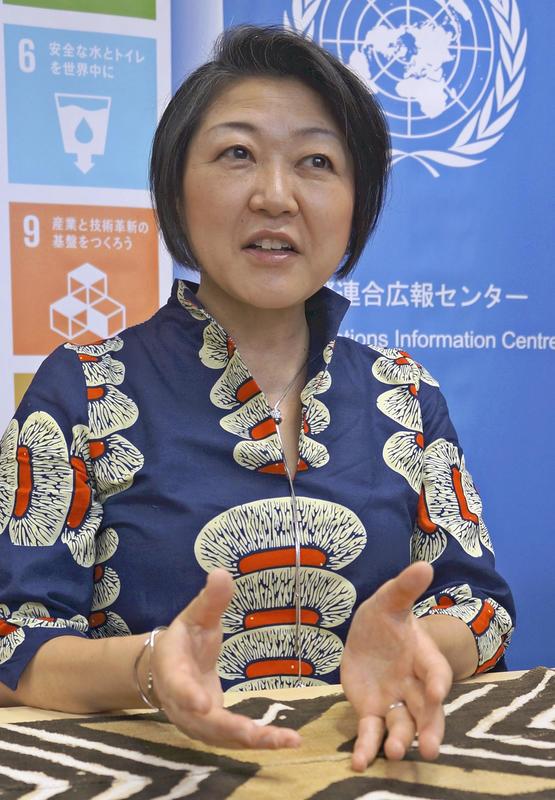
"There are people in the world who are struggling with poverty and disparity. SDGs started out of strong concern that if things remain as they are now, the Earth may not be able to keep going due to ever-increasing extreme weather caused by global warming," said Kaoru Nemoto, the director of the U.N. Information Centre in Tokyo.
She emphasized that it is important for everyone to look at those issues on the global scale from childhood -- formative years for one's basic values as a person.
"In the new series, U.N. experts collaborated with the creative team in writing the scripts," Nemoto said. "The name Nia means 'goal' in Swahili. I'm sure girls who've watched Nia going forward on her own initiative will grow into women free from traditional gender roles and who valiantly take on challenges."
Since its first adaptation into visual media in 1984 in Britain, the Thomas films and TV shows have made various changes to fit the times. The introduction of computer graphics was a particularly revolutionary move for the series, which was long loved for its live-action images and handmade touch in the use of railway models and other props.
In Japan, the TV series produced with computer-generated images first aired in 2010. CGI has made it possible for the program to depict a variety of things, from speeding engines to the quickly changing expressions on their faces.
The personality of Sir Topham Hatt has gradually changed as well. The Sodor railway director, whose trademark phrase is "You have caused confusion and delay," used to be an authoritative figure who would strictly scold engines for making mistakes. In the new film, however, he shows a kindly side to his personality and follows Thomas out of concern after the tank engine sets off on his journey.
The characters in the series include Hiro, who is modeled on the D51 Japanese steam locomotive. More Japanese-style trains may appear on the show, and Thomas and his friends might also visit Japan.
Read more from The Japan News at https://japannews.yomiuri.co.jp/