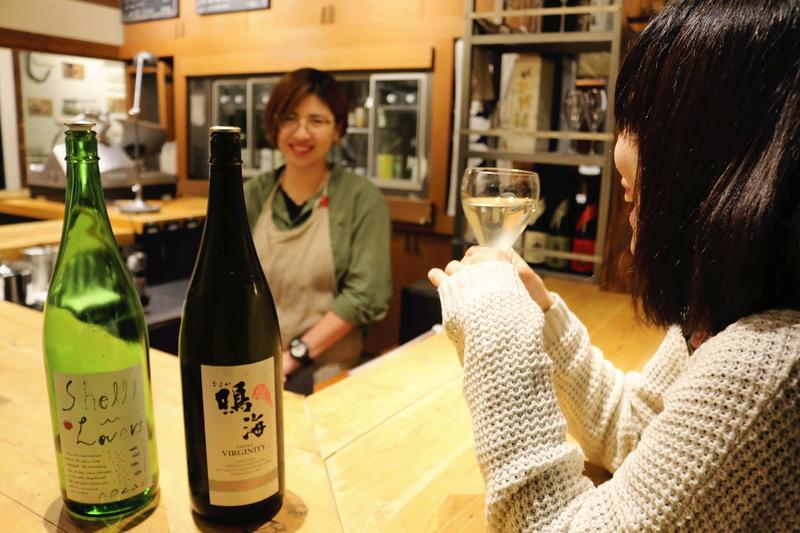
At Sake Bar Otonari in the Kagurazaka district in Shinjuku Ward, Tokyo, a 28-year-old customer ordered Naruka Virginity, a junmai ginjo sake, meaning it is made from highly polished rice and without the addition of distilled alcohol.
Naruka Virginity has been produced over the past several years by Azumanada Brewing Co. in Katsuura, Chiba Prefecture. For the key sake-making ingredient of koji, a mold that is sprinkled on steamed rice to ferment it, ki-koji is usually used, but the brewery also uses shiro-koji, which gives Naruka Virginity its refreshing aroma and acidity.
The sake was served in a glass that might be used to serve sparkling wine. "This is light and slightly sweet. It also has a splendid aroma and leaves quite an impression," the customer said to bar manager Chiharu Matsuoka after taking a sip.
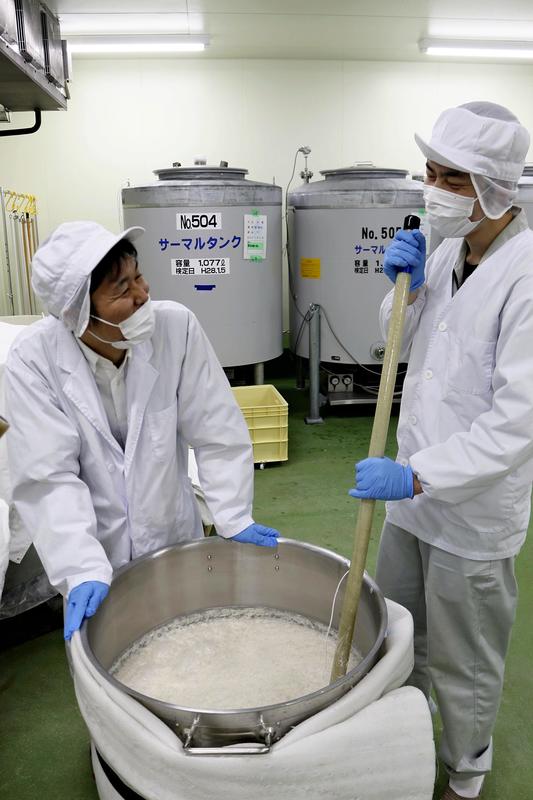
Matsuoka, 25, described Naruka Virginity in this way: "Its distinctive acidity makes it refreshing and easy to drink, and gives it bite. This is popular among young people, mainly in their 30s."
Changing tastes
In the world of sake, this light acidity has come under the spotlight as a characteristic not common in standard brews. In recent years there have been breweries that use some shiro-koji in addition to ki-koji. Usually used for producing shochu distilled liquor, shiro-koji generates citric acid, thus giving the impression of a sweet-sour flavor and lightness.
Koichi Nakajima, 36, the toji master brewer at Azumanada, said the brewery developed Naruka Virginity, "modeling it on white wine and aiming it at younger drinkers."
Shuso Imada, director of the Japan Sake and Shochu Information Center, said that there is an increasing number of sake products focusing on acidity as the nation's diet has become more diversified, mainly because of the influence of Western cuisine.
"This sake with light acidity is best served chilled," he added.
In the aftermath of World War II, the mainstay sake type was sweet as sugar was added. After the oil shocks ended the period of high economic growth, the 1970s and '80s saw a trend of rediscovering products by smaller breweries in regional areas. Moreover, not only did sake brands draw attention, but so did production methods. This led to a boom in sake categorized as ginjoshu, which refers to sake prepared with highly polished rice and fermented at a low temperature for a lengthy time.
"Consumers found ginjoshu very different from what they had drunk up to then, with its elegant fragrance and smooth texture," said sake critic Haruo Matsuzaki. "It inspired interests in the genuine flavors of sake itself."
However, sake consumption started to decline, partly because of an increase in the demand for shochu and wine. As many toji, who are usually employed by breweries, subsequently became older, an increasing number of successors to brewery operators have taken up the chief brewer duties themselves. This younger generation of brewers are attracting attention for unconventional sake types, such as sparkling sake.
Sake produced using shiro-koji first hit shelves around 2010.
"This is becoming a new category of sake," Matsuzaki said. "Thanks to their passions, younger brewers have expanded the freedom regarding production methods."
Variety of ideas
At Yucho Shuzo Co. in Gose, Nara Prefecture, which is known for its Kaze no Mori brand, the brewery has specialized in producing muroka nama-genshu, a type of sake that is unfiltered, unpasteurized and undiluted with water. This means the brewery ships its products in a very fresh condition right after pressing fermented mash called moromi.
The brewery has developed a technique to separate sake from moromi without pressing. The idea is to place the mash in a sealed tank and cool it to below freezing to allow the solid material to precipitate so that the clear liquid in the upper portion can be retrieved.
"As this method prevents the sake from being exposed to oxygen, it gets a fresher aroma and is more carbonated," said Chobee Yamamoto, 38, the 13th-generation operator of the brewery. "We aim to produce fascinating products that haven't existed before."
On the other hand, there is also a movement to refocus on traditional production methods.
Tsuchida Shuzo Inc. in Kawaba, Gunma Prefecture, employs the kimoto method by using lactobacilli found in nature when preparing moto, a mixture of rice, koji and water that helps increase the yeast necessary for fermentation.
"It's very rewarding for me to make sake in the traditional method," said Yuji Tsuchida, 43, the sixth-generation operator of the brewery. "It makes our sake have multilayered, complicated flavors."
The brewery also applies a technique that dates back to the Muromachi period (1336-1573) in which uncooked rice is used in preparing moto to boost lactic acid bacteria and better attract natural yeast.
"While it's true sake consumption is on the decline," Matsuzaki said, "its potential is expanding thanks to a variety of efforts by breweries."
Read more from The Japan News at https://japannews.yomiuri.co.jp/