The animated version of "GeGeGe no KITARO," a comic series depicting yokai Japanese monsters, is currently airing on the Fuji TV network on Sundays at 9 a.m. The latest series -- the sixth, and 50 years since the first aired -- has several notable aspects that reflect the present day.
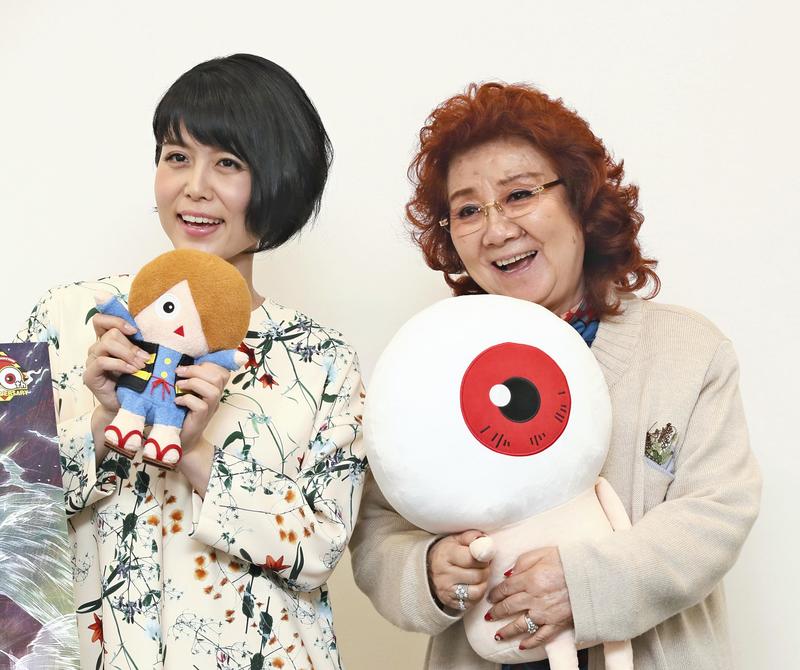
Another point about the current series is that Masako Nozawa -- who voiced Kitaro, the animation's main character, in the first series -- is voicing Kitaro's father, Medama Oyaji.
Staying with the times
A YouTuber at Shibuya's "scramble" crossing in Tokyo suddenly begins to struggle, and then turns into a tree-like monster. Passersby who snap photos of the monster also turn into trees.
This is the opening scene of the first installment of the latest series, which aired on April 1. Such settings were, until now, unfamiliar to these yokai comic stories -- a place that actually exists has never been depicted so realistically in a previous series of the animation.
"I wanted to introduce [the Shibuya crossing] as an icon of modern Japan," animation producer Daichi Nagatomi said.
"That place is strange, though, isn't it? Such a huge number of people cross at the same time without bumping into each other; it makes me think they aren't human. Foreigners visit the place because they think the phenomenon is interesting. But everyone has forgotten that the crossing is a place where yokai monsters are likely to appear," Nagatomi added.
Nagatomi sees the various animated Kitaro series -- produced almost every 10 years -- as "a mirror reflecting the Japanese people."
"The first series, from the 1960s, is faithful to the original comic stories. But the Kitaro [series] have always reflected societal changes, including the period of high economic growth in the 1970s, right before Japan's economic bubble in the 1980s, the sluggish economy in the 1990s and the pop culture era of the 2000s," Nagatomi said.
So what about Kitaro in the 2010s?
"The overriding theme of the latest series is the interactions between Japanese people who have darkness in their hearts and yokai monsters," Nagatomi said. He stressed that he would like to address the issue of diversity through various kinds of yokai monsters.
"In the contemporary world, where divisions are accelerating and people hastily point out foes from allies, Kitaro can thrive because he exists between humans and yokai monsters," Nagatomi said. "The [latest] series doesn't have simple stories about taking on evil. The messages of the original author, Shigeru Mizuki, should now really touch people's hearts."
Nozawa 'honored' to voice father
Masako Nozawa, who voices Medama Oyaji in the latest series, recalled finding out about getting the role: "I was surprised at the decision, but now I'm honored."
The voice of Medama Oyaji had been played for over 40 years by voice actor Isamu Tanonaka, who died in 2010. Nozawa, calling Tanonaka by his nickname, Tano, said, "I initially thought I shouldn't ruin the character's image established by Tano. But I came to understand that I should think that Kitaro has grown up and become a father, just like an ordinary family."
Kitaro's voice is provided by Miyuki Sawashiro in the latest series. On first hearing her predecessor voice Medama Oyaji, she said, "I thought [Nozawa's] voice was incredibly natural. It made me feel that [Nozawa] had been playing the father for a long time." Sawashiro's crystal-clear voice is suited to playing Kitaro, a calm yet mysterious character. She says she prepared for the role by watching past series of the animation and reading the original comics.
"People's expectations for the latest series are exceptionally high. But I don't want to be overwhelmed by the pressure," Sawashiro said. Calling Nozawa by her nickname, Mako-san, she added, "I'd like to act with Mako-san like a real father and son who have a good relationship."
Read more from The Japan News at https://japannews.yomiuri.co.jp/