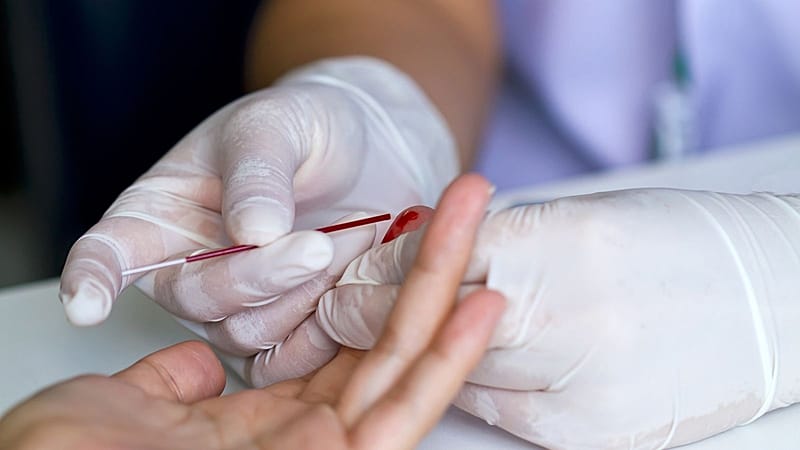
A new blood test that detects Alzheimer’s by taking a sample from a finger prick could diagnose the disease at early stages long before symptoms become severe, a new Europe-wide study found.
The new method, not available yet for clinical use, could eventually allow people to collect samples at home and post them to the laboratory, increasing accessibility and removing barriers to testing for the most common form of dementia.
The study, led by the United States’ institute Banner Health with the University of Exeter, tested 337 patients across seven European study centres in Denmark, Italy, Spain, Sweden, and the United Kingdom.
The cohort included people with no or mild cognitive impairment, people with dementia, and adults with Down syndrome, who have a high genetic risk of developing the disease.
Researchers collected a few drops of blood from the fingertips of the participants, which were dried on a special card, and compared them to the results from standard blood tests and spinal fluid analyses.
The results, published inNature Medicine, showed that the main markers used to diagnose the disease in the finger-prick test closely matched conventional tests, and that the new method was able to identify disease-related changes with an accuracy of 86 percent.
The team focused on three blood biomarkers linked to Alzheimer’s: p-tau217, a protein used as the main marker for the disease diagnosis, GFAP, a marker of brain inflammation, and NfL, which reflects damage to nerve cells.
"This breakthrough could fundamentally change how we conduct Alzheimer's research by proving that the same biomarkers doctors use to detect Alzheimer's pathology can be measured from a simple finger prick collected at home or in more remote community settings,” said Nicholas Ashton, senior director of Banner's Fluid Biomarker Program and lead investigator of the study.
He added that, while clinical use is still years away, the work opens research that was previously impossible, allowing scientists to study diverse and underrepresented populations, and to conduct large-scale screenings.
Alzheimer’s disease currently affects around 7 million people in Europe with cases set to double by 2030, according to the European Brain Council.
Most popular diagnostic methods include brain scans or spinal fluid tests, which are more invasive, expensive, and only available in specialised centers, explained the researchers.
“We're moving toward a future where anyone, anywhere, can contribute to advancing our understanding of brain diseases. This isn't just a technical advancement – it's a paradigm shift in how we conduct neuroscience research,” said Anne Corbett, professor in dementia research at the University of Exeter and one of the study’s authors.