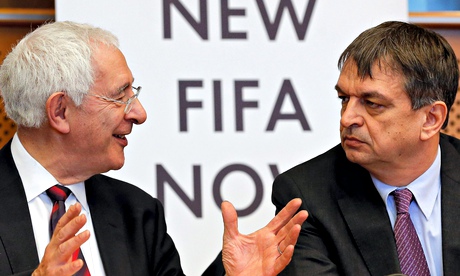
Working out how to instigate practical reform from outside the gates of Sepp Blatter’s Fifa headquarters can sometimes feel like juggling with jelly while running up a down escalator. The European parliament, as an institution frequently accused of wasting money and often under fire for the largesse of its inhabitants, might be considered an apt location to launch the latest well-meaning group to try to effect change in Zurich.
New Fifa Now is the brainchild of the Conservative MP Damian Collins, a frequent voice of sanity on Fifa matters and a former member of the parliamentary committee on culture, media and sport, which has aired some of the more striking allegations of recent years.
The aim is a noble one: to build a consensus of like-minded people who agree that the stench of corruption has grown overpowering and that external pressure is required to prise Blatter from his post and instigate the broader cultural change required to drag Fifa into the modern world.
In his four decades at Fifa, the Swiss has become adept at twisting the organisation to keep him in the manner to which he has become accustomed and entirely beholden to the promises he has made to remain there. So much so that the septuagenarian has become indivisible from a scandal-plagued governing body of the world game fashioned in his own image.
New Fifa Now’s charter, published at the end of the meeting, says: “Fifa is one of the most discredited organisations in the world with serial allegations of corruption plaguing almost its every move off the field, symptomatic of a crisis of leadership, governance and accountability.” On that, at least, everyone could agree. Most present talked a good game. Those who had seen the rotten 2018-2022 bid process from the inside (the former Football Association chairman Lord Triesman, the former Australia 2022 executive Bonita Mersiades) were eloquent about the way in which it practically invited corruption.
Triesman, forced from the FA six months before the vote following a newspaper sting, said Blatter presided over “a deeply flawed set of people” and that “tinkering with the arrangements around Fifa” would not be enough to change its culture.
“Had this been the chairman of a publicly quoted company they could not have survived this series of scandals,” he said. The leader of the inspection team who declared Qatar the only high-risk destination for the 2022 World Cup (the former Chilean FA chief Harold Mayne-Nicholls) highlighted the extent to which it was ignored and proffered ideas for a way forward.
The presidential hopeful Jérôme Champagne, while slightly undermining the New Fifa Now rhetoric by calling for reform rather than revolution, made a series of eloquent points about the economic imbalance in the world game.
Everyone agreed that more transparency – of salaries, of contracts, of meetings in the inner sanctum – is a prerequisite. “We have to stop talking and do something,” said the Belgian MEP Ivo Belet. “Public and political support for football is jeopardised because of the miserable situation at Fifa.”
Jaimie Fuller, the chairman of the sportswear brand Skins, who played a key role in effecting change in cycling, vowed to put pressure on sponsors to reconcile the corporate social responsibility promises they make in their annual reports with the $1.5bn they pour into Fifa coffers every four years. While the cash continues to roll in from sponsors and with broadcasters drawn to the World Cup like moths to a flame, the levers of change are hard to identify. Yet Coca-Cola, Visa, Adidas, McDonald’s and Castrol did not even respond to Fuller’s letters asking them to come to Belgium and explain themselves. They were not the only ones.
It was easy to imagine Blatter looking around the room and laughing at the collection of usual suspects gathered in front of the western European media to denounce him. They will not be quaking in their expensive shoes in Zurich.
Although there were observers from Uefa, Concacaf and Qatar 2022 in the room, there was not a single person from the 209 Fifa member associations. Fear stalks the associations. None yet wants to put a head above the parapet before a presidential election in which Prince Ali, the Jordanian royal backed by Uefa, is likely to be Blatter’s only credible challenger.
As usual where Fifa is concerned, there were more questions than answers. But the central proposal – to convene an independent body empowered by and overseen by Unesco to make practical proposals for Fifa reform – was a reasonable one.
“Fifa is not a private organisation,” reads New Fifa Now’s charter. “The people who run it do not own the organisation or the sport.”
But if New Fifa Now is to have any more impact than last week’s risible stunt by a publicity hungry bookmaker, they will need to built a broader coalition than the mainly male, mainly white, mainly western European consensus represented on Wednesday.
Blatter’s genius has been to nurture a power base anchored in Africa, in Asia, in South America and in the Caribbean. Change is achievable in the wake of great tremors that leave a sport on its knees, as the eventual ousting of Pat McQuaid as president of cycling’s UCI in the wake of the Lance Armstrong affair proved.
But removing Blatter and reforming Fifa will be more difficult, not least because the World Cup remains a reliable cash cow.
If the latest attempt to foment revolution is to succeed it will need a long-term view well beyond May’s Fifa election and a much broader base of visible support within the game and without.
Meanwhile, Blatter sails serenely on towards a fifth term he promised he would never stand for despite the continuing fallout from the farce of Michael Garcia’s investigation into the World Cup bidding process.
“Fifa’s reputation has fallen too far,” said Fuller. “Whatever the outcome of the May election, Fifa must be dragged kicking and screaming into change.”
Easy to say, difficult to do. Collins, hurrying from the room to make way for the committee on fisheries, insisted he is in it for the long haul. He will need to be.