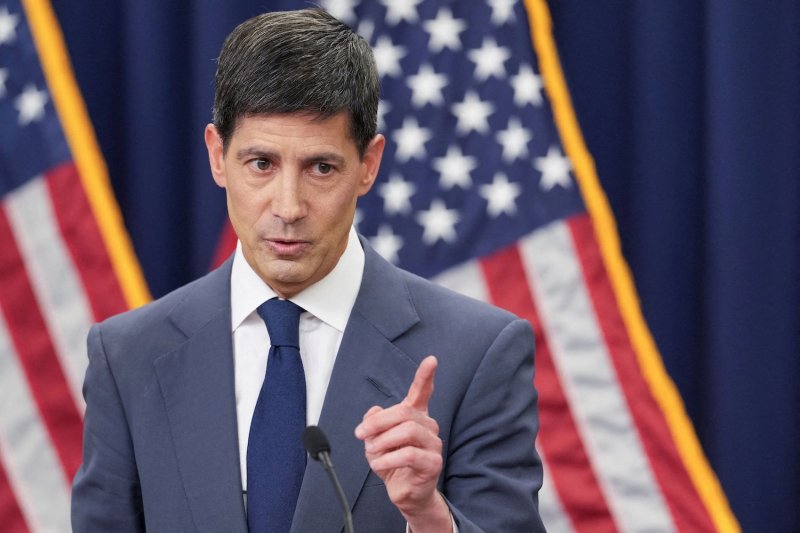
WASHINGTON - Federal Reserve chairman Kevin Warsh did not submit an interest-rate prediction as part of the central bank’s quarterly economic projections on Wednesday, spelling changes ahead for what has become a key guidepost for investors on monetary policy.
The news came as the Fed held its benchmark interest rate unchanged, as widely expected, citing concerns about energy-led inflation over the near term.
The central bank’s latest “dot plot” projections — the anonymised rate-path views of individual policymakers — featured just 18 submissions. The full slate of Fed policymakers numbers 19.
“It’s been the practice of this committee for participants to submit these projections, and I have encouraged my colleagues to continue to do so,” Warsh said at his press conference following the meeting.
“I however refrained from offering any projections of my own, consistent with my long-held views on the SEP, at least as it is currently structured,” he said referring to the quarterly Summary of Economic Projections report.
President Donald Trump, meanwhile, expressed confidence in Warsh, after the published projections showed nearly half of the Federal Open Market Committee members feel a rate hike will be needed this year.
“It’s all right. Whatever,” Trump said in France, when asked what he felt about the decision to hold interest rates steady.
Trump had repeatedly railed at Warsh’s predecessor, Jerome Powell, once calling him a “knucklehead” for not cutting interest rates. He says the central bank ought to lower borrowing costs to help the housing market, boost the economy and reduce the cost of the government borrowing.
But on Wednesday, Trump had no such words for Warsh.
“It could happen,” Trump said, when asked about the possibility of a rate hike. “It’s hard to believe. It just keeps the country down and it’s so, it’s so, unusual. But we have a very good guy over there right now so I’m guided by what he wants.”
Communications review
Warsh also announced that he is convening a task force of Fed staff and outside experts to review the Fed’s communications practices, including the dot plot that the Fed has published four times every year since 2012 to give the public a sense of where the central bank may be headed on rates.
He said he “wouldn’t be surprised” if there were a new communications framework in place by the end of the year. He also announced reform-oriented task forces in four other areas.
Fed policymakers themselves concede the dot plot is imperfect — it doesn’t, for instance, show how each policymaker’s forecasts for the labour market and inflation affect their rate-path view.
Nonetheless, it has been part of a number of progressively more open communication practices that policymakers credit with helping investors and the wider public understand the central bank’s thinking, which they believe has made monetary policy more effective.
Warsh, however, has long criticised such forward guidance, arguing it locks policymakers into a specific rate path without due regard to changing economic data.
Half of the policymakers submitting projections believe they will need to raise the policy rate this year, the dot plot showed. Six of the nine who expect higher rates by year-end felt that more than one quarter-point rate hike would be needed.
Eight of Warsh’s colleagues felt holding rates steady in their current range of 3.50% to 3.75% will be enough to bring inflation back down to the Fed’s 2% goal. One policymaker felt a rate cut would be needed.
The projections illustrate how quickly the debate within the central bank has flipped from a focus on how long to hold rates steady before cutting them, to a growing worry that the Fed will need to raise rates to keep price pressures from higher fuel prices from seeping more broadly into underlying inflation.
Global oil prices have dropped sharply since last week when Iran and the US announced a deal to end their conflict and get oil flowing through the Strait of Hormuz again.
But it is not clear how quickly shipping and exports could recover after the agreement is signed, particularly given the damage that energy facilities sustained during the three-month war. Inflation has been running above the Fed’s 2% target for more than five years.