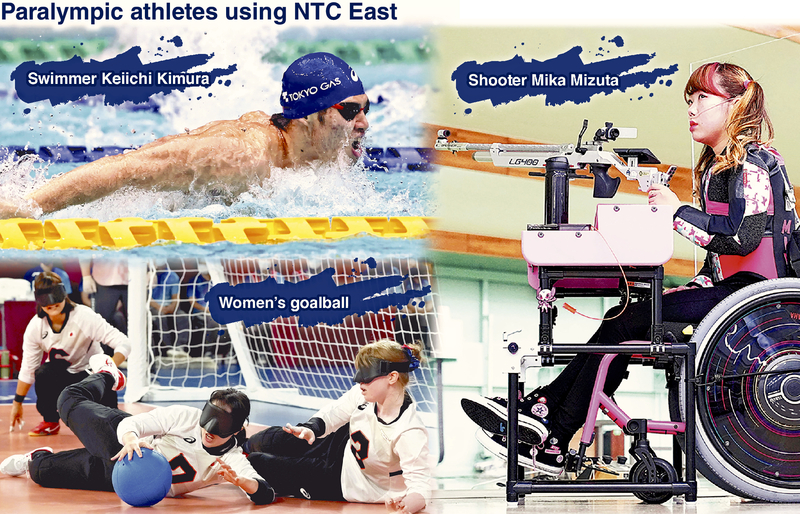
The National Training Center (NTC) East, a barrier-free facility completed in June 2019 in Kita Ward, Tokyo, has been a vital asset to the athletes participating in the Tokyo Paralympics, helping them prepare more effectively than ever before.
-- Long-term training
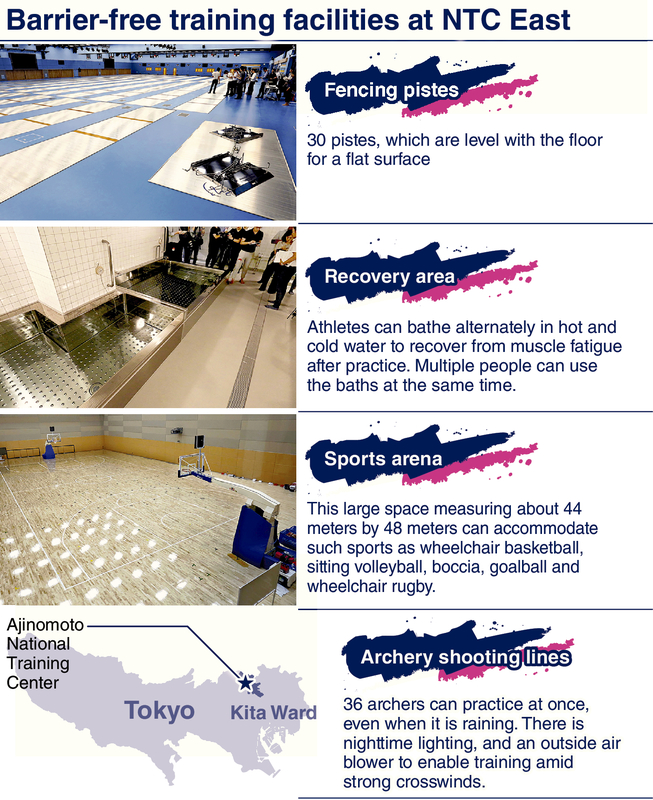
Known as the East, the facility was constructed at a cost of about 19.4 billion yen as an expansion of the Ajinomoto NTC, a national facility opened in 2008 to support Olympic athletes. The building has six floors above ground and one below, and was designed for universal use by the disabled and able-bodied alike.
It is equipped with a dining room and a training gym that can be easily used by wheelchair athletes, and has so far been utilized by participants in many para-athletic events, including badminton, swimming and shooting.
The Japanese men's and women's national goalball teams have held long-term training camps at the East, as the facility has the same kind of flooring used in the Tokyo Games. General manager Kyoichi Ichikawa had been struggling to secure a place to practice, and he praised the facility as "an absolutely wonderful environment."
Ichikawa said the teams were able to make their best preparations ever.
-- Infection prevention
Initially, there was only one year from the completion of the facility to the Tokyo Games, but they were postponed due to the spread of the novel coronavirus. This gave athletes more time to use the facility and carefully improve their performance.
Use of the facility is limited to top-level athletes and staff, and thorough countermeasures have been taken against infection, so para-athletes who might become seriously ill if infected were able to train with peace of mind.
Keiichi Kimura, the ace para-swimmer who won four medals at the 2016 Rio de Janeiro Paralympics, spent a lot of time at the East after returning to Japan last spring from his base in the United States, where infections have spread.
"It's nice to have a state-of-the-art swimming pool and training room, and a dining room, too. I can concentrate on my training with peace of mind, with my daily life and training closely connected here," Kimura said gratefully.
-- Practicing with Olympians
Another great advantage for Paralympians is that they can deepen their interaction with Olympic athletes. Since they use the same training rooms, they can see Olympians' training methods up close and apply them to their own development.
Paralympian shooter Daisuke Sasaki received advice from Olympian Naoya Okada at the practice range before the Games.
"It's great to be able to practice together [with Olympians,]" said Sasaki.
Tatsumi Tanaka, secretary general of the Japanese Sports Shooting Federation for the Disabled, said: "Paralympians are inspired by the Olympians and can learn from them. It will contribute to the development of both the Olympics and the Paralympics." He feels that the "barrier-free relationship" between the athletes of the Olympics and Paralympics is steadily progressing.
The Japanese Olympic fencing team practiced at the center until just before the Games while staying at the athletes village, and ultimately won Japan's first-ever gold medal in fencing in the men's team epee.
The Paralympic badminton team also made full use of the facilities until just before their appearance in the second half of the Games.
"The biggest advantage of hosting the Games in our country is that we can draw on our local resources," said Junichi Kawai, head of the Japanese Paralympic delegation and chairman of the Japanese Paralympic Committee.
Read more from The Japan News at https://japannews.yomiuri.co.jp/