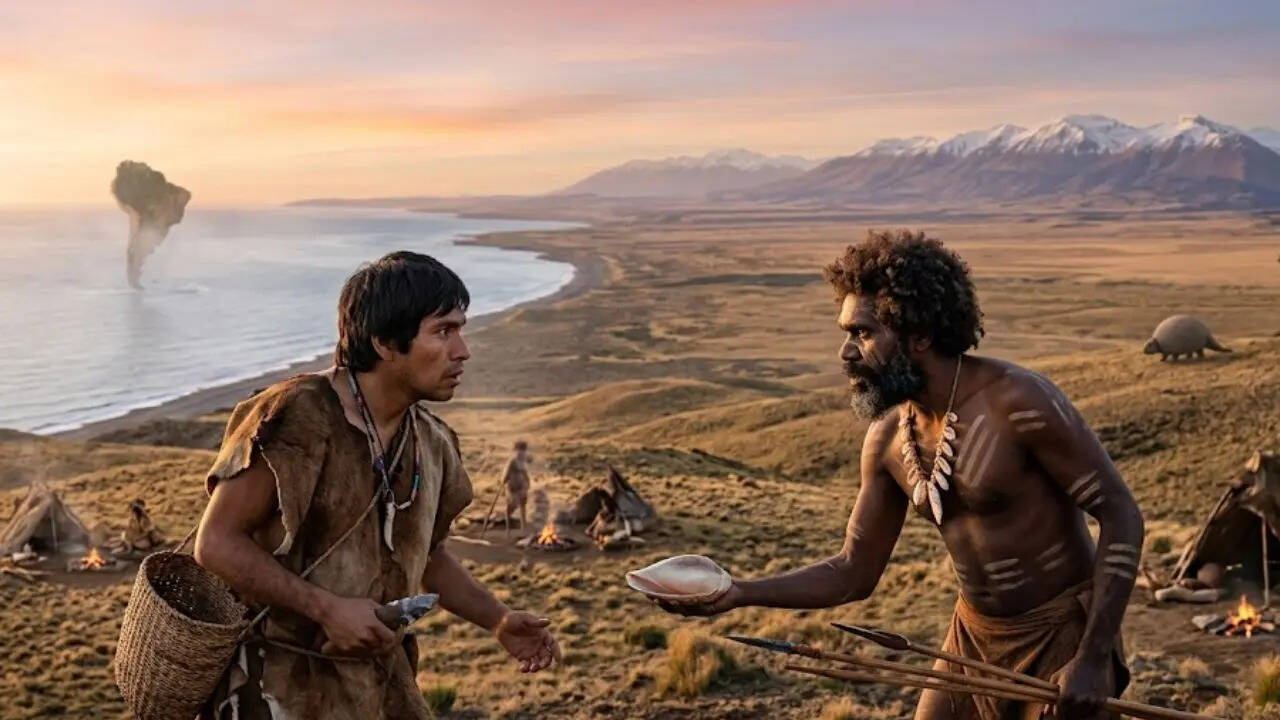
The fulfilment of South America increases the last large human migration in history and took place after other continents were occupied at least 10,000 years apart, thus making it the final major landmass to be colonised; the new study published in Nature redefines what we know about that colonisation process, which was not some chronological sequence of events as previously thought.
According to research published in Nature, the researchers looked at the genome (the entire collection of primary cells) of 128 indigenous people from 8 different Latin American countries. In doing so, they concluded that there were 3 distinct waves of dispersal for these indigenous peoples. However, the most surprising discovery to come out of this research is that certain groups of Indigenous people who live in the Amazon today share common ancestry with people who currently reside in Australasia, thereby offering a completely new perspective on how humans adapted to and survived in the variable and often very harsh environments found throughout all of North, Central, and South America during the last few thousand years. Genetic evidences like this revolutionizes our understanding of early human migration patterns, highlighting complex ancestral connections that spanned across vast oceanic distances.
South America’s earliest settlers shared ties with Australasia
The findings presented in this research indicate that 2 per cent of Indigenous Amazonians have shared genetic traits with Indigenous Australasians (such as Indigenous Australians, New Guineans and people from the Andaman Islands). These co-habitants may descend from an early Asian ancestry (referred to as the Ypykuéra or Y Population), which appears to be a sister group of modern-day Australasians, as noted in a study at Arizona State University. These groups likely interacted with modern-day Amazonians in Beringia (the land mass that once joined Siberia to Alaska) about 10,000 years ago. This suggests that previously unknown populations played a major role in the initial colonisation of the Americas.
How ancient genes bolstered early survival
The evidence that this 2 per cent genetic signature has persisted over 10,000 years implies it has offered some form of evolutionary selective advantage. Researchers performed genome analyses to uncover evidence of ‘positive selection’, or the selection of genetic characteristics that favour their further propagation. They identified genes associated with Ypykuéra ancestry that were over-represented in their study populations. These included genes related to fertility, immunity, insulin signalling and cancer progression; these may have contributed to the survival and thriving of the earliest settlers into regions not previously populated.
Complex patterns in the peopling of the Americas
Recent investigations reveal a far more dynamic history than previously assumed. Beyond the established waves 15,000 and 9,000 years ago, researchers have identified a previously unknown third dispersal. Genomic data suggest that Indigenous groups from central and southern Mexico spread into South America and the Caribbean starting approximately 1,300 years ago, as noted in a study at Arizona State University. This migration was a gradual, interconnected process that reshaped the genetic landscape of the region, proving that the settlement of South America was not a single, linear event but a multi-phasic process driven by increasing connectivity between Mesoamerica, the Caribbean, and the South American continent.
Neanderthal and Denisovan contributions
Beyond the Australasian signal, the study confirmed that 1 per cent to 3 per cent of the genomes of contemporary Indigenous American populations derive from archaic hominids. While this prevalence is consistent with other global populations, the study highlighted a distinctive pattern: specific inherited variants were critical tools for survival. These genetic contributions provided the necessary biological adaptability for early settlers to withstand extreme ecological pressures, ranging from the low-oxygen, high-altitude environment of the Andes to the diverse pathogens and resources of the dense Amazon rainforest.