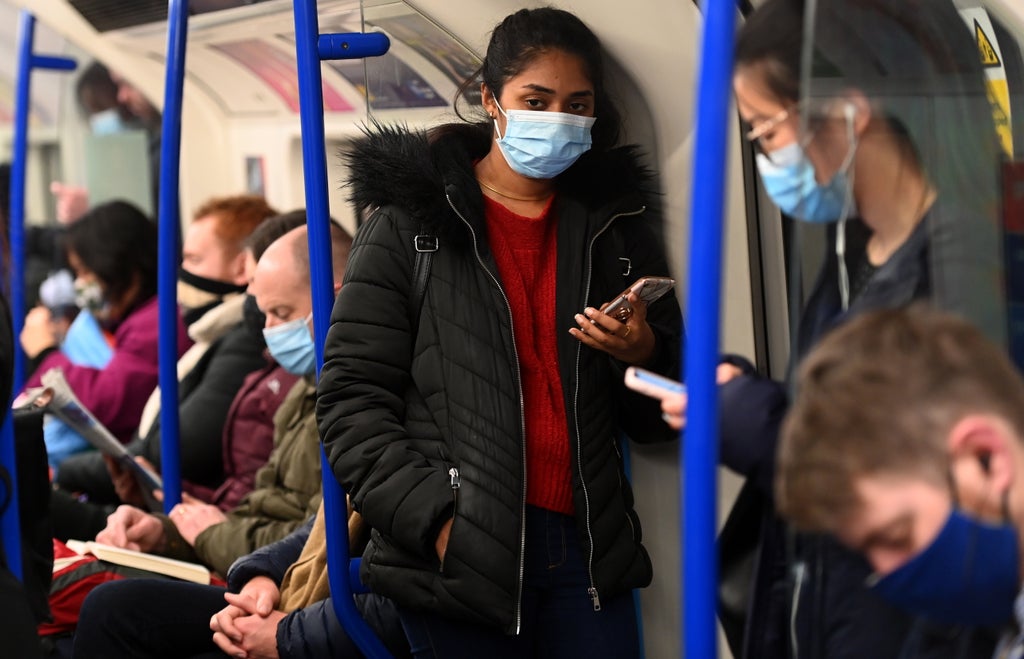
Boris Johnson’s government has reintroduced face mask restrictions in some settings to curb the spread of the new Omicron variant of Covid-19 as it continues to spread and overall case numbers climb in the run-up to Christmas.
The prime minister initially announced the news at a press conference on Saturday 27 November, also saying that booster vaccines would soon be made available to younger adults and the period between second and third jabs shortened from two to three months, in accordance with expert advice.
As Omicron began to establish its presence in Britain, Mr Johnson was forced to tighten the rules a second time on Wednesday 8 December when he gave a second press conference from Downing Street announcing further measures to stop the spread.
What has been announced?
In his first address, the prime minister said that face coverings would become mandatory once again in shops and on public transport in England.
Government guidance issued the following day added that people must wear them in other places “such as banks, post offices and hairdressers” from 4am on Tuesday and that schools are “strongly advised” to ensure that pupils in year seven and above, plus staff and visitors, wear face coverings in communal areas.
In his second announcement, that was extended to include cinemas, theatres and places of worship but not restaurants and pubs, an exception being made to accommodate eating and drinking (and singing, an interesting grey area).
Mr Johnson’s 8 December address also revealed that working from home orders would be in force from Monday 13 December and that NHS Covid Passes would be required for entry to crowded public venues from the following Wednesday.
All of the above has now come to pass, after MPs in the House of Commons voted in favour of their adoption on Tuesday 14 December, not without a significant Tory revolt in opposition to the so-called vaccination passports.
The prime minister has stressed that the new measures are “temporary and precautionary” and will be reviewed in three weeks.
“I’m absolutely confident that this Christmas will be considerably better than last Christmas,” he said, setting a low bar after a disappointing festive season for many in 2020, defined by separation from loved ones after a last-minute change to the rules.
Scientists and experts around the world say they do not yet have enough “real-world” data to be able to give an accurate assessment on how dangerous Omicron is, but it is believed to be more transmissible than the delta variant, which remains the dominant strain in the UK.
The UK has recorded 12 deaths from the new variant so far and 45,145 confirmed cases.
London mayor Sadiq Khan has declared a major incident over the extent of the Omicron outbreak in the capital while NHS England has announced a return to its highest level of emergency preparedness, level four national incident, meaning that the health service’s response will be coordinated as a national effort, rather than led by individual trusts.
Overall, the UK added another 91,743 infections in 24 hours on Monday 20 December plus a further 44 fatalities, a slight fall from the pandemic high of 93,045 recorded the preceding Friday.
What else is being done to mitigate against Omicron and its spread?
The government’s Joint Committee on Vaccination and Immunisation has issued new guidance on extending the rollout of Covid booster shots to younger adults, with the campaign still considered integral.
While the UK’s vaccine rollout over the course of the calender year has been nothing short of a triumph, fears persist that immunity is beginning to wane and so far just 50.4 per cent of Britain’s adult population has had its third dose.
The new goal to have every British citizen over-18 offered a third jab by the end of December is ambitious but thought to be highly necessary in the circumstances, even if it means placing the NHS under additional pressure.
Heightened messaging around the need for a booster has already seen the NHS booking website crash due to intense demand and queues forming around the block at walk-in vaccination centres and pharmacies offering the jab.
The UK also initially added several more southern African countries to its travel “red list” to stop the spread but has since rolled back that step.


.png?w=600)