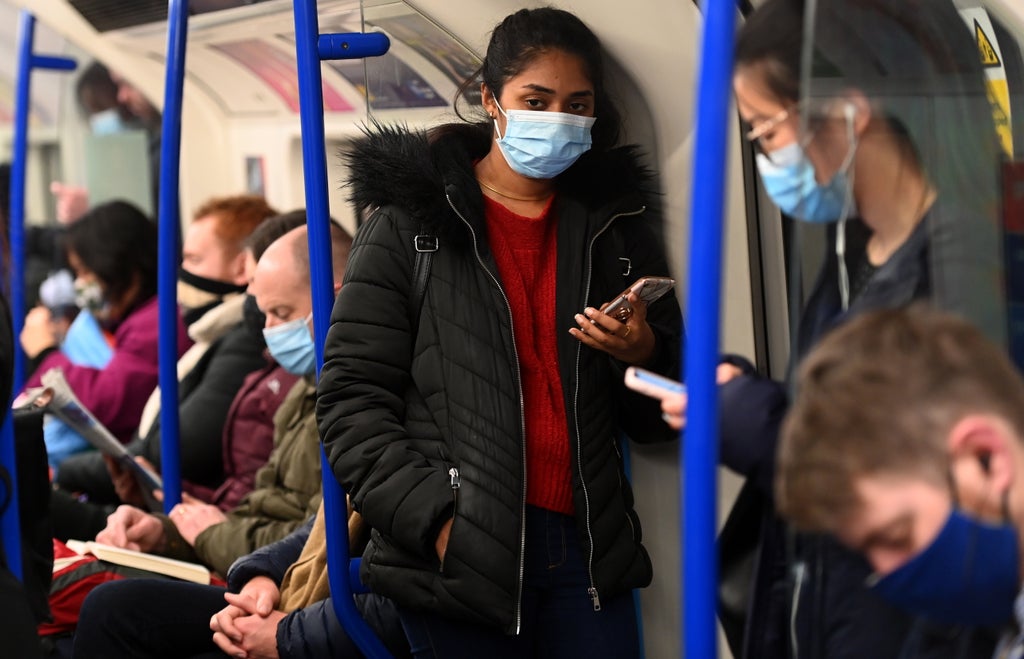
Boris Johnson’s government has reintroduced face mask restrictions in some settings to curb the spread of the new omicron variant of Covid-19 as it continues to spread and overall case numbers climb in the run-up to Christmas.
The prime minister initially announced the news at a press conference on Saturday 27 November, also saying that several southern African countries had been added to the UK’s travel red list and that booster vaccines would soon be made available to younger adults and the period between second and third jabs shortened from two to three months, in accordance with expert advice.
As omicron began to establish its presence in Britain, Mr Johnson was forced to tighten the rules a second time on Wednesday 8 December when he gave a second press conference from Downing Street announcing further measures to stop the spread.
What has been announced?
In his first address, the prime minister said that face coverings would become mandatory once again in shops and on public transport in England.
Government guidance issued the following day added that people must wear them in other places “such as banks, post offices and hairdressers” from 4am on Tuesday and that schools are “strongly advised” to ensure that pupils in year seven and above, plus staff and visitors, wear face coverings in communal areas.
In his second announcement, that was extended to include cinemas, theatres and places of worship but not restaurants and pubs, an exception being made to accommodate eating and drinking (and singing, an interesting grey area).
Mr Johnson’s 8 December address also revealed that working from home orders would be in force from Monday 13 December and that NHS Covid passes would be required for entry to crowded public venues from the following Wednesday.
The prime minister has stressed that the new measures are “temporary and precautionary” and will be reviewed in three weeks.
“I’m absolutely confident that this Christmas will be considerably better than last Christmas,” he said, setting a low bar after a disappointing festive season for many in 2020, defined by separation from loved ones after a last-minute change to the rules.
Some Conservative MPs remain viciously opposed to introducing more restrictions 18 months into the pandemic and a backbench rebellion against Mr Johnson’s increasingly-troubled leadership is expected when the House of Commons votes on the new restrictions on Tuesday 14 December.
Labour Party leader Sir Keir Starmer, however, has indicated that his MPs will vote in favour of the measures, ending any chance of a serious challenge to their implementation.
Scientists and experts around the world say they do not yet have enough “real-world” data to be able to give an accurate assessment on how dangerous omicron is, but it is believed to be more transmissible than the delta variant, which remains the dominant strain in the UK.
A further 249 omicron infections were detected in Britain on Thursday (9 December), taking the total to 819, according to the UK Health Security Agency.
The total number of daily Covid cases was meanwhile at 50,867 and 148 deaths.
What else is being done to mitigate against omicron and its spread?
The government’s Joint Committee on Vaccination and Immunisation has issued new guidance on extending the rollout of Covid booster shots to younger adults, with the campaign still considered integral.
While the UK’s vaccine rollout over the course of the calender year has been nothing short of a triumph, fears persist that immunity is beginning to wane and so far just 37.8 per cent of Britain’s adult population has had its third dose.
Border controls have also been tightened.
Four more countries - Angola, Mozambique, Malawi and Zambia - have been added to the UK’s travel red list.
All arrivals into the UK from those countries - including South Africa and Botswana, which were added to the list when news first broke of omicron’s existence - must pay to quarantine in a government-approved hotel for 10 days.
The changes came into effect at 2am on the morning of Sunday 28 November.
Anyone who returned from the four new red list countries within the four preceeding days - even if they arrived before the Sunday deadline - were instructed to self-isolate at home and get a PCR test, the Department of Health said.
“We will do all we can to protect the UK public against this emerging threat and that is why we are surging testing capacity to the impacted communities and introducing travel restrictions on a further four countries: Malawi, Mozambique, Zambia and Angola,” health secretary Sajid Javid said, adding: “We will not hesitate to take further action if required.”