
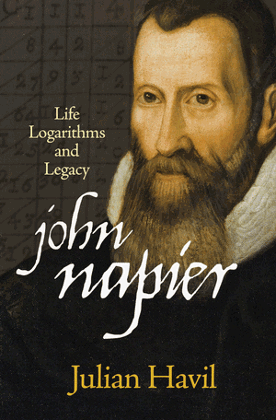
John Napier: Life, Logarithms, and Legacy by Julian Havil [Princeton University Press, 2014; Guardian bookshop; Amazon UK hardcover; Amazon US hardcover/kindle US]
Publisher’s synopsis: John Napier (1550-1617) is celebrated today as the man who invented logarithms -- an enormous intellectual achievement that would soon lead to the development of their mechanical equivalent in the slide rule: the two would serve humanity as the principal means of calculation until the mid-1970s. Yet, despite Napier’s pioneering efforts, his life and work have not attracted detailed modern scrutiny. John Napier is the first contemporary biography to take an in-depth look at the multiple facets of Napier’s story: his privileged position as the eighth Laird of Merchiston and the son of influential Scottish landowners; his reputation as a magician who dabbled in alchemy; his interest in agriculture; his involvement with a notorious outlaw; his staunch anti-Catholic beliefs; his interactions with such peers as Henry Briggs, Johannes Kepler, and Tycho Brahe; and, most notably, his estimable mathematical legacy.
Julian Havil explores Napier’s original development of logarithms, the motivations for his approach, and the reasons behind certain adjustments to them. Napier’s inventive mathematical ideas also include formulas for solving spherical triangles, “Napier’s Bones” (a more basic but extremely popular alternative device for calculation), and the use of decimal notation for fractions and binary arithmetic. Havil also considers Napier’s study of the Book of Revelation, which led to his prediction of the Apocalypse in his first book, A Plaine Discovery of the Whole Revelation of St. John -- the work for which Napier believed he would be most remembered.
John Napier assesses one man’s life and the lasting influence of his advancements on the mathematical sciences and beyond.
My first impression: Who was John Napier? If you are like most Brits, you’ve no idea of anything about him. But Napier, who was Scottish, was one of the world’s foremost mathematicians. With his discovery of logarithms and the decimal point 400 years ago, he made the first significant mathematical discoveries in Great Britain. In this engaging book, we learn more about Napier the mathematician, the religious zealot, the person. The book does include a number of equations, but don’t let those scare you away; the author writes well and strikes a nice balance between writing a biography of a mathematician and a history of science book for a general audience.

Alexander the Great: A Very Short Introduction by Hugh Bowden [Oxford University Press, 2014; Guardian bookshop; Amazon UK paperback; Amazon US paperback/kindle US]
Publisher’s synopsis: Alexander the Great became king of Macedon in 336 BC, when he was only 20 years old, and died at the age of 32, twelve years later. During his reign he conquered the Achaemenid Persian Empire, the largest empire that had ever existed, leading his army from Greece to Pakistan, and from the Libyan desert to the steppes of Central Asia. His meteoric career, as leader of an alliance of Greek cities, Pharaoh of Egypt, and King of Persia, had a profound effect on the world he moved through. Even in his lifetime his achievements became legendary and in the centuries that following his story was told and retold throughout Europe and the East. Greek became the language of power in the Eastern Mediterranean and much of the Near East, as powerful Macedonian dynasts carved up Alexander’s empire into kingdoms of their own, underlaying the flourishing Hellenistic civilization that emerged after his death.
But what do we really know about Alexander? In this Very Short Introduction, Hugh Bowden goes behind the usual historical accounts of Alexander’s life and career. Instead, he focuses on the evidence from Alexander’s own time -- letters from officials in Afghanistan, Babylonian diaries, records from Egyptian temples -- to try and understand how Alexander appeared to those who encountered him. In doing so he also demonstrates the profound influence the legends of his life have had on our historical understanding and the controversy they continue to generate worldwide.
My first impression: This interesting little book provides a very different view from what we usually read about Alexander the Great’s life. By focusing upon the times and the places where Alexander lived, we gain a different, although often complementary, appreciation for who Alexander was as a person and as a king, who were his closest allies, what they did to help him and the sacrifices they made along the way. The author, Hugh Bowden, a senior lecturer in ancient history at UCL, presents Alexander the Great’s story mostly chronologically, starting from before his birth and ending after his death. The narrative, which is captivating and informative, clearly states what we know about Alexander and how we know these things. The author also mentions that Plutarch’s Life of Alexander, which is roughly the same size as a Very Short Introduction, is a good companion volume (although Plutarch’s account is not necessarily entirely trustworthy).
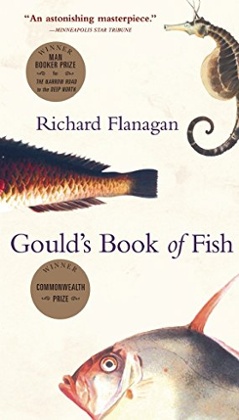
Gould’s Book of Fish by Richard Flanagan [Grove Press, 2002; Guardian bookshop; Amazon UK paperback/mp3 CD; Amazon US paperback/kindle US/mp3 CD]
Publisher’s synopsis: Once upon a time, when the earth was still young, before the fish in the sea and all the living things on land began to be destroyed, a man named William Buelow Gould was sentenced to life imprisonment at the most feared penal colony in the British Empire, and there ordered to paint a book of fish. He fell in love with the black mistress of the warder and discovered too late that to love is not safe; he attempted to keep a record of the strange reality he saw in prison, only to realize that history is not written by those who are ruled.
Acclaimed as a masterpiece around the world, Gould’s Book of Fish is at once a marvelously imagined epic of nineteenth-century Australia and a contemporary fable, a tale of horror, and a celebration of love, all transformed by a convict painter into pictures of fish.
My first impression: When I first set eyes upon this paperback at the recent Frankfurt Book Fair, everything about it attracted my attention -- the cover art, the title, its unusual shape -- so I picked it up to skim a bit. I was immediately enchanted by the rhythm of the prose, the quirky imaginative style and the subtle humour. As I thumbed through the novel to read a passage here and there, the author’s literary influences became readily apparent -- Melville, Morrison, Hemingway, just to name a few. Yet this novel is not dominated by those writers: this is a singularly powerful book that actually possesses its own distinct voice. Impressed, I purchased it.
.. .. .. .. .. .. .. .. .. .. ..
When she’s not got her nose stuck in a book into the wee hours, GrrlScientist can also be found here: Maniraptora. She’s very active on twitter @GrrlScientist and lurks on social media: facebook, G+, LinkedIn, vProud and Pinterest.