Premium compact hatchback ditches rear-wheel drive in favour of a more space-efficient front-drive format.

Why has BMW done that?
Rear-wheel drive cars tend to offer more driving fun than in their front-drive counterparts.
The former type, however, has a disadvantage in the sense that the need to install an engine longitudinally means some repercussions in cabin room.
And since we’re talking about a compact car here, BMW found it more sensible to switch to front-wheel drive format with a motor laid out transversely for its all-new 1 Series, revealed here in official pictures before a world premiere in Germany late next month.
Here’s some good proof of the transition. Although the third-gen five-door hatch has a shorter wheelbase and overall length, it has more rear legroom and boot space than in its predecessor. The ability to move the engine compartment forward has also allowed for shorter front overhang.
Other advantages of using a front-drive floorplan is cost. Other models using the so-called FAAR platform include the X1, 2 Series and Mini Countryman, all with the ability to accommodate electrification.

What’s the un-green choice?
The range-topping version announced initially for the 1 Series is the M135i xDrive powered by BMW’s latest 306hp 2.0-litre petrol-turbo. Transmission is via eight-speed torque-converter automatic and all-wheel drive.
The M135i may not be as powerful as the outgoing M140i, which ran 340hp 3.0-litre turbocharged inline-six. But due to reasons of weight, the M135i is equally accelerative from 0-100kph in 4.8sec. Oh, and it’s greener with a 14.1kpl economy rating (13.5kpl for the M140i).
Chassis mods in the M135i comprise of beefier brakes and sportier steering, while additions include limited-slip differential for the front wheels, all-wheel drive that can send 50% of driving force to the rear wheel and launch control for quicker acceleration from standstill.
Lesser, front-wheel drive models in the new 1 Series range include those with either three- or four-cylinder petrol or diesel engines. Some choices include 150hp 118d and 140hp 118i.
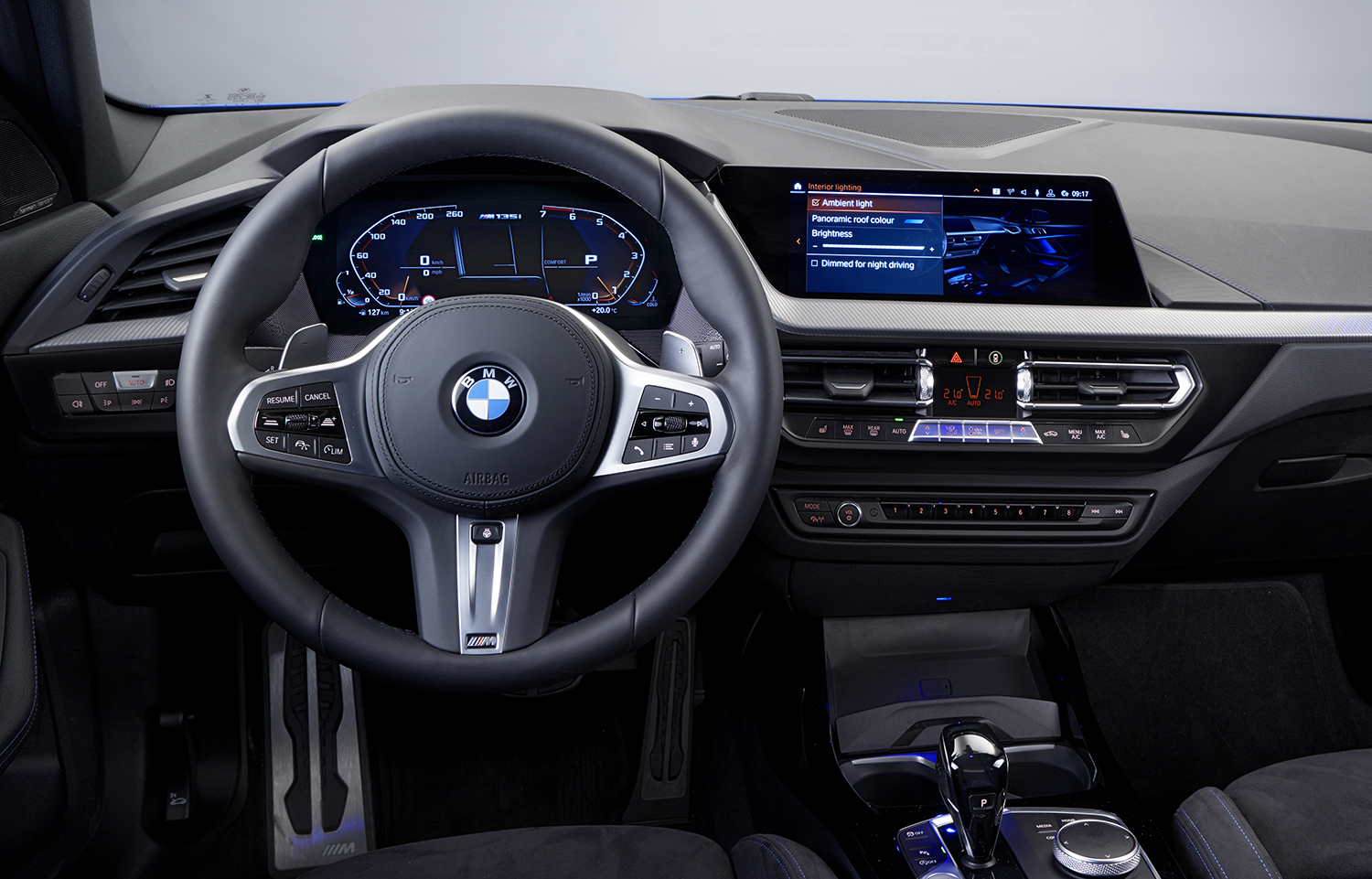
Unlike in the M135i, these more basic variances get seven-speed dual-clutch auto. The M135i also has a mesh-style grille up front and M-specific steering wheel inside (as pictured here); the others receive the traditional vertical-slat design and more restrained-looking rack.
Apart from more space, all 1 Series models now feature digital displays in the cabin and the latest in voice control system and smartphone integration. Plus, many driving aids are available now.
Which one is coming to Thailand?
The second-gen model was sold in 118i M Sport form costing just a smidge over two million baht, which might be the case for the new one spec-on-spec.
There’s a good chance that the warmed-up M may be sold on an official basis for the first time in Thailand as Mercedes-Benz Thailand is planning to offer the pending A-Class hatchback in just A35 AMG form.
The five-door A35 has a similarly powered 306hp 2.0-litre turbo four-pot and all-wheel drive but is a tenth of a second faster than the M135i in the 0-100kph acceleration time.
Although not a crucial segment, both BMW and Mercedes are hoping to capture driving enthusiasts with three million baht to spare who might have considered a Subaru Impreza WRX STi.