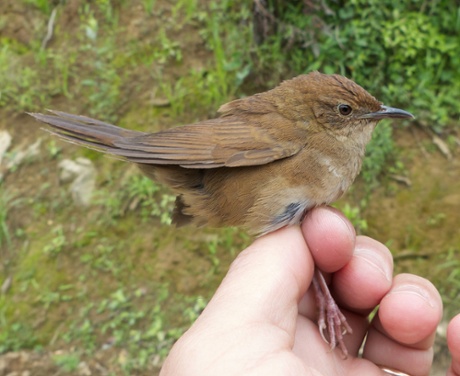

A new bird species has been discovered in central China by an international team of scientists. This shy brown bird, named the Sichuan bush warbler, Locustella chengi, breeds in the mountainous region of the Sichuan Basin at 1000-2300 m elevation. Its winter home is currently unknown. This bird was first noticed whilst singing its distinctive song in May 1992 by two members of the research team, who thought it might be something new. After nearly two decades of searching, they found the bird again. Extensive analyses of the bird’s DNA, physical measurements, plumage colour and vocalisations confirmed their hunch that this is indeed a new bird species to science.

“I first heard this species together with my friend Urban Olsson when we visited the sacred Emei mountain in Sichuan province, central China in May 1992”, writes Per Alström, a professor of systematics and evolution at Swedish University of Agricultural Sciences (Sveriges Lantbruksuniversitet) and lead author on this paper. Professor Olsson, associate professor of systematics and biodiversity at the University of Gothenburg (Göteborgs universitet), is one of the many co-authors on this paper.
“We heard a song that was unfamiliar to us coming from a dense patch of tall herbs close to the trail. The song didn’t sound very ‘bird-like’, and as we couldn’t see a trace of any bird, we were debating for a little while whether it was a bird or some insect”, recalls Professor Alström.
“Although we thought it was most likely a bird.”
The sound they heard was a series of repeated phrases consisting of a drawn-out harsh note followed by a shorter note. This is the sound they heard on that particular morning in May 1992 (fig.2):
Eventually, the two friends caught several fleeting glimpses of a small round-bodied chocolate-brown bird with a dark stubby tail, long pink legs, large dark eyes and a pointy black beak, scampering quickly through the dense underbrush. After listening and watching for awhile, they decided this shy little bird was their singer, and that it looked rather like a russet bush warbler, Locustella mandelli (pictured below) -- a species that both men had previously seen and heard in northwest Thailand.
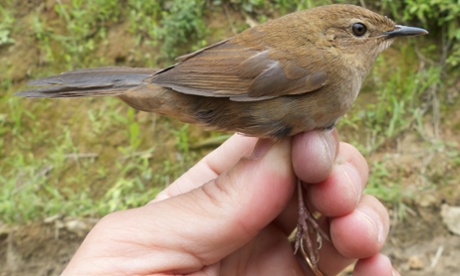
But this bird’s song was so strange! Was it really a russet bush warbler? Although neither was convinced, they couldn’t be sure since they neither saw nor heard this elusive bird again during that visit.
The two friends returned home to Sweden, pondering this mousy bird. Meanwhile, weeks lengthened into months and turned into years -- many years, in fact. During the ensuing decades, the two friends landed good jobs at separate universities in Sweden, relocated a few times and immersed themselves into their work, their colleagues and students, and their families. Yet neither forgot their encounter with that mysterious little chocolate-brown bird in the faraway mountains of China.
How did the research team realise this bird is a new species?
Nearly twenty years later, Professor Alström returned to China as a visiting professor at the Chinese Academy of Sciences. He was just as determined to find and identify this mystery bird as when he first heard it. Some of Professor Alström’s bird-watching colleagues in China had noticed this mystery bird, too. Soon, Professor Alström and his Chinese colleagues were even discussing this species using the provisional name they’d given it; “Sichuan bush warbler”.

After learning that the “Sichuan bush warbler” and the russet bush warbler had both been found breeding in the Qinling mountains, a team was assembled to seek out both birds, to learn more about how they interacted with each other. Together with his Chinese colleagues Fumin Lei, Gang Song and Zuohua Yin from the Institute of Zoology at the Chinese Academy of Sciences in Beijing and Xuebin Gao from the Shaanxi Institute of Zoology in Xian, they mounted an expedition to the Qinling mountains, where they collected the first “Sichuan bush warbler” on 28 May 2011. This individual is the holotype for his species, which is to say that he is the one specimen that represents what the species looks like. This specimen is now housed in the Institute of Zoology at Chinese Academy of Sciences, along with sound recordings and a sample of his DNA.
Later, more individuals were spotted, captured and measured, their songs recorded and DNA samples collected.
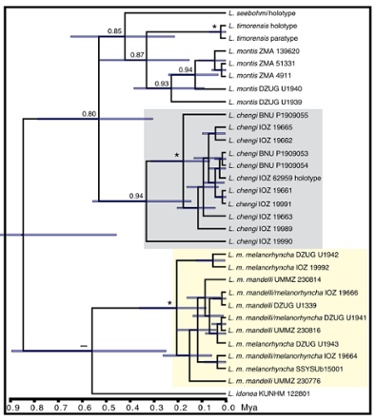
Back in the lab, mitochondrial DNA analyses of samples from birds in the genus Locustella revealed that these two bush warblers are very closely related. Further, these analyses estimated that the two species diverged from a common ancestor roughly 850,000 years ago (fig. 3).
The team measured plumage colour across each bird’s body as well as a variety of physical features -- length, height and width of each bird’s beak, and wing and leg length, for example.

Analyses of these measurements confirmed that the two species are significantly different. For example, when compared to the russet bush warbler, the Sichuan bush warbler’s breeding plumage is generally greyer overall, lacking the appropriately-named russet bush warbler’s strong russet tones. They also found that the Sichuan bush warbler has a shorter tail and longer wings than the russet bush warbler.
The research team’s field studies found that the Sichuan bush warbler is locally common, and does not appear to be under any imminent threat.
By this time, the team gave this bird its formal names: its English name refers to Sichuan province where it was first discovered, and its specific name, chengi, honours the late professor Cheng Tso-hsin (1906–1998), China’s greatest ornithologist.

How does a birder identify cryptic bird species in the field?
The Sichuan bush warbler is very similar to its closest relative, the russet bush warbler, but the two species are not identical. Which raises the question: short of carrying an automated PCR and DNA sequencer into the field -- laboratory equipment that can be as large and as heavy as a refrigerator-freezer -- how can an ornithologist or birder reliably distinguish these bird species, especially when they are hiding in an impenetrable bush, as they tend to do?
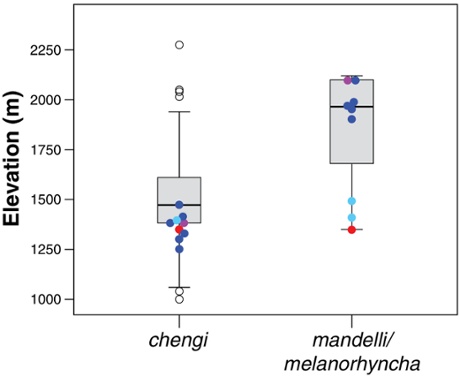
This is where the science and the art of bird watching meet because identifying birds requires careful study of the bird in the field combined with a deep knowledge of each species’ natural history. In the case of these two cryptic species, several characters help distinguish them. First, the russet bush warbler’s range (orange dots, fig. 1) is not identical to that of the Sichuan bush warbler (red dots, fig. 1). Second, even where their ranges overlap, as in parts of Sichuan Province, the two species breed at different elevations: the Sichuan bush warbler nests on lower mountainsides (fig. 4, left) whilst the russet bush warbler nests at higher altitudes (fig. 4, right).
But the most obvious difference of all, especially for those who listen carefully to birds, is song. The Sichuan bush warbler sings a lower-pitched song with more drawn out notes (fig. 2) compared to the russet bush warbler (fig. 5):
Not only do these two species’ songs sound dramatically different, but a side-by-side comparison between the sonograms created from their song elements also look strikingly different (figure 6):
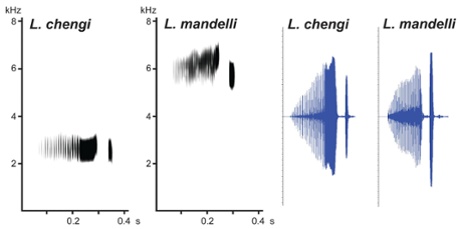
Why is discovering new species important?
Discoveries provoke questions, and this newly identified species will likely trigger a plethora of interesting research, particularly about evolution and the process of speciation in birds. For example, understanding how the common ancestor of these two bird species came to differentially exploit past environments could shed more light upon the complex relationships between evolution, ecology, geology and climate. Of course, such an investigation is made more challenging by the lack of fossils.
As an ornithologist and birder, a basic question that I’ve been pondering is which came first, the song or the species? Song is an important form of communication in birds. They use it to maintain their breeding territories, to advertise their overall fitness, and to attract mates. Since female songbirds choose their mates based on their songs, ornithologists are investigating how female choice influences the evolution of male song. These two, nearly identical, species that inhabit distinct niches and produce distinct songs could provide more insight into these two intersecting processes.
Another interesting question is the relationship between birdsong and habitat: did these two species’ songs evolve so they each travel most effectively through the particular niche that the singers live in? Research has shown that birds living in dense vegetation with a complex structure (a rainforest, basically) tend to sing songs with narrow bandwidths, low frequencies, drawn-out song elements and longer inter-element intervals, whereas birds that sing songs with broad bandwidths, high frequencies, short song elements and compressed inter-element intervals tend to live in more open habitats that lack obstructive vegetation (grasslands and the like).
But you don’t need to be a scientist or a birdwatcher to appreciate and be excited by the discovery of new species. Professor Alström pointed out in email: “ALL living organisms are interesting, and there are SO MANY cool creatures all over the world that are thoroughly enjoyable to observe.”
Sources:
Per Alström, Canwei Xia, Pamela C Rasmussen, Urban Olsson, Bo Dai, Jian Zhao, Paul J Leader, Geoff J Carey, Lu Dong, Tianlong Cai, Paul I Holt, Hung Le Manh, Gang Song, Yang Liu, Yanyun Zhang and Fumin Lei (2015). Integrative taxonomy of the Russet Bush Warbler Locustella mandelli complex reveals a new species from central China, Avian Research, 6 (9) doi:10.1186/s40657-015-0016-z (OA)
Per Alström [emails: 19, 20, 27-3o April & 1 May 2015]
Pam Rasmussen [emails: 28 April 2015]
Background:
Alström P., Fregin S., Norman J.A., Ericson P.G.P., Christidis L. & Olsson U. (2011). Multilocus analysis of a taxonomically densely sampled dataset reveal extensive non-monophyly in the avian family Locustellidae, Molecular phylogenetics and evolution, 58 513-526. doi:10.1016/j.ympev.2010.12.012 (₤ [Free PDF summarising main findings]).
.. .. .. .. .. .. .. .. .. .. ..
When she’s not out birding or trying to hack audio embed codes, GrrlScientist is very active on twitter @GrrlScientist and sometimes lurks on social media: facebook, G+, LinkedIn, and Pinterest.