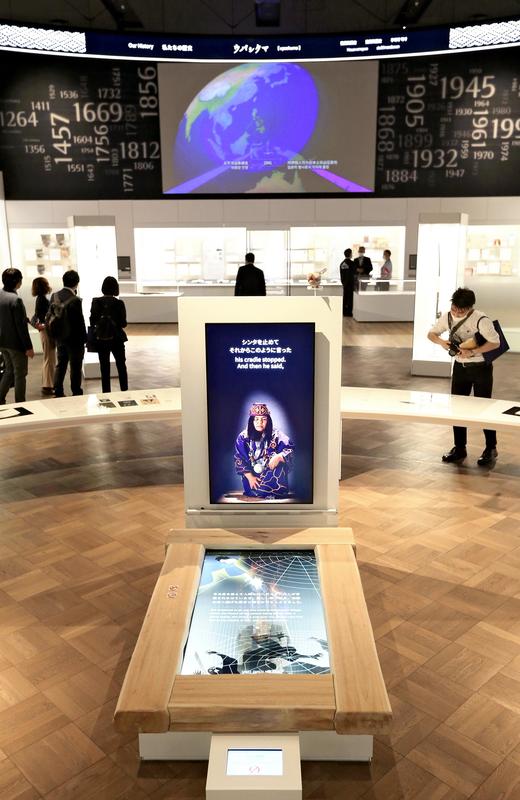
A national center for Ainu culture opening Saturday in Shiraoi, Hokkaido, carries the hope of resurrecting the Ainu language, which the UNESCO designated as a "critically endangered language" in 2009.
The Upopoy National Ainu Museum and Park was built as the hub for the cultural revival of the Ainu, the indigenous people of Hokkaido. The complex consists of the National Ainu Museum and the National Ainu Park. Upopoy means "singing together by many" in the Ainu language.
The complex is distinctive in that it uses Ainu as the first language of all text displays, from explanations for the exhibits to the facility guide.
The purpose of the facility is the development of Ainu culture by introducing its history and culture as well as nurturing people who can pass it on to the next generation.
Since it is not a written language, the Ainu words at Upopoy are basically transcribed in katakana. At the entrance of the museum in the center of the facility, visitors will see an Ainu phrase above the museum's name in Japanese. The phrase -- an = ukokor aynu ikor oma kenru -- means "a building that houses Ainu treasures we share."
Signs in Ainu are found at many other places around the facility, such as "asinru" (restroom) and "semapa" (main entrance).
"I hope people will become interested in Ainu by being exposed to many Ainu words," said Masato Tamura, director of the museum's exhibition planning section.
The Ainu people have nurtured their own idiosyncratic culture, mainly in Hokkaido. But the culture's existence is in danger due to assimilation and other policies implemented since the Meiji period.
Upopoy is operated by the Foundation for Ainu Culture, which has trained 72 Ainu people to become Ainu language instructors. The practice began in fiscal 1998 by the Ainu Culture Promotion / Research Foundation, one of its predecessors.
Chiba University Prof. Hiroshi Nakagawa, an Ainu language specialist, has been a lecturer at the foundation for a long time and has played a pivotal role in providing Ainu words in Upopoy.
"We have established a system of Ainu people themselves teaching other Ainu people," Nakagawa said.
"I want to pass on the words of my grandfather, who was 'ekashi' [an Ainu elder]," said a 22-year-old postgraduate student in Sapporo, who completed a two-year course at the foundation.
"If many Japanese people deepen their understanding of the Ainu language, it will help them honor different cultures," said an official in charge at the Cultural Affairs Agency's Planning and Coordination Division.
Read more from The Japan News at https://japannews.yomiuri.co.jp/