Israel’s coalition talks finally concluded at midnight on Wednesday, six long weeks after the election. Israel, with its proportional representation election system, has only ever had coalition governments – but the latest, which is Benjamin Netanyahu’s fourth, is already shaping up to be one of the worst.
It is hard to decide what is of greater concern – the handing of key ministries, education and justice, to the leaders of the far-right Habayit Hayehudi (Jewish Home) party, or the fact that this coalition comprises five rival parties, with a majority of only one Knesset member, spells political paralysis and two equally unappetising alternatives. Two things may happen: long-term stagnation during which none of Israel’s cardinal issues – the occupation of the Palestinian territories, inequality within its society and the neglect of minority communities – will continue and deteriorate, or there will be another election that is unlikely to yield better results.
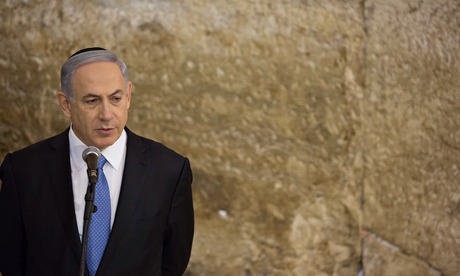
The real mystery, however, remains Netanyahu himself. A man who has succeeded in surviving all of his rivals, dominating Israel’s political scene for much of the last three decades and establishing himself as a default prime minister without giving Israelis a clear idea of where he wants to lead the country.
Few of his colleagues really believe they understand what Netanyahu is hoping to achieve. In the last two elections, his Likud party did not even publish a manifesto outlining its key policies. But Netanyahu’s failure over the last month and a half to establish a stable coalition, the way he scrambled with an hour to spare before the deadline to conduct a fire-sale of ministries and committees in order to finalise the last coalition agreement, does offer something of a guide.
After his surprisingly strong victory on 17 March, Netanyahu had two options. He could form a rightwing religious coalition with parties aligned with Likud, which would have given his new government a support base of 67 members in the 120-strong Knesset. Or he could have tried to engage with the Labour party and form a more centrist national-unity government. In public he embarked on the first course of action and attempted the second through back channels.
From members of the different parties’ negotiating teams, it emerges that Netanyahu’s representatives were uninterested in talking about policies. The main issues that came up were laws to limit the powers of the supreme court and a commitment to support Netanyahu’s plans for restructuring the media landscape. He was prepared to discuss each party’s special interests and the powers each minister was to receive, but there was little if any debate on the government’s key defence and diplomatic policies, crucial issues for an Israeli administration, or on social policy. Above all, Netanyahu was insistent on the safeguards that would minimise outside criticism and judicial oversight.
Talks with Labour foundered over his unwillingness to seriously share power with the second-largest party, nearly as large as Likud. At the last moment, the cynical foreign minister Avigdor Lieberman pulled out, realising he had lost his influence with the prime minister. Netanyahu remained with just the bare bones of a coalition and what is almost inevitably going to be a dysfunctional government.
Whatever one thinks of Netanyahu’s beliefs, there is no denying that in the earlier stages of his career he was a man with a plan. He published books on diplomacy and counter-terrorism, and another on economics which was mysteriously kept from publication. There was a dynamism about him - on some issues even radicalism. All that seems to have disappeared in recent years and been replaced simply by a survivalist determinism that no matter what, Bibi must be leader.
He has sublimated the national interest in his own image as the man who knows what is best for Israel and now a democratically elected coalition exists to serve that purpose only.