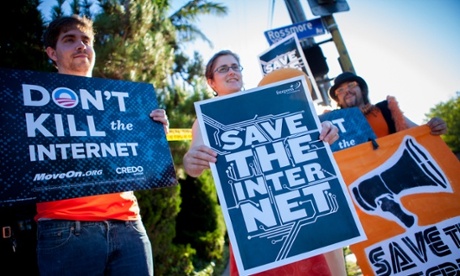
Net neutrality rules will go into effect on Friday, after a federal court rejected a bid by cable and telecommunication companies to stay the rules while a lawsuit challenging them is pending.
“This is a huge victory for internet consumers and innovators!” Tom Wheeler, chairman of the Federal Communications Commission, said in a statement. “Starting Friday, there will be a referee on the field to keep the internet fast, fair and open.”
“Blocking, throttling, pay-for-priority fast lanes and other efforts to come between consumers and the internet are now things of the past. The rules also give broadband providers the certainty and economic incentive to build fast and competitive broadband networks.”
The fight for an open internet is far from over, however.
“I plan to fight the order all the way to the supreme court,” said Daniel Berninger, founder of the Voice Communication Exchange.
At the end of February, the FCC approved a 313-page order that would allow it to treat internet access like a public utility. Cable and telecommunication companies objected, saying the order was an overreach by the FCC and that such rules should be created by Congress.
By mid-April, a handful of lawsuits had been filed against the FCC, seeking to overturn the net neutrality rules. The Cellular Telecommunications Industry Association (CTIA) filed one such suit; so did the National Cable and Telecommunications Association (NCTA) and the US Telecom and the American Cable Association.
“I am pleased that the FCC’s Open Internet Order and strong rules to ensure there are no slow lanes on the internet become effective tomorrow,” said Mignon Clyburn, a FCC commissioner, on Thursday.
“A free and open internet is vital to our democracy and competitive market. I am proud to stand up for the consumer to protect free speech and a free market.”
Not everyone at the FCC was as thrilled. Ajit Pai, one of the two Republican FCC commissioners who voted against the plan, said he was disappointed with the court’s decisions. He added that the “development was not unexpected”.