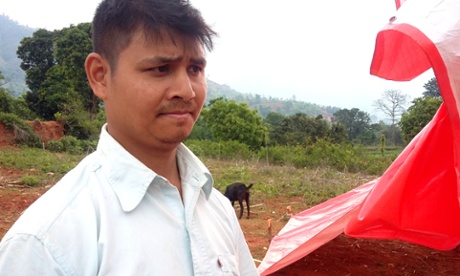
In the rubble of a small village in the hills 20 miles west of Kathmandu, Purna Shrestha is hard at work. His house collapsed in the 7.8-magnitude earthquake that hit Nepal nine days ago, killing his wife and mother.
He had arrived home from Qatar only two days before. Shrestha had spent the past 10 months working 12 hours a day, often seven days a week, preparing meals for other Nepalese working on the construction of a luxury hotel destined to welcome players, officials or fans in the wealthy Gulf kingdom when it hosts the 2022 Fifa World Cup.
“I came back to my village for my sister’s wedding days before the earthquake. I spent the next day buying ornaments, presents and decorations. They were all buried. My wife and mother died. All I have left is my six-month-old son,” Shreshtra, 32, told the Guardian.

There are similar stories all over the upland areas of Nepal, which have been hit hard by the quake, and in Kathmandu, the capital. A third of Nepalese households have at least one member working abroad, according to the UN. Most are employed in the Gulf or the Far East as labourers or menial staff.
The remittances they send home support an estimated 7 million people, most very poor, and contribute up to a quarter of GDP in the south Asian country.
In the immediate aftermath of the quake, embassies in the Gulf, Malaysia and elsewhere were overrun by desperate migrant workers unable to contact their families, and often without the means to return to Nepal. Many had surrendered their passports to their employers.
Jeeban Puri, of Swarathok, a small village in Sindhupalchowk district, which was destroyed in the tragedy, was working as a driver for a businessman in Damam, Saudi Arabia, when the quake struck. “I started calling my family immediately when I heard what had happened but no phones were working,” he said.
Two days later, when Puri finally got through to Swarathok, he learned that his three-year-old son had been killed and his house destroyed. His employer gave him leave of absence and paid for a ticket home. “I couldn’t believe my eyes when I got to the village. How could an earthquake not even spare a single house?” he said. “I will have to get back to my job once the future is a bit more clear and build a small hut for my family. I have no choice.”
His family are now living in a cattle pen and are yet to receive any substantial assistance. Six other men from Swarathok were on their way back from the Gulf, Shrestha said.
Raghu Kafle, who works for Kathmandu’s foreign ministry, said diplomats were lobbying other countries to help Nepalese migrant workers get leave from employers to return to their homeland. “Though we don’t have exact data, hundreds of people are coming from Malaysia, the Gulf and other countries,” he said.
Conditions for migrant workers, particularly in the Gulf, are often poor, with many ordered to undertake hazardous tasks in intense heat. More than 400 Nepalese migrant workers have died on Qatar’s building sites since the kingdom won its bid to host the tournament, leading to calls for the World Cup to be held elsewhere.

Money from remittances has been crucial to Nepal’s recent achievements in reducing the proportion of people living below the poverty line, from 42% to 25% over the past decade, one senior aid official in Kathmandu said. “People can be pushed back into deep poverty very easily and if they can’t get their hands on the remittances will be in real trouble,” warned the official, who did not wish to be named.
Employment agents in Nepal illegally demand huge sums from jobseekers, leading desperate men from poverty-stricken areas to take illegal loans with extortionate interest rates to pay the fees.
“I’ve only been working 10 months and I paid a broker 150,000 rupees ($1,500) to get the job,” Puri said. “The money was borrowed at 36% interest. Now I am trapped. The longer I stay here, the more interest I will have to pay.” He was paid about $250 a month in Saudi Arabia but was yet to pay off the loan as most of his wage was spent on the basic needs of his family.
I borrowed money at 35% interest. Now I am trapped. The longer I stay here, the more interest I will have to pay
Shreshtra had paid $800 to an agent to find him a job in Qatar. He earned about $250 a month, about three or four times what he would have earned as a labourer in Nepal. Per capita income in Nepal is less than $1,000.
Similar disasters have triggered a surge in migrant workers. Though a construction boom fuelled by foreign aid money will mean better-paid jobs in Nepal, wages will not get close to those offered overseas.
Sheshtra’s brother, Manoj, 25, hopes he can soon return to the United Arab Emirates, where he was a construction worker. His employers have given him three months’ leave to deal with the quake aftermath. “There are no jobs here, or you earn nothing at all,” he said. “Once everything is sorted out I will go back.”
Additional reporting by Ishwar Rauniyar in Dhading district.