Summary
We’re going to bring the blog to close for now. Here’s a summary of the latest developments:
- The death toll from Saturday’s earthquake has risen to more than 3,800 as fears grow for the fate of people living in remote villages. One aid worker told the Guardian that he feared that as many as 15,000 have been killed.
-
Five foreign nationals were among those killed on Everest. Australia named one of the victims as Renu Fotedar Melbourne mother of two.The US State Department said three US citizens were killed including a Google engineer, a medic and a filmmaker. Japan’s foreign minister said a Japanese man was also among the dead.
- Survivors desperate for shelter have turned to camping out in sewage pipes as thousands of people prepare to spend a third night sleeping rough.
- Helicopters have started to rescue up to 150 mountaineers stranded on Everest above an ice fall caused by the earthquake. An additional 61 were injured in the avalanche and an unknown number are still missing.
- Britain’s Disasters Emergency Committee has launched a joint appeal to help the survivors of the earthquake. The UN’s World Food Programme said a “massive” aid operation will start on Tuesday.
- Unicef said nearly one million children in Nepal were severely affected by the earth quake. It also warned of waterborne and infectious diseases.
- Thousands of Nepalis have began fleeing the capital Kathmandu in the wake of powerful aftershocks that have stoked fears of food and water shortages. Roads leading out of the mountain valley city of one million were reportedly jammed with people.
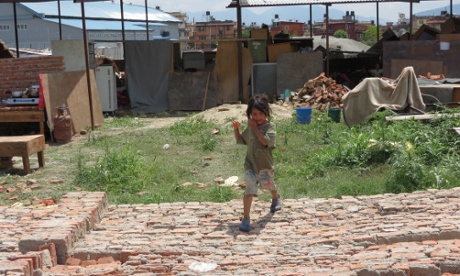
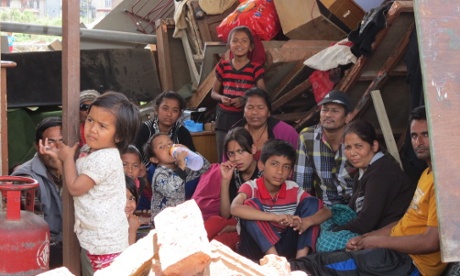
Anna Codrea-Rado has sent through more pictures from the makeshift camp in the Baluwater neighbourhood of Katmandu which she reported on earlier.
Sky News has broadcast drone footage of the earthquake damage in Katmandu.
This drone footage shows the scale of destruction following the #NepalEarthquake http://t.co/HNluRj1DLE
— Sky News (@SkyNews) April 27, 2015
Updated
The death toll has risen yet further to 3,815, according to the Nepalese news site Kantipur, citing government figures.
It also includes this Home Ministry breakdown of the victims by area:
- Sindhupalchwok 875
- Kathmandu 808
- Dhading 247
- Nuwakot 245
- Gorkha 223
- Bhaktapur 232
- Kavre 191
- Lalitpur 155
- Rasuwa 150
- Dolakha 65
- Ramechhap 29
- Makwanpur 33
- Khotang 16
- Okhaldhunga 15
Nitika Thapa couldn’t make her way out of the house for all its trembling, and so she hid under the bed, writes Melody Schreiber in Katmandu.
When the quake subsided, she and her family headed for open ground 1km away. They visited their home around 5am on Monday to stockpile more food. They have been buying noodles and juice – from the few small shops that have reopened nearby. Safe bottled water is tough to find around here .
Their home has no power, so they walked to a boutique Thapa’s mother owns in order to charge their phones. While they waited, they sat in an empty field under a tarpaulin about a meter and a half high. There are five of them in all – Nitika, her mother, her brother, and her uncle. Nitika’s stepfather had to report for work today; he works at a bank, and many people are eager to make withdrawals; they’re beginning to run out of whatever cash they had with them when the quake hit.
“It was a nightmare,” she said. “It was like Doomsday.”
She’s afraid that a 9 or 10 Richter earthquake will occur. “So many rumours,” she said.
“We’re really afraid to go back to our home,” Thapa said. The memory of the disaster won’t leave her. She feels as if it is shaking all the time.
“The aftermath is really exhausting. Too much stress,” she said. “We’re just not prepared for this.”
She’s staying in an open plot – previously used to graze cattle and occasionally dump rubbish – with about 500 other people. There is one semi-functioning toilet.
“If the earthquake won’t take us, then probably the viruses will,” Thapa said. She’s worried about pneumonia and diarrhoea, and typhoid has arrived early this year in Nepal.
Thapa is waiting until after the 72-hour period advised by the government before returning home. But there’s a danger of aftershocks for up to six months after a quake.
“I’m hoping it will end,” Thapa said. “But it just keeps coming, again and again.”
At the end of a dirt track, a few hundreds meters from the former Nepali Prime Minister’s house, locals were spending day three in a self-built camp, writes Anna Codrea-Rado.
In an abandoned field usually used as a dumping ground in the Baluwatar neighbourhood of Kathmandu, hundreds of Nepalis were sheltering from the midday sun under tarpaulin and in tents. Men were cuddled around tables playing betting games with cards and children were playing football.
Inside an orange tent, Lawang Lama, 35, was laying on a camping matt next to his sister-in-law, Yang Chan Dulkar. The two had been there since the quake, along with five other members of their family.
Lama, a trekking guide, had returned to Kathmandu from Annapurna Base Camp where he had been leading climbers, a few days before the earthquake hit.
“We’re scared,” Lama said. The family brought the tent and supplies from their house, but they said they do not have enough food or water. Dulkar, 22, said they have not received any help or assistance from anyone so far. “We would like our government to help with food,” Dulkar said, “We just need the basics.”
She added: “We have no idea when we will go back to our houses.” She said they do not feel safe returning to their homes, which were damaged in the earthquake. The pair said when the rest of the camp starts to go home, they will too.
This is Lawang Lama, a trekking guide. He's been camping in an abandoned field. He's scared to return home. pic.twitter.com/XrsOxOaFOK
— Anna Codrea-Rado (@annacod) April 27, 2015
Survivors desperate for shelter have turned to camping out in sewage pipes, reports Anurag Acharaya from the Nepal Times.
People holed up inside sewer pipes lying on roadside, meant for reconstruction. #NepalQuake pic.twitter.com/OTgx71tFCT
— Anurag Acharya (@Anurag_Acharya) April 27, 2015
He also reports a shortage of tents and medical supplies.
As more families pouring inside CA perimeter, shortage of tents,long lines for medical supplies. #NepalQuake pic.twitter.com/r5I9h9hlGE
— Anurag Acharya (@Anurag_Acharya) April 27, 2015
There are reports of survivors being trapped under rubble in 19 separate locations in Katmandu, according to Nepalese news site My Republica citing the army.
Some survivors have been texting rescue workers who still can’t reach them, according to local journalist Salokya.
Local informed us that ppl r texting from inside but rescue team unable to get inside #NepalEarthquake #NepalQuake pic.twitter.com/bEiTDM6bGB
— salokya (@salokya) April 27, 2015

State media in China says more than 400 climbers from more than 20 separate countries were on the north side of Everest when the earthquake struck. All have since descended to safety, according to Reuters citing the Xinhua news agency.
The Chinese side of Everest is less popular with climbers, in part because a special permit is required to enter Tibet. But it is an alternative to the heavily trafficked Nepalese side, and it is growing popular especially with Chinese climbers.
This helps break the relentless stream of grim news from Nepal. AP has footage of a man being rescued alive from deep beneath rubble in Katmandu.
Blogger and Nepal based journalist Saloka posts what he claims is the first drone image of the damage to the city of Bhaktapur, east of Kathmandu.
First drone image of Bhaktapur #Exclusive #NepalQuake #NepalEarthquake pic.twitter.com/gOuW8La9ly
— salokya (@salokya) April 27, 2015
World Vision said its staff members were able to reach Gorkha, near the epicentre of the quake, but gathering information from the villages remained a challenge, AP reports.
Even when roads are clear, the group said, some remote areas can be three days’ walk from Gorkha’s main disaster centre.
Some roads and trails have been blocked by landslides, the group told AP.
“In those villages that have been reached, the immediate needs are great including the need for search and rescue, food items, blankets and tarps, and medical treatment.”
Lila Mani Poudyal, the government’s chief secretary and the rescue coordinator, said Nepal needed more.
He said the recovery was also being slowed because many workers water tanker drivers, electricity company employees and labourers needed to clear debris “are all gone to their families and staying with them, refusing to work.”
“We are appealing for tents, dry goods, blankets, mattresses, and 80 different medicines that the health department is seeking that we desperately need now,” Poudyal told reporters. “We don’t have the helicopters that we need or the expertise to rescue the people trapped.”
As people are pulled from the wreckage, he noted, even more help is needed.
“Now we especially need orthopedic (doctors), nerve specialists, anaesthetists, surgeons and paramedics,” he said. “We are appealing to foreign governments to send these specialised and smart teams.”
Britain’s Disasters Emergency Committee, made up of 13 leading aid charities, has launched a joint appeal to help the survivors of the earthquake.
DEC chief executive Saleh Saeed says: “The pictures and stories coming out of Nepal show families ripped apart by this disaster.
“Survivors are in need of medical help, shelter, food and water. In many cases they have lost everything and our members are ready to help them rebuild.”
The donation line has just opened. Tel: 0370 60 60 900. More details are on the DEC’s website.
The official death toll in Nepal alone has increase to more than 3,700 according to the Nepalese government’s national emergency operation centre.
Its Twitter account said more than 3,000 bodies had been recovered amid reports that hospitals are running out of space for the dead.
Dead(3729): Injured(6944): Dead Body Handovered( 3113)
— EarthquakeNepal-MoHA (@NEoCOfficial) April 27, 2015
More bodies being brought into the morgue at Kathmandu's Bir hospital. Most of them left outside because there's no space. #NepalEarthquake
— Sanjoy Majumder (@BBCSanjoyM) April 27, 2015
The UN food agency said is is preparing a large-scale aid operation starting on Tuesday.
“This will be a large, massive operation,” Elisabeth Byrs, spokeswoman for the UN’s World Food Programme, told AFP.
WFP experts arrived in Kathmandu on Sunday to evaluate the needs, and the agency estimates shelter and medical equipment should be the first priority.
The World Health Organization said it had already distributed medical supplies to cover the health needs of more than 40,000 people for three months in the country.
But with food also expected to quickly run scarce, the UN agency has “mobilised all of our food stocks in the region,” Byrs said.
WFP is loading a plane with rations of food that does not require cooking in Dubai, and Byrs said it would likely arrive in Nepal Tuesday.
The food will be distributed to survivors in the country, taken by truck where possible, but due to the massive destruction, “the relief cargo may need to be airlifted,” Byrs said.
WFP experts are meanwhile pouring over satellite images to estimate how many people have been affected by the disaster, Byrs said.
She said the worst-hit area was in “an agricultural zone that is home to between two and three million people.”
Photos from our staff in Nepal show the devastation of the #NepalQuake. You can help here: http://t.co/mwZcsqpibF pic.twitter.com/kq31phLM6c
— World Food Programme (@WFP) April 27, 2015
Death toll expected to rise sharply
The eventual death toll could exceed 15,000, a leading aid agency fears.
Lex Kassenberg who is directing Care International’s response to the disaster, pointed out there were reports that between 70% and 90% of houses in some remote villages have been destroyed.
Speaking to the Guardian via Skype, he said:
Information from the surrounding districts is only trickling in. But you can imagine – the government has declared 30 out of the 75 districts as emergency areas, so my fear, and that of the international community, is that these numbers will really go up. And that the 3,000 that we have at the moment is a very tentative number and it will go up over the 10,000, 15,000 [level].
He said the priority now was to provide emergency shelter to those left homeless by the earthquake, as well as water and sanitation.
But he warned that many remote areas will only be accessible on foot on paths that may have been destroyed.
Kassenberg warned that the forthcoming monsoons could bring more devastation. “The challenge will be that in five or six weeks the rainy seasons starts in Nepal. If the top soil has been loosened by the earthquake we may see more damage during the monsoons.”
Updated
Australia’s department of foreign affairs has confirmed a Melbourne mother of two, Renu Fotedar, was among thousands killed in the earth quake.

Earlier on Monday the foreign affairs minister, Julie Bishop, told reporters more than 830 Australians in Nepal were confirmed as safe, but there were “grave concerns” for at least one Australian.
Her department confirmed to Guardian Australia that the 49-year-old, last seen at Everest base camp, had been killed.
Updated
Aid teams and rescue workers are arriving from around the world, according to the UN’s humanitarian chief Valerie Amos.
Search&rescue +medical teams from around the world have deployed to #Nepal. #UN is on the ground supporting and coordinating intl efforts
— Valerie Amos (@ValerieAmos) April 27, 2015
The European Commission has released €3m in emergency aid.
The British based aid agency Oxfam said it was gearing up to deliver clean water and sanitation.
It says its working with Unicef to provide sanitation facilities in Tudikhel in Bhaktapur by Tuesday.
Zubin Zaman, Oxfam India Deputy Director, said: “Our priority is to ensure that people affected have adequate humanitarian assistance and we are able to prevent secondary disasters, including outbreak of disease by providing safe water and critical sanitation support. Hundreds of thousands of displaced people need urgent humanitarian assistance now - including children and women who are forced to be out in the open, huddled in groups with no food, safe water, or shelter.”
A team of technical experts are flying from the UK with supplies to provide clean water, sanitation and emergency food supplies.
Tens of thousands of people are huddled in makeshift tent cities desperate for help and terrified of aftershocks, AFP reports.
“This is a nightmare, why don’t these aftershocks stop?” asked 70-year-old Sanu Ranjitkar, clutching her dog and with an oxygen mask strapped to her face as she sat under a tarpaulin.
With just sheets of plastic to protect them from the cold and rain, many said they were desperate for aid and information on what to do next.
“There is just too much fear and confusion,” said Bijay Sreshth, listening to a radio in the hope of hearing a message from the government.
“We don’t know what to do next or for how much longer we are here,” said Sreshth, who fled to a park with his three children, wife and mother when the quake hit.
Lengthy queues formed outside petrol stations while supermarkets were seeing a run on staples such as rice and cooking oil.
A government official said tonnes of clean water and other essential supplies were needed for the survivors as well as stepped-up search and rescue efforts outside the capital.
“We need more helicopters for our rescue operations in rural areas,” home minister spokesman Laxmi Prasad Dhakal told AFP.
“We also need supplies of essential goods such as food and clean water to provide relief for survivors.”

Updated
Families in Kathmandu queued on Sunday to cremate their loved ones following the earthquake. Bodies lie side by side wrapped in orange cloth, Pete Pattisson reports in a new Guardian video. One young man cremates his 21-year-old girlfriend at the holy site of Pashupatinath on the river Bagmati. She was crushed when the walls of a school fell on her.
Thousands of people continue to flee Kathmandu after aftershocks stoked fears of food, water, and fuel shortages
Pictures have emerged showing roads leading out of the mountain jammed with families.
ITV’s Dan Rivers reports 5km long queues.
This traffic jam is 5 km long apparently pic.twitter.com/Zggs4Rc0at
— Dan Rivers (@danieljerivers) April 27, 2015
Shops remain shut in the city, according to local journalist Dewan Rai.
Shops remain shut on third day after the earthquake, Jawalakhel now #NepalQuake pic.twitter.com/YC7q4L4sp5
— Dewan RAI (@rdewan) April 27, 2015
Vodafone Australia is offering free calls to Nepal for its customers wishing to contact family and friends caught up in the aftermath of the earthquake.
It originally consisted of the names of 900 names. The ICRC is inviting survivors to register themselves as alive.
It currently includes dozens of British people still reported as missing.
Australian woman among dead
Australia’s foreign ministry has confirmed that a woman from Victoria was among those killed. It named her as Renu Fotedar.
Earlier ABC News reported that Fotedar was a 49-year-old mother of two.
Trekking company Dreamers Destination confirmed to the ABC that Fotedar had been killed and the company was trying to return her body to Kathmandu.
Updated
Before and after photographs show the destruction of the Dharahara tower - one of Katmandu’s best known landmarks.

There have been more confirmed deaths in the Gorkha district near the epicentre of the earthquake, taking AP’s tally of the death toll to more than 3,700.
Udav Prashad Timalsina, the top official for the Gorkha district, told the agency that 223 people had been confirmed dead in the area but he presumed “the number would go up because there are thousands who are injured.”

Death toll increases to 3,617
The death toll has shot up again, AP reports:
Nepal’s police say at least 3,617 people have been confirmed killed in Saturday’s earthquake, including 1,302 in the Kathmandu Valley alone.
In addition, 6,515 people were injured nationwide, the police department said in a Tweet.
Total number of dead and injured as of 12 o'clock is as follows. Dead 3617 and 6515. In KTM valley dead 1302 and injured 4228.
— Nepal Police (@NepalPoliceHQ) April 27, 2015
Updated
Summary
Here’s a summary of the latest developments:
- The death toll from Saturday’s earthquake has risen to more than 3,300 as fears grow for the fate of people living in remote villages. The official death toll in Nepal currently stands at 3,218, but that does not include 18 people killed in an avalanche, and another 61 people were killed in neighbouring India, and 20 killed in Tibet.
- Four foreign nationals were among those killed on Everest. The US State Department said three US citizens were killed including a Google engineer, a medic and a filmmaker. Japan’s foreign minister said a Japanese man was also among the dead.
- Helicopters have started to rescue up to 150 mountaineers stranded on Everest above an ice fall caused by the earthquake. An additional 61 were injured in the avalanche and an unknown number are still missing.
- Unicef said nearly one million children in Nepal were severely affected by the earth quake. It also warned of waterborne and infectious diseases.
- Thousands of Nepalis have began fleeing the capital Kathmandu in the wake of powerful aftershocks that have stoked fears of food and water shortages. Roads leading out of the mountain valley city of one million were reportedly jammed with people.
Three helicopters are being used to rescue up to 150 climbers trapped on Everest, Nepalese officials have confirmed.
The climbers, who were not thought to be seriously injured, were being brought down to base camp rather than all the way down the mountain, tourism department chief Tulsi Gautam told AFP.
“We have deployed three helicopters today to bring climbers down from Camp One and Two. They are safe but we need to bring them down because part of the route is damaged,” Gautam said.
He said the climbing season might again be called off in the wake of the avalanche that swept through base camp, triggered by the earthquake.
“It is possible that climbing might not continue this year. However, there has been no official decision,” he said.
Helicopters have already rescued scores of climbers and their teams injured at base camp in Saturday’s avalanche, which sent a cloud of snow cascading down the mountain.
There had been more than 800 people at different places on the mountain, which has also felt a series of aftershocks, an official has said.
Another tourism official, Gyanendra Kumar Shrestha, estimated some 150 people were stranded at or between Camps One and Two.

The evacuation of up to 100 mountaineers stranded at Everest camps above the Kumbu ice fall appeared to have begun in earnest on Monday, writes Peter Beaumont.
According to reports from climbers at Everest base camp three helicopters have been brought in to run shuttles into the camps in the Western Cwm above the ice fall – a jumble of ice cliffs and crevasses - where the usual climbing route, equipped with ropes and ladders, was badly damaged by Saturday’s earthquake.
Although a team of climbers among those trapped at camp one had descended on Sunday to check the viability of descending with equipment dropped by helicopter earlier in the day they returned to report both that the route was damage and that the sherpas who usually maintain the route had left.
Because of the altitude the small helicopters involved in the evacuation can only take two climbers at a time according to Alex Gavan, a Romanian mountaineer among those still at base camp where 22 climbers were killed and 61 injured in a massive avalanche on Saturday.
Gavan reported the start of the evacuation on Monday morning.
Stranded climbers evacuation from camp1&2 continues. 3 helis fly non stop. Only 2 people per shuttle due to high altitude. Weather good.
— Alex Gavan (@AlexGAVAN) April 27, 2015
Efforts to help those stranded at camps one and two – both above 6000 metres on the world’s highest mountain had been hampered at first by poor weather and by the need for the helicopters to evacuate the worst injured first to a clinic in the village of Pheriche.
Jim Davidson, a US climber among those trapped at camp one, was one of the first to be evacuated updating his Facebook page by satellite phone.
“Weather good on Everest. Evacuation of C1 & C2 going well. I am safe in basecamp now ...the injuries, fatalities & tragedy are heartbreaking.”
On Sunday Argentine climbing guide Damian Benegas, working for the US expedition company AAI, had led a small team down to the ice fall to attempt to find a route through for the climbers stranded higher on the mountain.
“Tremors made this impossible,” a spokesperson from AAI wrote in an update posted to the company’s website. “At this time, the teams at base camp feel a route through the icefall will be very difficult and thus we are looking to use helicopter transport to move our and other teams from Camp I to Base Camp.”
Altitudes in the Western Cwm mean that only small helicopters are able to reach the climbers trapped in camps one and two typically Eurocopter B3s which at most can ferry two to three passengers at a time. According to some estimates that would mean it it would take several dozen flights to retrieve all the climbers trapped in the Western Cwm.

Updated
If you didn’t know Kathmandu had been hit by a major earthquake, you might not immediately realise it, writes Pete Pattisson reports from the Nepalese capital.
The roads are busy, some shops are open and the vast majority of buildings are still standing.
Those that have been destroyed are largely the old traditional structures, such as temples, monuments and buildings like Durbar high school, the first school ever built in Nepal, which looks beyond repair.
But residents remain tense and jittery as aftershocks, some of which register as significant earthquakes in their own right, continue to hit the city.
The questions many locals will be asking now are; where can we get water, food, gas and petrol? When will some power return? And when is it safe to go back indoors?
Every single lost life is a tragedy - and yesterday I watched heart-breaking scenes as families cremated their loved ones killed by the quake - but those of us who live here expected worse. Kathmandu regularly tops the tables for the city expected to incur the most casualties in the event of a major earthquake. When I spoke to Amod Mani Dixit, the executive director of the National Society for Earthquake Technology 18 months ago, he said that a major earthquake could immediately cause 100,000 deaths, with up to 400,000 dying in a few weeks.
While locals have always been somewhat blasé about the earthquake threat, some ex-pats have kitted their homes out with earthquake alarms and go-bags with emergency supplies (in fact Dixit said one of the most cost effective tools of earthquake survival is a simple whistle).
Given this context, Kathmandu has got away relatively lightly. The more significant problems are likely to lie in the rural areas closer to the earthquake’s epicenter, which are hard to access even at the best of times. Basic infrastructure in rural Nepal is rudimentary and government services, like health posts, are patchy and unreliable. I fear worse news is still to come.

The death toll has soared past 3,300 and is expected to rise further as the devastation in remote villages is becoming clearer, according to AP.
Udav Prashad Timalsina, the top official for the Gorkha district, near the epicentre of Saturday’s quake, said: “I’ve had reports of villages where 70% of the houses have been destroyed.”
An aid worker told BBC Radio 4’s Today programme that he had been told of village of 2,000 residents where 90% of homes were destroyed.
AP has this tally of the the victims:
Deputy Inspector General of Police Komal Singh Bam said that Nepal’s death toll had risen to 3,218 people. That does not include the 18 people killed in an avalanche, which were counted by the mountaineering association. Another 61 people were killed in neighbouring India, and China reported 20 people dead in Tibet.
Seismologist James Jackson, head of the earth sciences department at the University of Cambridge, said he and other experts were not surprised to hear of the horrific earthquake, Associated Press reports.
“Physically and geologically what happened is exactly what we thought would happen,” Jackson said.
“It was sort of a nightmare waiting to happen.”
The location of a natural seismic fault, poor building construction, overdevelopment and a large population meant conditions were rife for disaster, he said.
Jackson said 50 earthquake and social scientists from around the world went to Kathmandu last week to come up with a disaster preparation plan because of those conditions.
But experts did not expect disaster to occur so soon after their visit, he said.

Army spokesman Jagdish Pokhrel said just about every member of Nepal’s 100,000-soldier army is currently involved in rescue operations, reports the Associated Press.
“90% of the army’s out there working on search and rescue,” Pokhrel said, showing clear signs of exhaustion. “We are focusing our efforts on that, on saving lives.”
It’s now just on midday on Monday in Nepal, and you can expect to begin seeing reports coming from the more remote, mountainous regions of Nepal that has been at the epicentre of the quake and likely suffered some of the worst damage.
I’m now handing over the reins of the live blog to my colleague Melissa Davey who will continue to update you on the situation.
Prime minister of Bhutan, Tshering Tobgay, flew to Kathmandu to call on Nepalese prime minister Sushil Koirala, according to his unverified Twitter account.
Tobgay offered to assist the country “in any way”, which has seen over 3,000 deaths and thousands more injured after a massive earthquake hit parts of Nepal on 25 April.
The prime minister said flags would fly at half mast in Bhutan on Monday to mourn the lost lives.
Was very happy to call on Nepal's PM Sushil Koirala to convey condolences of His Majesty the King, government and people of Bhutan.
— Tshering Tobgay (@tsheringtobgay) April 27, 2015
Guardian reporter Anna Codrea-Rado says many foreign nationals in Nepal are trying – with varying success – to leave the country.
I’m outside the Jet Airways office in Kathmandu where dozens of Indian nationals are trying to rebook their tickets for flights home but have found the office is not letting them in.
The mood of the day is now that everyone wants to try and get out. The people outside the Jet Airways office are angry because they aren’t being told when they can rebook flights and are being held in a line outside in the heat.
Line outside Jet Airways office, people trying to get tickets out of Nepal- group mainly Indians trying to get home pic.twitter.com/hmpNDmOZpJ
— Anna Codrea-Rado (@annacod) April 27, 2015
Updated
Summary
- The death toll from Nepal’s earthquake is at 3,218, according to a police official. An additional 6,538 people have been injured in the Saturday quake, the worst in the country in 81 years.
- The earthquake triggered an avalanche on Mount Everest, killing at least 18 people on the mountain. An additional 61 were left injured and an unknown number are still missing.
- Australia’s minister of foreign affairs, Julie Bishop, has said she has “grave fears” for the welfare of one Australian known to be at the Mount Everest base camp. Earlier today Fairfax spoke to an expedition leader who reported the death of four members in the avalanche, including one Australian.
- Bishop said the department has activated its 24-7 emergency call unit (+61 1300 555 135) which has already taken over 1,400 calls from family and friends of missing Australians. A nine-person crisis response team has been dispatched to affected areas.
Updated
New footage and reports from climbers stranded on Mount Everest are coming in, with one British climber saying he feared the “race against time” for those awaiting rescue:
James Grieve, 52, told the Sun over a satellite phone from camp one – more than 6,100m up on the world’s highest peak – that the rescue effort was being hampered by storms. His group’s supplies would last only a few more days, he said.
“Everyone is apprehensive about what’s happening and what will happen in the next 24 hours. We have a few days of food and drink left. Our tents have all been lost and we have around 18 dead bodies at base camp.
“Rescue teams are struggling to get us help due to the weather and the next few days’ forecasts are not great. There is a lot of confusion in the cap and there are still about 120 of us here waiting to be rescued.
“We are in a race against time to get off the mountain.”
Rescue efforts have come after a 7.8 magnitude earthquake hit parts of Nepal, and triggered an avalanche at Mount Everest. At least 18 people on the mountain have died, with 61 injured and an unknown number still missing.

Updated
Scientists and disaster management experts have said poor building construction in poverty-stricken parts of Nepal, combined with Saturday’s powerful 7.8 magnitude earthquake, lies behind the rising 3,200 person death toll.
“The videos and photos of the devastation show the chilling truth that earthquakes don’t kill people, collapsing buildings do,” said Dr Ilan Kelman of the University College London’s Institute for Risk and Disaster Reduction.
Kelman said Nepal has some of the world’s best experts and initiatives for community-based seismic risk reduction and earthquake education, but that conflicts, poor governance and ongoing poverty had left the country vulnerable.
“We have long known how to construct buildings which do not fall down in earthquakes, but that knowledge is not always applied,” said Kelman. “Despite the heroic efforts of our Nepali friends and colleagues over the years, including retrofitting schools, political not technical factors slowed the work.
“As people are still being pulled from the rubble, let’s recognise that this was not a natural disaster, in order to work towards overcoming the politics which causes disasters.”

Updated
Nearly a million children have been “severely affected” by the earthquake that struck Nepal on Saturday, a spokesman for the United Nations Children’s Fund (Unicef) has told Reuters.
As rescue and aid workers struggle to cope with the rising death toll of 3,218 and more than 6,500 injured, hundreds of thousands of Nepalis are sleeping out in tents or in the open.
Unicef said its relief workers were watching for waterborne and infectious diseases.
“We know at this point there are nearly a million children who are severely affected,” said Christopher Tidey by telephone. “Our biggest concern for them right now is going to be access to clean water and sanitation. We know that water and food is running out.”

Updated
Stories from Australian survivors of the deadly Nepal earthquake have begun to emerge:
“It was pretty scary, pretty horrible,” said Camille Thomas who was in a guesthouse in Langtang village, just north of the capital Kathmandu, when the earthquake struck.
“We ran and hid under some stuff and it all started coming down. Snow and rocks and houses, everything. An avalanche.”
The surrounding area was blanketed with snow after the quake, which destroyed villages around Lantang, she said. “From where we were, there was nothing you could see. All the villages were gone.”
Australia’s foreign minister Julie Bishop has confirmed more than 830 Australians who were in Nepal when the quake struck on Saturday are safe, but there are still many who remain missing.
Updated
Few reports have managed to come out of Gorkha district, one of the worst-hit areas in Nepal by the earthquake.
Roughly 270,000 live in the mountainous region, in the middle of the country, with photos pointing at widespread damage.
Entire villages of Gorkha, Sindupalan, Dhading, Lamjing destroyed. Waiting for any Help. #NepalQuake #NepalEarthquake pic.twitter.com/YHiCku6C3u
— JigmeUgen (@JigmeUgen) April 27, 2015
Aerial Photo: Gorkha district, west #Nepal, close to quake’s epicentre, is hit hard #NepalQuake #NepalEarthquake pic.twitter.com/gXW2eiW6uG
— JigmeUgen (@JigmeUgen) April 27, 2015
.@UNOCHA: #NepalQuake most affected areas are Gorkha and Lamjung Districts. The impact on Kathmandu City is moderate. pic.twitter.com/GoM6BUuRU4
— Steve Herman (@W7VOA) April 26, 2015
Updated

Guardian reporter Jason Burke is on the ground in Nepal, and written a story that gives a good sense of the terrible damage this earthquake has inflicted across several parts of the country.
In the former royal city of Bhaktapur, dozens of traditional temples have been reduced to dirt and palaces have lost entire wings. Damage to the famous Unesco-listed durbar squares of the city has been extensive; the Dharahara tower, one of Nepal’s most famous landmarks, was reduced to rubble, killing up to 180 people and leaving up to 200 people trapped inside. Masonry lay scatted across the stone paving. An ornate dragon’s head lay next to a chipped effigy of a god.
Rescuers used their bare hands, with no protective gear or heat detectors, in their optimistic search for survivors. The narrow alleys would stop cranes, earthmovers or diggers reaching most of the houses that have collapsed, even if the aftershocks hadn’t scared workers out of even trying, said Shyam Adhikari, the local police chief.
“Anyway, there’s not much point. There are some entire families buried. We know because no one reported them missing. No one is alive under the rubble,” he told The Guardian.
Updated
Australia’s minister of foreign affairs, Julie Bishop, has said she has “grave fears” for the welfare of one Australian known to be at the Mount Everest base camp where a number of deaths have occurred.
Earlier today Fairfax spoke to an expedition leader who reported the death of four members in the avalanche, including one Australian.
The ministry is currently working to establish the identity of the Australian, but confirmed the safety of more than 850 Australians in Nepal.
The 7.8 magnitude earthquake that hit Nepal on Saturday also triggered a major avalanche at Mount Everest. Officials in Nepal have said more than 3,200 are dead and over 6,500 injured due to the earthquake, with that figure set to rise.
Speaking from a press conference in Sydney, Bishop said the department has activated its 24-7 emergency call unit (+61 1300 555 135) which has already taken over 1,400 calls from family and friends of missing Australians. A nine-person crisis response team has been dispatched to affected areas by the ministry.
Updated
Guardian correspondent Jason Burke has been speaking with people in touch with Everest base camp where the situation remains “frightening” and tremors continue. The earthquake in Nepal, which has killed more than 3,000 people, triggered an avalanche on Everest mountain on Saturday.
The death toll from the massive avalanche is around 17 dead and 60 or 70 injured and some of those are beginning to reach Kathmandu. The toll is likely to rise as no one knows how many people were at base camp and in the vicinity. Many of the dead are locals, making this the second year running that the sherpa and other communities have been hit hard on the mountain. Only one of the major expeditions has its camp intact and it seems very unlikely anyone will be continuing any climb on the peak.
Meanwhile in Kathmandu, the capital city of Nepal, Burke says it’s a sunny morning after a night of rain and more aftershocks.
There is a sense that the battered city is slowly, just, reviving. No real word of how bad things are out in Gorkha district near the epicentre, although it’s clear there is extensive destruction.
Yesterday’s weaker aftershock, the epicentre of which appears to have been closer to Kathmandu, caused more destruction though proved less damaging than the initial earthquake. Another round of shocks around 6am would have caused major alarm 48 hours ago but are now being ignored. People are astonishingly resilient but supplies in hospitals are running low.

Updated
Hundreds of foreign tourists are bedding down in the lobbies of Kathmandu’s upmarket hotels for fear of aftershocks, reports journalist Pete Pattisson from the capital city.
The normally glistening reception areas have become makeshift camps covered in mattresses, blankets and pillows. Guests in the Annapurna Hotel made a dash for the doors when a series of aftershocks struck last night, while in Hotel Himalaya the large lobby was packed with scores of young tourists, after the management asked everyone to vacate their rooms for the night.
But this is just a minor inconvenience compared to that facing the average resident of the city. Thousands are still sleeping, and indeed living, on the streets, whiling away the hours under canvas sheets, too afraid to return indoors.

Updated
Death toll rises to more than 3,000
The death toll from Nepal’s earthquake has jumped to 3,218, a police official has said, as reported by Reuters.
An additional 6,538 people have been injured in the Saturday quake, the worst in the country in 81 years.
Updated
I’m now handing over the reins of the live blog to my colleague Monica Tan. It is almost 8.30am in Nepal so we should be getting more news on what it is like on the ground there in the next few hours. Australia’s foreign minister, Julie Bishop, is also about to address media to talk about the earthquake in Nepal so Monica will bring you the latest from her briefing as well.
At least one Australian has been killed by the Saturday avalanche at Mount Everest, Fairfax is reporting.
“I have lost four team members in the avalanche – two Nepalis, one Chinese and Australian,” said Temba Tsheri Sherpa of the Dreamers’ Destination Treks and Expeditions.
“But the situation is so bad, this is only the beginning of bad news.”
Australia’s minister for foreign affairs Julie Bishop is due to hold a press conference at 12.30pm.
Updated
Foreign countries have sent personnel as well as money to help with the Nepal rescue efforts, though the after shocks have been hindering their progress. A summary of the aid provided so far:
- Britain provided a £5m relief package so that its partners and the British Red Cross could address immediate needs in Nepal
- Australia provided $5m. Half of which will go to Australian non-government organisations, $2m of which will support United Nations partners and $500,000 for the Australian Red Cross.
- America pledged $1m to the aid effort and said it would send a disaster response team.
- Other countries to provide immediate help include India, Sri Lanka, Japan, China, Russia and Israel as well as the European Union.
Updated
Another witness to the Nepal earthquake has written about the weekend in Kathmandu in Nepal. You can read freelance writer, Donatella Lorch’s, diary of an earthquake here.
Even animals appear traumatized. Our dog will not leave my side and tries to force his way into our tiny tent. The city’s huge flocks of crows — in happier times, residents jested that this place should be named Crowmandu — have been on edge, freaking out with each aftershock.
Footage from the avalanche at Mount Everest
German climber Jost Kobusch was at the Everest base camp filming when the avalanche hit and has allowed the incredible footage to be published. Just as a warning, some people may find this confronting.
Dr Jon Kedrowski, a mountaineer from Colorado, blogged about being at the base camp when the avalanche hit, saying it was the compressed air after the avalanche that caused the most damage.
His eyewitness account is also quite confronting:
Hurricane-force wind from the blast completely pulverized and blew the camp away. Some Duffels from Expedition members were tossed for more than a football field’s length. Expedition boots, dining tent frames, and ice axes were tossed far across the glacier too. Right now 20-plus people are injured and the death toll is 8-20 people, but that may increase. Many of the injuries were similar to ones you might see in the Midwest when a tornado hits, with contusions and lacerations from flying debris. Head injuries, broken legs, internal injuries, impalements also happened to people. Some people were picked up and tossed across the glacier for a hundred yards. People that took refuge in tents turned out to be the unlucky ones … only a few feet away if a person hid behind a rock or a ice bank they escaped unharmed. People in tents were wrapped up in them, lifted by the force of the blast and then slammed down onto rocks, glacial moraine and ice on the glacier. Such an unbelievable force of wind and compressed air from the falling ice seracs and snow, it’s very hard to wrap my head around it.
Updated
The commissioner of the Australian charities and not-for-profits commission (ACNC) has warned people wanting to donate to the victims of the Nepal earthquake to be wary of people posing as charity workers.
Susan Pascoe has warned donations to unregistered charities may not be used for their intended purpose which is not only good advice for those in Australia, but anyone in any country.
We encourage anyone who wants to donate to help those affected by the Nepal earthquake to give to an established humanitarian charity. These charities have the skills and experience to ensure donations go to where they are most needed. You can use the Charity Register to find these charities and contact them directly using the details listed on the register.
Updated
The British Foreign Office has received no reports of British nationals being killed or injured in the Nepal earthquake, but said it has helped hundreds of people, according to a report just published.
Teams of consular staff in the country have been scouring hospitals and popular tourist hotspots, looking for British nationals who may need assistance.
The foreign secretary, Philip Hammond, said 200 Britons had been given practical help by embassy staff.
There are several hundred British nationals in Nepal at this time of year and we expect that almost certainly some will have been caught up in the earthquakes. But at this moment we have no reports of any British nationals killed or injured.”
We have information about the foreigners who were travelling in Nepal when the earthquake hit collated from the information countries have about their citizens.
In alphabetical order, courtesy of Reuters:
-
AUSTRALIA: 549 Australians registered as travelling in Nepal, 200 confirmed safe. No reports of Australian deaths.
-
AUSTRIA: About 250 Austrians in Nepal, no reports of any casualties.
-
BANGLADESH: 50 nationals, including members of the country’s under-14 girls’ football team, evacuated. No information on exact number of nationals in Nepal.
-
BRITAIN: Several hundred Britons believed to be in Nepal. No report of death or injuried.
-
CHINA: Xinhua news agency, quoting the Chinese embassy in Kathmandu, reports four people confirmed dead and 10 seriously injured.
-
COLOMBIA: Seven nationals missing. No reports of any deaths or injuries.
-
CROATIA: Four tourists, all accounted for.
-
CZECH REPUBLIC: 155 nationals in Nepal, 54 have not yet been contacted.
-
FRANCE: French authorities have located 1,098 nationals, but another 674 are still not in touch. No reports of casualties.
-
GREECE: Two Greek nationals safe.
-
INDIA: Five Indians killed in Nepal, and another 66 in Indian regions over the border. So far 1,417 Indians evacuated from Nepal.
-
INDONESIA: 34 nationals in Nepal, 18 of them resident. Eighteen have not yet been contacted.
-
IRELAND: About 100 citizens in the affected region. Many have been contacted.
-
ISRAEL: About 600 Israelis estimated to be in Nepal. About 400 have been contacted, most of them sheltering at the embassy in Kathmandu. These include 25 couples in Nepal to bring home babies born to surrogate mothers.
-
ITALY: More than 300 Italians in Nepal have been traced, others not yet contacted.
-
JAPAN: No reports of Japanese killed or injured, though checks are still under way. Some 1,100 Japanese living in Nepal are registered with the embassy, but no information on number of nationals travelling through.
-
LATVIA: 41 nationals have been contacted. No reports of injuries.
-
LITHUANIA: 55 Lithuanian nationals in Nepal. Five people not reachable, 50 are safe.
-
MALAYSIA: All Malaysians in Nepal are accounted for and safe, including a team of Malaysian climbers at Everest base camp.
-
MEXICO: 28 Mexican nationals are safe. One missing.
-
NORWAY: About 150 nationals in Nepal, no reports of any dead or injured.
-
PAKISTAN: About 30 nationals have been evacuated from Nepal, no information on exact number.
-
PHILIPPINES: Two Filipino climbers are reported safe.
-
PORTUGAL: All seven Portuguese known to be in Nepal are safe.
-
ROMANIA: 28 Romanians in Nepal, including mountaineer Alex Gavan and three others, all reported to be safe.
-
RUSSIA: Tass news agency, citing Emergencies Ministry, says no casualties among Russians.
-
SINGAPORE: No information on the exact number, but a majority of the registered Singaporeans in Nepal have been contacted.
-
SRI LANKA: Around 100 Sri Lankans have sought help for evacuation. No casualties reported.
-
SOUTH KOREA: Three nationals injured in the earthquake; 650 residents and as many as 1,000 travellers are estimated to have been in Nepal.
-
SWEDEN: Around 150 Swedes are known to be in Nepal, no reports of casualties. Most have been accounted for.
- UNITED STATES: Three Americans killed.
Updated
The injured who survived the avalanche on Mount Everest are beginning to arrive in Kathmandu and speak about what they saw at the mountain’s base camp.
Bhim Bahadur Khatri, 35, a cook and a Sherpa, was preparing food in a meal tent when the avalanche struck, according to an Associated Press report. He briefly told his story to waiting media after arriving at the airport:
We all rushed out to the open and the next moment a huge wall of snow just piled on me. I managed to dig out of what could easily have been my grave. I wiggled and used my hands as claws to dig as much as I could. I was suffocating, I could not breathe. But I knew I had to survive.
When he finally dug his way out, gulping in fresh air, he was surrounded by devastation. Part of the base camp village was gone.
I looked around and saw the tents all torn and crushed. Many people were injured. I had lived but lost many of my friends.”
Witnesses said the avalanche began on Mount Pumori, a 7,000m (22,966 ft) mountain just a few kilometres from Everest, gathering strength as it headed towards base camp and the lower reaches of Everest’s climbing routes. Numerous climbers remained stranded Sunday on routes above base camp, but teams in contact by satellite telephones said no one was believed to be in danger or running short of supplies.


Updated
Two more Americans killed in the Nepal earthquake have been named – a medic and a film-maker who were at the base camp for Mount Everest climbers, Reuters reports:
Marisa Eve Girawong was a physician’s assistant who worked for Madison Mountaineering, a Seattle-based guide service, according to Kurt Hunter, the company’s co-founder and chief technology officer.
She was quite beloved by our entire team. We’re deeply saddened by her loss.”
Girawong, who was from Edison, New Jersey, according to media reports, was among more than a dozen people who perished in the Mount Everest avalanche.
Tom Taplin, a 61-year-old film-maker and photographer from Evergreen, Colorado, was making a documentary about the Mount Everest base camp when the avalanche hit. He also died, his wife Cory Freyer said on Sunday in a telephone interview.
Taplin had been on the mountain for almost two weeks, his wife said. He was there with two friends who are cameramen, but both had left before the avalanche.
He was such a well-loved individual, always up for adventure.”
The third American who had already been named, Dan Fredinburg, was a veteran Google executive, who served most recently as head of privacy at Google X, a research division at the Mountain View, California-based technology company. His death was announced on Saturday.
We have a short clip of Fredinburg showing the Guardian’s Carole Cadwalladr inside his tent at Everest base camp. Cadwalladr spent two weeks with Fredinburg and his colleagues while writing a story on this year’s climbing season.
Updated
Three premature Israeli babies, born to Nepalese surrogates, are being flown to Israel in a rescue mission.
The first Israeli Air Force transport plane rescuing Israelis from the earthquake was scheduled to land in Israel about an hour and a half ago, the Jerusalem Post reports.
Israel is also sending search and rescue teams and emergency aid to the earthquake-stricken country.

Updated
The death toll in Nepal from Saturday’s earthquake was inevitable according to experts who warn there are other world cities at similar risk, reports the New York Times.
The Times has a good geographic explainer for how and why the earthquake occurred. Other places an expert lists as vulnerable are Tehran, Haiti, Lima and Padang in Indonesia.
Updated
The Nepal earthquake has also sent shocks through neighbouring Tibet where 17 people are confirmed dead and 53 injured.
Here villagers rest outside tents in the south-west of Tibet’s autonomous region:

Students at the University of South China have held a candlelight vigil to pray for the victims of the earthquake:


Updated
The death toll from Nepal’s earthquake has officially exceeded 2,500, with thousands more injured, needing shelter or both.
My colleague Jason Burke is in Kathmandu and reports the country’s infrastructure is struggling to cope with so many injured and in need of shelter.
In the former city of Bhaktapur he reports:
Rescuers used their bare hands, with no protective gear or heat detectors, in their optimistic search for survivors. The narrow alleys would stop cranes, earthmovers or diggers reaching most of the houses that have collapsed, even if the aftershocks hadn’t scared workers out of even trying, said Shyam Adhikari, the local police chief.
“Anyway, there’s not much point. There are some entire families buried. We know because no one reported them missing. No one is alive under the rubble,” he said.
Meanwhile, foreign government are trying to locate the thousands of missing citizens in Nepal.
Stay with us today as we bring you the latest reports from the Guardian team in the country and region.