Summary
We’re going to bring the blog to close for now. Here’s a summary of the latest developments:
- A 15-year-old boy has been rescued from the rubble in Kathmandu after surviving for five days on jars of ghee. Pemba Lama was prised from the debris using a car jack. He was later photographed sitting up in bed eating tinned pineapple.
- Hopes are dimming of finding more survivors after the body of another teenager was found near Pemba. He told rescuers he had been in communication with two others buried in the same debris before losing contact this morning.
- The UN’s humanitarian chief, Valerie Amos, has arrived in Nepal to give her support to relief effort. Amos is due to spend three days in Nepal to assess the relief operation and highlight the plight of survivors.
- The death toll from Saturday’s earthquake has reached 5,844, according to figures from the ministry for home affairs. It said a further 11,538 people were injured .
- Heavy rain and aftershocks have added to the difficulty of getting aid to remote areas in Nepal, the Guardian’s Jason Burke reported after travelling to within 10 miles of the epicentre of the earthquake in Gorkha district. He said the main priority now was to help hundreds of thousands of people forced to sleep rough with little or no means of survival.
- The first British government flight back from Nepal has arrived in London, bringing 120 Britons home to emotional reunions with family and friends. Among those on board were children, older people and those chosen as a priority because of health conditions.
- The UN has launched a $415m (£270m) urgent appeal to help estimated 8 million people affected by the earthquake over the next three months. An estimate 2.8 million people have been displaced by the earthquake, it said.
Pemba Lama (or Tamang) has been photographed sitting up in bed eating tinned pineapple after being rescued earlier today.
Peter Walker has more on his rescue.

Death toll: 5,844
The death toll has increased again according to another grim and blunt update from Nepal’s Nepal’s National Emergency Operation Centre.
Dead(5844);
— EarthquakeNepal-MoHA (@NEoCOfficial) April 30, 2015
The first British government flight back from earthquake-hit Nepal arrived this morning bringing 120 Britons home to emotional reunions with family and friends.
Here’s video of their arrival.
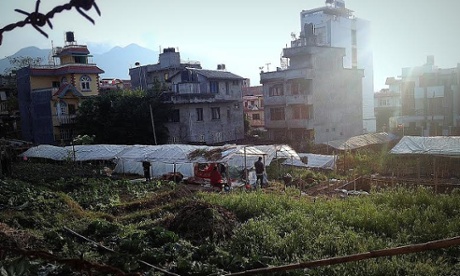
Some earthquake survivors have been forced to sleep rough in poly tunnels used for growing tomatoes in a south-west suburb of Kathmandu, writes Ishwar Rauniyar.
Updated
The Guardian’s Jason Burke has urged NGOs to try to reach some of the remote villages he reported from over the last three days after returning from close to the epicentre of the quake.
Any NGOs etc I have contacts for health worker in swarakoth, in sindhulpalchok. Be good to get aid in there. Jason.burke@theguardian.com
— Jason Burke (@burke_jason) April 30, 2015
He pointed out that the Swarathok, where all 71 homes were destroyed, had no aid deliveries.
“No one has come. I walked to the police post and told them we were here. They said there was no plan and they had no orders and told us to stay where we are and wait. So we are waiting,” health worker Rashmita Shashtra told Jason on Tuesday.
This village I reported on three days ago still not seen a single official, ngo etc. kid was sick when I was there. https://t.co/ARbOH9mTc7
— Jason Burke (@burke_jason) April 30, 2015
Jason, who provided a phone update on his trip earlier, urged the authorities not to neglect remote areas.
Back in Kathmandu after 2 days I ghorka. Big contrast. Capital much calmer. Danger of remote regions being forgotten by central govt.
— Jason Burke (@burke_jason) April 30, 2015
UN's Valerie Amos arrives in Nepal
The UN’s humanitarian chief Valerie Amos has arrived in Nepal to give her support to relief effort.
#EarthquakeNepal USG Valerie Amos meets the Search and Rescue Teams in Nepal. pic.twitter.com/svHlfTMZEX
— UN OCHA Asia Pacific (@OCHAAsiaPac) April 30, 2015
Amos is due to spend three days in Nepal to “show solidarity with the Nepalese people, raise the visibility of the crisis and assess the response operations,” a spokeswoman said.
Death toll nears 6,000
The death toll has increased to 5,693 according to Nepal’s National Emergency Operation Centre. It says a further 11,538 were injured.
Dead(5693);Injured(11538);
— EarthquakeNepal-MoHA (@NEoCOfficial) April 30, 2015
The manager of an orphanage in Bhaktapur, east of Kathmandu, says 40% of the city being destroyed but only one international organisations has come to help.
Writing for the Guardian’s Global development network Ramesh Prahananga says thre is mounting anger at the lack of help.
There are big organisations like Unicef, UNDP, and other international NGOs in Nepal, but still none have come to Bhaktapur. The people are very angry. It’s been five days and no one has come to us. One international NGO came with around 100 tents but the people needed around 10,000. They were so angry, violence was about to break out.
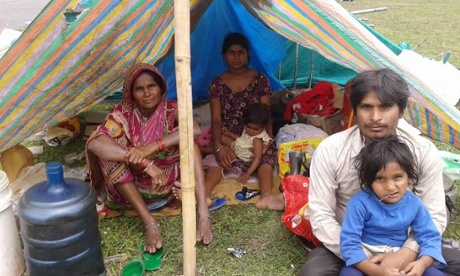
The number of people sleeping rough has decreased but tens of thousands of people still face a sixth night camping in the open, writes Ishwar Rauniyar.
They include Rajendra Mahato, a 26-year-old carpenter from India and his family who are camping out in Kathmandu’s Tudilkhel army parade ground.
He has been left homeless and jobless with nothing to help support his children and pregnant wife. The family’s rented flat was completely destroyed in the disaster.
“We only survived because we had gone to the cinema when the earthquake hit” he said.
The family has had no proper food and is living under a leaky tent. Gesturing to his wife Mahato said: “She is feeling uneasy living in such place, and these two toddlers they are not getting proper food and water.” One of his children has a fever.
Mahato added: “The Indian government has arranged a vehicle for us, but how can I go? All the belongings, money etc. are buried in the house.”
More than 130,000 homes destroyed
Nepal’s National Emergency Operation Centre has updated figures on the number of buildings damaged by the earthquake.
It said more than 10,000 government buildings had been totally destroyed, with another 13,502 partially damaged.
Its Twitter feed added that more 130,000 homes had been destroyed and a further 85,856 had been damaged.
This represents a significant increase on the initial estimates. In its $415m (£270m) urgent appeal the UN noted that the government initially said 70,000 homes had been destroyed.
Total number of totally affected public houses till now in recent earthquake = 130033
— EarthquakeNepal-MoHA (@NEoCOfficial) April 30, 2015
Here’s a Guardian-edited version of that CCTV footage showing the impact the earthquake made at a busy roundabout in Kathmandu.
Updated
Nepal’s Prime Minister Sushil Koirala, who was in Thailand when earthquake struck, only found out about the disaster via a tweet from his Indian counterpart Narendra Modi, according to the Times of India.
Modi told reporters that Koirala called to say that his tweet was his first source of information on the earthquake.
Here’s how Modi broke the news to Koirala.
News has come in about an Earthquake in Nepal. Several parts of India also experienced tremors.
— Narendra Modi (@narendramodi) April 25, 2015
Quartz India sums up the revelation like this: “The prime minister of a country of 28 million people only learned of a devastating earthquake at home more than 40 minutes after it hit—via Twitter.”
Relatives of those feared buried in the rubble with Pemba Lama are losing hope of finding their loved ones alive, writes Ishwar Rauniar in Kathmandu.
Kumar Khadka, 21, was waiting anxiously outside the collapsed building at New Bus Park, praying for “good news” of his wife and six-month-old daughter.
“My daughter and wife is buried under this guest house. I have lost my hope that they would be alive,” he said.
Kumar, who works as a driver, said: “My wife had come to visit me from home in Kavre district. After taking a tour of city I asked her to take lunch at the guest house while I drove on a job.”
“An hour later Kathmandu was hit by an earthquake, and took away my happiness,” he said.

Summary
Here’s a summary of the latest developments:
- A 15-year-old boy has been rescued from the rubble in Kathmandu after surviving for five days on jars of ghee. Pemba Lama was prised from the debris using a car jack.
- Hopes are dimming of finding more survivors after the body of another teenager was found near Pemba. He told rescuers he had been in communication with two others buried in the same debris before losing contact this morning.
- The death toll from Saturday’s earthquake has reached 5,630, according to figures from the ministry for home affairs. It said a further 7,879 people were injured.
- Heavy rain and aftershocks have added to the difficulty of getting aid to remote areas in Nepal, the Guardian’s Jason Burke reported after travelling to within 10 miles of the epicentre of the earthquake in Gorkha district. He said the main priority now was to help hundreds of thousands of people forced to sleep rough with little or no means of survival.
- The first British government flight back from Nepal has arrived in London, bringing 120 Britons home to emotional reunions with family and friends. Among those on board were children, older people and those chosen as a priority because of health conditions.
- The UN has launched a $415m (£270m) urgent appeal to help estimated 8 million people affected by the earthquake over the next three months. An estimate 2.8 million people have been displaced by the earthquake, it said.
AFP has confirmed that another teenager’s body has been pulled from the same ruins where Pemba Lama was rescued. Hopes appear to be dimming of finding any more survivors from the spot after Pemba had told his rescuers he had been speaking to other survivors this morning. AFP has more on the rescue:
Libby Weiss, a spokeswoman at the Israeli military-run hospital where Pemba was taken said: “He was under the rubble for 120 hours and it is certainly the longest we have heard anybody of being under the rubble and surviving.
“We understand he didn’t have any food and just two jars of ghee (clarified butter), which he had at the time he was under the rubble.
“He was triaged but, remarkably, speaking with us, fully conscious and was able to communicate and doesn’t have any major injuries or wounds. He is doing remarkably well.”
“The area was very narrow. We used our tools and dug him out. We asked ‘Is anyone inside?’ and we heard a ‘dhuk dhuk’ sound and kept searching,” L.B. Basnet, one of the Nepalese rescuers, told local television.
“He was behind a bike, we had to cut through it. And we pulled him out successfully. This was very good, very good.”
Joy at Pemba’s rescue however was tempered when the body of another teenager was found close to his.
“He (Pemba) told us he had been speaking to two other people until early this morning but after that he could no longer hear them,” said Narayan Thapa, an APF inspector.
This is the hole where 15-year-old Pemba Lama managed to survive for five days before being pulled alive from the rubble, according to the BBC Nick Garnett.
The hole where the boy was rescued in Kathmandu today @bbc5live pic.twitter.com/N1cyqrPkYr
— Nick Garnett (@nicholasgarnett) April 30, 2015
A Guardian gallery has more images from the rescue.
Updated
Death toll increases to 5,630
The death toll has reached 5,630 according to the Nepal news site My Republica, citing the ministry for home affairs.
It says a further 7,879 people are injured.
More extraordinary CCTV footage has emerged showing the moment the earthquake struck. This shows chaotic scenes at a busy crossroads in the Tripureshowr district of south-west Kathmandu, when the power of the earthquake bought down a temple-like structure in the middle of a roundabout.
ITV’s Dan Rivers who is also at the scene where Pemba was rescued, reports seeing rescuers pull another dead body from the rubble.
US rescue teams doing vital work - but grim scenes unfolding as another body recovered pic.twitter.com/4vB341D7mL
— Dan Rivers (@danieljerivers) April 30, 2015
A group of American rescuers together with Nepalese police and army personnel are trying to locate more survivors from the rubble of the building that buried survivor Pemba Lama, Ishwar Rauniyar reports from the scene.
Everyone is quiet, trying to hear any sound of the survivors. Three sniffer dogs are trying to pick up the scent of those trapped.
Pemba, who had been working at the guest house when it collapsed said, told rescuers he had been in conversation with two other survivors until 4am on Thursday morning.
Hundreds of people have gathered in the street hoping to see another successful rescue.
Updated
Heavy rain and aftershocks have added to the difficulty of getting aid to remote areas in Nepal, Jason Burke reports after travelling to within 10 miles of the epicentre of the earthquake in Gorkha district.
In a phone update from Nepal, he said the aid operation is “slow moving” because it so difficult to travel just a few miles on the roads. “The weather has been a real factor in slowing things down,” he said and recalled reaching one village by walking for an hour after the 4x4 vehicle he was travelling in was blocked by mudslides.
Tensions are beginning to rise, Jason confirmed. “There is a lot of frustration at the government ... There is increasing anger they feel abandoned by the government and are taking the matter into their own hands.” Local businessmen are donating rice, while others are trekking to Kathmandu for food, he reported.
Jason said the main priority now was to help hundreds of thousands of people forced to sleep rough with little or no means of survival. Many people are trying to camp out with nothing “not even a spoon, not even a bucket” he pointed out.
It is that basic, those people need basic survival equipment – a tarpaulin, a blanket, a foam mattress, a bag of rice, some kind of cooking utensils, a means of lighting fires, and they need medicine.

Extraordinary CCTV footage has emerged from Kathmandu of the moment the earthquake struck.
Others survivors buried with Pemba were shouting until Wednesday, he told the BBC’s Yogita Limaye.
Earlier we reported that rescue workers have resumed searching the building after Pemba told them two more people were buried with him.
Pemba tells me there were still people shouting out there until yesterday.
— Yogita Limaye (@yogital) April 30, 2015
Pemba told the BBC that he survived on ghee and water dripping from clothes.
There were two bottles of clarified butter (ghee) near him. Pemba ate that to survive.
— Yogita Limaye (@yogital) April 30, 2015
Pemba says he was shouting for days. Drank water dripping from wet clothes to survive.
— Yogita Limaye (@yogital) April 30, 2015
Doctors told Limaye that he is in good health.
Doctor tells me Pemba is in very good condition pic.twitter.com/GhqTc0OBrE
— Yogita Limaye (@yogital) April 30, 2015
She also reported that the army officer who pulled out Pemba was treated as a hero by cheering crowds.
Cheers went up. Officer who pulled him out was hoisted up by colleagues on their shoulders. Small moment of joy amidst this grave tragedy.
— Yogita Limaye (@yogital) April 30, 2015

Pemba managed to survive in a 50cm hole underneath 2m of rubble, according to the BBC’s Nick Garnett.
He was freed using a car jack that pushed up a sheet of metal Pemba had been stuck under, Garnett told BBC Radio 4’s Today Programme.

Updated
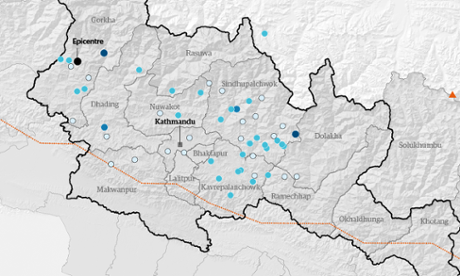
The Guardian’s graphics teams has put together a helpful guide to the extent and location of the earthquake damage and the humanitarian crisis it has prompted.
Updated
There’s been no more word on the rescue of a 11 year old girl in Bhaktapur.
Her survival may not have been quite as extraordinary as first appeared. Nepal Times editor Kunda Dixit said she had been trapped under the rubble for almost four days. But the Nepalese Army released an image of her which carried Sunday’s date.
Two more people trapped in rubble, survivor says
Two more people are trapped in the rubble, 15-year-old earthquake survivor told his rescuers, writes Ishwar Rauniyar from the Nepalese capital.
About 30 minutes ago Pemba Lama was rescued alive from a Guest House in Gongabu, Kathmandu, after being trapped since Saturday.
The rescue teams have resumed searching the rubble after Pemba told them two more people were still alive inside the rubble of guest house.
The Armed Police Force, American Rescue Team and Team of Nepal Army have launched another search in the area.
Police Force spokesman Narayan Thapa said: “It took around six hours to rescue him.”
Thapa said the police were were trying to get inside a collapsed buildings when they heard noises.
“Our team were clearing the way and recovering dead bodies, and they heard some voices from inside and launched search and rescue,” said Thapa.

The first images are emerging of Pema Lama the 15-year-old boy who was pulled from the rubble in Kathmandu five days after the earthquake.

AP reports:
Crowds cheered as a teenage boy was pulled, dazed and dusty, from the wreckage of a seven-story Kathmandu building that collapsed around him five days ago when an enormous earthquake shook Nepal.
The boy was carried out in a stretcher. His face was covered in dust, and medics had put an IV drop into his arm. A blue brace had been placed around his neck. He appeared stunned, and his eyes blinked in the sunlight.
Two children saved from the rubble
That boy in Kathmandu has been pulled out alive, while a girl in Bhaktapur has also been rescued.
AP reports:
A teenage boy has been pulled out from the rubble of a Kathmandu building five days after the earthquake.
Waiting crowds roared and cheered as the boy was carried out in a stretcher. His face was covered in dust, and medics had put an IV drop into his arm. A blue brace had been placed around his neck. He appeared stunned, and his eyes blinked in the sunlight.
Meanwhile, a 11-year-old girl has been rescued alive in Bhaktapur, according Kunda Dixit, editor of the Nepal Times.
Girl, 11, rescued from Bhaktapur Dattatreya Sq after 90 hrs under rubble by Nepal Army. #NepalQuake pic.twitter.com/AAb9EmLnv7
— Kunda Dixit (@kundadixit) April 30, 2015
While we wait for more news on the attempts reach the the boy in Kathmandu, let’s hope it ends like this.
Guardian video shows the rescue of an elderly woman in Bhaktapur, east of the capital.
It took the rescue crew almost 40 minutes to dig her out. Despite minor injuries and shock, she is recovering well, according to aid workers
Rescuers try to save boy
Rescuers in Kathmandu are trying to reach a 15-year-old boy buried under the rubble and apparently still alive five days after the earthquake.
USAID team leader Andrew Olvera says: “We have lights, we have generators, we have heavy breaching equipment, jackhammers, and we’re trying to get him out.”
He says the boy is not too far down, but the floors have collapsed and “he’s pancaked between them.”
The team has dropped medical supplies and IV fluid to team members who went down inside, including a U.S. firefighter medic who is part of the team. It’s unclear if the boy was able to receive them, AP reports.
The team also stuck a rotatable camera on a pole into the hole to see how best to get him out. Olvera says it looks like it used to be a seven-story building with concrete slabs hanging down.
Happening now: #USAID aiding in rescue of boy still trapped in rubble in #Kathmandu. #NepalEarthquake pic.twitter.com/tXAH966PXU
— Moni Basu (@MbasuCNN) April 30, 2015
Hope amidst despair. 15 year old boy possible still alive after 120 hours under the rubble. Frantic efforts to pull him out.
— Yogita Limaye (@yogital) April 30, 2015
Hopes had been fading of finding any more survivors. On Wednesday the Nepalese authorities turned away international offers of dispatching more search and rescue teams.
There are at 37 teams on the ground with more than 500 rescuers and their sniffer dogs.
The UN’s $415m (£270m) urgent appeal launched on Wednesday pointed out that only 14 people were known to have been rescued from beneath the rubble at the time its assessment was drawn up.
AFP also has an update on the situation at Mount Everest. Remarkably the tourism minister for Nepal has declared that climbing will continue from next week despite the earthquake. Here’s some of that report:
Saturday’s avalanche that ripped through base camp also destroyed ladders through the treacherous Khumbu icefall higher up the mountain, raising doubts about the future of this year’s climbing season.
But tourism department chief Tulsi Gautam advised climbers against abandoning their expeditions, saying repairs were under way.
“The ladders will be repaired in the next two to three days and climbing will continue, there is no reason for anyone to quit their expedition,” Gautam told AFP.
Some 800 climbers were on the mountain when the avalanche roared through base camp, leaving 18 people dead and scores injured.
The avalanche was triggered by a massive earthquake that has devastated Nepal and left more than 5,500 people dead.
Emergency teams using helicopters evacuated the most seriously injured from base camp, while scores trapped higher up Everest were also rescued.
But Gautam said the government has this week held talks with mountaineers and guides who said they were keen to resume climbing.
“There is no scientific reason to expect another quake... and we feel the ground is stable enough for climbing despite aftershocks,” he said.
On that theme of how difficult it has been for the rescue teams involved in the Nepal earthquake disaster AFP tweets this out:
#UPDATE: Nepal toll rises as relief teams face five-day trek to deliver quake aid http://t.co/68PDihS8T1 pic.twitter.com/sbjrUIJz5k
— Agence France-Presse (@AFP) April 30, 2015
In some parts the rescue phase is now over:
Search and rescue operation has ended in #Kathmandu's historic Darbar square - the clean up begins #NepalEarthquake pic.twitter.com/WpLFjRG7Xh
— Yalda Hakim (@BBCYaldaHakim) April 30, 2015
Reuters has just filed its latest story from the capital. It makes for grim reading with the weather now adding to the problems that rescue and relief workers are facing.
While rescue teams were out in the capital Kathmandu despite the rain, helicopters could not fly to the worst-hit areas in the countryside of the impoverished Himalayan nation.
“There may not be any more survivors,” said Rameshwor Dandal, chief of the disaster management centre at Nepal’s home ministry.
“The rain is adding to the problems. Nature seems to be against us.”
Ishwar Rauniyar adds to his previous reporting from Kathmandu:
The city today is little calm and with less movement of people even as thousands are still leaving Kathmandu valley.
“It’s been five days since we have been living in open space, in Bhaktapur, but no one came to help us so I am planning to go back to my home in Sunsari district in the eastern Nepal,” said Rajendra Yadav,39, who was getting bus ticket.
“I along with my wife and three children are leaving today.”
Sukhimaya Magar, 46, a vegetable seller, said: “We are finding difficulty leading our daily lives, everything we had is buried inside the house.”
A single mother Magar added: “I cannot even go to my village, as there is no one there.”
Sudarshan Satyal, 36, from Kavre district had come to Kathmandu looking for support as relief had not yet reached his village.
“Everyone at my village near Panchkhal is living under the open space with less access to water and food,” he said. “I came here for support but am returning empty hand. I couldn’t even buy any tents as they seem not available in the market.”
Sambhu Dahal, President of Purwanchal University College Association of Nepal, who is voluntarily managing the buses said:
“There was a chaotic situation yesterday, as we lacked proper coordination, but things are alright today.”
According to him more than 100 “free of cost buses” provided by the government have already left this morning.
“We have more 200 buses in the loop that will leave today to various parts of the country,” he said. “We distributed 5000 coupons yesterday, from tomorrow we do not have any free vehicles.”
AFP reports that a group of trekkers has been rescued from the Gorkha valley after they built a 3-metre “help” sign to attract attention:
As the helicopter swooped over Nepal’s lush Gorkha Valley in search of earthquake survivors, the 10-foot ‘HELP!’ sign spelled out by a desperate group of foreign trekkers couldn’t fail to grab the pilot’s attention.
“Thank God you’ve come!” said 31-year-old Julia Strelcoua after the Indian military helicopter landed in a clearing and then whisked her and fellow trekkers to safety in the adventure sports hub of Pokhara.
Strelcoua was part of a group of around a dozen mainly Slovakian trekkers who were enjoying the stunning views of central Nepal’s tranquil Gorkha district when a 7.8-magnitude quake tore through the ground on Saturday.
While they were uninjured, many nearby villages were devastated, with their flimsy brick huts and wooden shacks unable to withstand the impact of the tremors.
“Rocks and rubble tumbled down, it was the most horrifying experience,” Strelcoua told AFP. “We walked around looking for help and we found villages completely destroyed, dead people laying around.
“The sight of dead animals … they were just rotting, the smell, I can’t even describe,” added Strelcoua.
Unnerved by the aftershocks and with communications down, the group decided to stay put rather than try to carry on with the planned trek for fear that their path would be blocked by rockfalls or landslides.
“Four days we were just stuck. No signal, no communication,” said Strelcoua.
“We didn’t know if anybody would find us. What if we were stuck there for weeks or months? It was so scary. I can’t begin to tell you how I feel right now.”
Updated

The total purse this week is $A1.62m, with the winner to receive $A243,400.
World number one Ko told journalists ahead of the North Texas Shootout that she wanted to help victims, saying the disaster had had an impact on her:
We had a big one in New Zealand, too, a couple years ago [in Christchurch], and it affected a lot of people.
Natural disasters you can’t do much about. Sometimes it’s hard to be prepared for it, so I thought, those people there, nice people and very innocent, I wanted to give this tournament’s earnings and donate it to them.
Updated
'No one has come to help us'
Ishwar Rauniyar, who is working for the Guardian in Nepal, reports that many people are still awaiting aid:
At a time when the government is saying they have sent relief packages to almost every parts of affected area, this morning I received a call from Swarathok in the remote district of Sindhupalchowk, which has been left devastated by the earthquake, saying “no aid agencies or government has appeared to help them”.
Rasmita Shrestha said: “No one has come to help us. There is not even a single house standing out of 71 houses in the village.”
She added: “We are in dire need of support: there is no water, no food, no shelter and even the dead animals are smelling badly. The local police is not coordinating us.”
It is the same story in Badal Gaon in Kavre district, where Shiva Hari Khatri says: “We are left nowhere, how can we get the support?
“Millions of aid is coming to Nepal but we don’t have a tent to hide our heads.”
Around 120 British nationals who were in Nepal when the earthquake struck have just arrived back at London’s Stansted airport on a UK aid flight that had delivered relief supplies to Kathmandu.
The youngest is a four-year-old child.
Cheers and tears as as families of first evacuated arrive home @GMB pic.twitter.com/eamQazFWXh
— Lee Hannon (@LeeITV) April 30, 2015
Up to 200 other British nationals remain in the British embassy in Kathmandu.
On Wednesday evening, Philip Hammond, the UK foreign secretary, confirmed that one British dual national, a resident of Hong Kong, had died in the disaster.
More than a dozen Britons remain trapped in the Langtang valley, a popular trekking spot north of Kathmandu, Nepal’s capital, according to some who have been able to get in touch with their families. But relatives say the FCO has done nothing to help them.
Hammond said:
We know that this is an agonising time for those who are waiting for news of loved ones. But the scale of the disaster and the limited communications means that it may be some time before we can account for everyone.
Many are likely to be in a place of safety but not able to communicate easily.
Updated
Death toll reaches 5,500
Police in Nepal say the death toll from Saturday’s earthquake has topped 5,500.
The UN World Food Programme (WFP) has warned that it will take time for food and other supplies to reach more remote communities that have been cut off by landslides.
The programme’s Geoff Pinnock, who is coordinating aid flights, said:
More helicopters, more personnel and certainly more relief supplies, including medical teams, shelter, tents, water and sanitation and food, are obviously needed.
He said the relief effort would need to continue for months.
The WFP says it is concentrating its efforts on priority areas outside Kathmandu, including Gorkha, Lamjung, Sindhupalchowk, Rasuwa, Nuwakot, Dhading, Dolakha, Ramechhapp, Kavre, Bhakapur and Lalitpur.
Why is aid moving so slowly?
Part of the problem is the sheer scale of devastation: more than 8 million people have been affected by the earthquake and its aftermath, with the UN estimating that 1.4 million people are currently in need of food assistance.
As Jason Burke reports, transporting the aid to those who need it is also a major hurdle:
A series of bottlenecks is slowing the entry of aid into the country. Nepal’s sole international airport, in Kathmandu, is massively congested. Though some major NGOs had stockpiles of basic non-perishable items in Nepal before the quake, the poor country’s inadequate road system has posed huge problems even in areas that emerged relatively unscathed from the quake.
The problems were made even worse on Wednesday by a mass exodus from Kathmandu. Tens of thousands crowded on to buses to leave the city, driven by the prospect of further earthquakes, epidemics and a breakdown in law and order.
By 8am, more than 300 packed buses and coaches had passed the checkpoint on the main western highway out of the city, officials stationed there said, nearly 10 times the usual number.
Most were heading for distant regions where the family homes of many Kathmandu residents were located. One official said the total number of those leaving the city since Tuesday could reach 300,000, more than a tenth of the city’s total population. “They keep coming, I’ve never seen it like this,” said sub-inspector Tara Bhattrai, in charge of the Thankot checkpoint. “They are going to all destinations.”
Supplies are running thin and aftershocks have strained nerves in the city. Many of those travelling appeared in a state of near panic.
Associated Press reports that China has closed all climbing on its side of Mount Everest for the rest of the spring:
Hundreds of climbers and Sherpas who were attempting to climb Mount Everest from the north side when the earthquake struck the region are packing their gear and heading out after expedition leaders said Chinese authorities had closed all climbing in Tibet for the spring.
Meanwhile, some climbers in Nepal have announced plans to try to return to the mountain, a move that was criticised by others in the climbing community.
In Tibet, climbing guide Adrian Ballinger, with California-based Alpenglow Expeditions, said on Wednesday that they were working to leave the country soon.
“We are focusing our efforts on how we can help in Nepal, how we can get our members home, and how we can get our Sherpa team back to the Khumbu,” said Ballinger, who was leading a team of 10 climbers and 12 Sherpas.
No one climbing on the north side was injured following Saturday’s deadly quake, but Ballinger said the China Tibet Mountaineering Association called back the 25 teams, made up of about 300 climbers, to base camp to discuss whether to allow them to continue.
On Wednesday, Chinese officials held their final meeting and announced their decision to end the climbing season. Ballinger said two reasons were cited: safety concerns over possible additional earthquakes and solidarity with Nepal and the Sherpas. “China believes Sherpas should be able to go home and begin rebuilding,” he said.

Nineteen people were killed in the base camp on the Nepal side of the mountain when a quake-triggered avalanche swept through.
In Nepal, some climbers have received permission to try again for the summit. Russell Brice, leading a team for the London-based Himalayan Experience Limited, posted a blog saying they are considering a return to Everest. “Our Himex team will stay at Everest BC for the next few days and we will then decide if we will continue or not,” he said.
Brice said he met with the Nepal Mountaineering Association and the Minister of the Ministry of Tourism on Wednesday and received permission to fly loads to Camp 1 after helicopters were free from rescue operations.
Longtime mountain guide Peter Athans of Washington state, who has summited Everest seven times, called the idea disrespectful. “Ethically, it’s neither climbing the route and neither is it very respectful to the suffering of the Nepalese who need heli support immediately,” Athans said. “The climbers would be diverting this critical resource at a dire moment in the crisis.”
Ballinger also said the resources should be used on earthquake victims: “My thought is expedition teams on the ground in Nepal guides, doctors, Sherpas could be using their skills and strength for far better purposes.”
This graphic shows the zone affected by Saturday’s quake. Close to the epicentre is Gorkha, to where the Guardian’s Jason Burke travelled this week. You can read his dispatch here.
In neighbouring India 61 people were killed and China’s official Xinhua News Agency said 25 people had died in Tibet.
Eighteen others were killed in avalanches on Mount Everest.
Updated
Opening summary
Five days after the devastating 7.9 magnitude earthquake that struck Nepal, killing more than 5,000 people and injuring at least 100,000, many survivors – particularly those in more remote areas – have still yet to receive emergency aid.
Despite stories of incredible survival – a four-month-old baby pulled from the rubble of his family house in the town of Bhaktapur; a man rescued after being trapped for 82 hours – hopes are fading that more people will be found alive amid the ruins.
Anger erupted in Kathmandu on Wednesday over what many see as the slow pace of relief efforts to the stricken country. Protesters blocked traffic, with one saying:
We are hungry, we haven’t had anything to drink. We haven’t been able to sleep.
I have a seven-year-old child who is sleeping in the open. It’s getting cold and people are getting pneumonia.
Thousands of people attempted to flee the capital as supplies ran low.
But conditions in many places beyond the city are also dire. The Guardian’s Jason Burke, who has travelled to the remote Gorkha district near the border with Tibet, reports:
Officials and relief workers are desperately seeking information on about 10,000 people living in the northernmost areas of Gorkha district, where the epicentre of Saturday’s earthquake was located.
Nothing is known of the condition of villagers in these remote and mountainous areas near the frontier with Tibet, but up to 90% of buildings in nearby areas a similar distance from the epicentre have been destroyed or rendered uninhabitable.
The UN has launched a $415m appeal to help the estimated 8 million people affected by the earthquake.
This live blog will have updates throughout the day as aid and rescue efforts continue.