- The death toll from the 7.9 magnitude earthquake that struck Nepal on Saturday has risen to more than 2,500. More than 5,000 people have been injured. Powerful aftershocks today between Kathmandu and Everest unleashed more avalanches in the Himalayas and caused panic in the capital, where hospital workers stretchered patients out into the street as it was too dangerous treat them indoors.
- At least 17 people believed to have been killed on Everest, and 61 injured, by an avalanche which left mountaineers calling for helicopter assistance to evacuate the most badly wounded.
- The UK government has announced that it will donate £5m to help the rescue effort in Nepal.
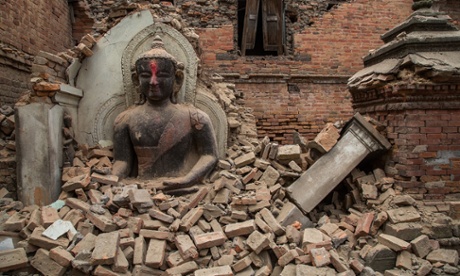
- A state of emergency has been declared Many historic landmarks, including the Dharahara tower, have been reduced to rubble following the quake.
- Governments are scrambling to locate thousands of their nationals and relatives took to social media to find their loved ones.
- The international community has also pledged support and aid packages to Nepal. The US secretary of state, John Kerry, has said the US will pledge $1m to the aid effort and will also assist with a disaster response team. Australia has also pledged a Aus$5m aid package, while India, Sri Lanka, the UK, China and others are all sending disaster response teams to assist in search and rescue.
- Pope Francis led prayers in St Peter’s Square for the dead, displaced and injured in Nepal and surrounding areas.
- Weather reports suggested that survivors of the quake - who are sleeping outside because of fear of unsafe building - will face heavy downpours in the next week.
- The quakes caused widespread damage to Nepal’s infrastructure which has further hampered search and rescue operations. Injured climbers at Mount Everest, where an avalanche struck following the quake, have been flown by helicopter to receive medical treatment.
The official number of dead from Saturday’s Himalayan earthquake has topped 2,500 and may continue to rise as remote areas near the epicenter are searched, according to the Associated Press.
Nepal authorities said Sunday that at least 2,430 people in that country had died in Nepal alone, not including the 18 people that the Nepal Mountaineering Association says died in an earthquake-triggered avalanche on Mount Everest. Another 61 people died from the quake in India and a few in other neighboring countries.
With search and rescue efforts far from over, it was unclear how much the death toll would rise.
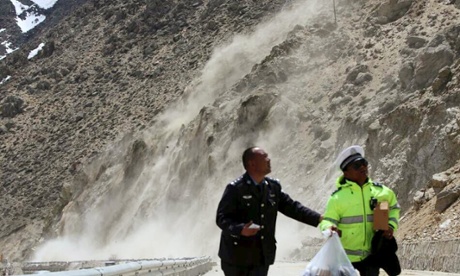
Some shocking CCTV footage, which shows the moment aftershocks hit in Tibet after Nepal earthquake.
Devastating Nepal quake kills over 1,000 http://t.co/6RXvxUJppB (Photo: Reuters) pic.twitter.com/Qz3yl9zNiy
— ABS-CBN News (@ABSCBNNews) April 25, 2015
Reuters have this report on how doctors are having to operate on injured victims of the quake in the streets because of fear of reentering unsafe buildings:
Overwhelmed doctors moved hundreds of patients onto the streets of Nepal’s capital on Sunday when aftershocks rattled hospitals and buildings already damaged by an earthquake that killed more than 2,400 people and devastated Kathmandu valley.
Sick and wounded people lay on a dusty road outside Kathmandu Medical College while hospital workers carried more patients out of the building on stretchers and sacks.
Doctors set up an operating theatre inside a tent and rushed in the most critical, following a particularly big tremor that sent people running terrified into the streets.
The aftershock, itself a strong 6.7 magnitude quake, triggered more avalanches in the Himalayas after Saturday’s 7.9 quake - which unleashed Everest’s worst disaster and was the strongest since 1934 when 8,500 people were killed.
Outside the National Trauma Centre in Kathmandu, patients in wheelchairs who had been under treatment before the earthquake hit joined hundreds of injured with fractured and bloody limbs, who lay inside tents made from hospital sheets.
“We only have one operation theatre here. To be able to provide immediate treatment we require 15 theatres. I am just not able to cope,” said Dipendra Pandey, an orthopaedic surgeon, adding he had done 36 critical operations since Saturday.
Relief agencies and officials said most hospitals were overflowing and short on medical supplies.
“Both private and government hospitals have run out of space and are treating patients outside, in the open,” said Nepal’s envoy to India, Deep Kumar Upadhyay.
Neighbouring countries sent in military transport planes laden with medical supplies, food and water. But little sign of organised relief efforts was visible as aid agencies struggled to fly helicopters in cloudy weather, aftershocks forced the intermittent closure of Kathmandu airport and roads were blocked by landslides.
The extent of the damage around the epicentre, near Gorkha in the western highlands, had still not been fully assessed.
Patchy mobile telephone and email communication added to the slow progress of relief as Asia’s poorest country reeled from its worst earthquake in eight decades.
As rescuers dug with their hands through the rubble of brick buildings in crowded Kathmandu, thousands of survivors prepared to spend a second rainy night outside because they were afraid of going back to damaged homes.
Dfid have issued a new press release with details of the aid that will be given to Nepal to help the rescue operation.
The Department for International Development has activated its rapid funding mechanism for charities and partners on the ground dealing with the aftermath of the Nepal earthquake, International Development Secretary Justine Greening announced today.
This is part of a new £5 million package of UK support in response to the Nepal earthquake which includes:
•£3 million released under the Rapid Response Facility (RRF) so partners can address immediate needs on the ground; and
•£2 million for the British Red Cross.
UK Government officials in Kathmandu and London are providing consular assistance to British nationals who have been caught up in this disaster and the Foreign Office has opened a crisis hotline for those concerned about friends or family. Britain is also sending Rapid Deployment Teams to provide assistance to British nationals.
Justine Greening said:
“As the death toll rises and the scale of this devastating earthquake becomes evident, the UK is continuing to do everything it can to help all those affected by this tragedy.
“I have now activated the Rapid Response Facility. This means we can fast track funding to aid workers on the ground so they can provide desperately needed supplies including clean water, shelter, household items and blankets. We are also sending humanitarian experts from the UK to provide urgent support on the ground.
“Meanwhile UK Government officials in Kathmandu and London continue to provide assistance to British nationals who have been caught up in this disaster. We will continue to do everything we can to help all those affected.”
My colleague Jason Burke has been tweeting from the scene at Kathmandu
Power out in much of #kathmandu but most people cheerful, scared and cooking dinner in gardens, streets, anywhere but inside. #quake
— Jason Burke (@burke_jason) April 26, 2015
Saddest story of day: three girls playing cricket outside home. Buried in seconds, mother too. Dad survived no one knows whereabouts. #quake
— Jason Burke (@burke_jason) April 26, 2015
He’s been speaking to officials in the Ghorka district, close to the epicentre, who say at the moment they only have two helicopters out for rescue operations.
Officials in ghorka district close to epicentre tell me half houses destroyed. Have got two helicopters up for rescue. That's all.
— Jason Burke (@burke_jason) April 26, 2015
UK announce £5m funding for Nepal relief effort
International Development Secretary Justine #Greening announces £5m in UK funding to contribute towards relief effort #NepalEarthquake
— Sky News Newsdesk (@SkyNewsBreak) April 26, 2015
Justine #Greening says the UK has deployed a team of humanitarian experts to #Nepal to provide support for those affected by the #earthquake
— Sky News Newsdesk (@SkyNewsBreak) April 25, 2015
NEWS: UK sends humanitarian support for those affected by #Nepal earthquake http://t.co/zdS4F6UxGM
— DFID (@DFID_UK) April 25, 2015
Dfid news release on humanitarian support:
The UK has deployed a team of humanitarian experts to Nepal to provide urgent humanitarian support for people affected by the earthquake, International Development Secretary Justine Greening announced today.
The eight-strong team of disaster response specialists, which includes experts in search and rescue, will travel to Nepal overnight tonight and begin work tomorrow assessing the scale of the damage and helping the Nepalese authorities direct the humanitarian response.
Justine Greening said:
My thoughts are with the people of Nepal, in particular all those who have lost loved ones. The absolute priority must be to reach people who are trapped and injured, and provide shelter and protection to those who have lost their homes.
Nepal needs our urgent humanitarian assistance. That is why we have rapidly deployed a team of humanitarian experts who will immediately begin work assessing the damage and helping the Nepalese authorities respond to this devastating earthquake.
Updated
Reader Thirdness, whose daughter is in Lhasa, has asked if there is any information from Tibet.
This report from DNAIndia gives a few details, but not much.
Death toll in southwest China’s Tibet Autonomous Region has risen to 17 in the wake of the devastating earthquake that hit neighbouring Nepal on Saturday, while the Communist giant on Sunday dispatched a 62-member search and rescue team to help the Himalayan nation.
Nearly 1,500 people, including two Indians, have died in Nepal and hundreds are feared missing, after a 7.9-magnitude earthquake tore through that country flattening houses and buildings including the iconic Dharhara tower and landmark Darbar Square in the heart of its capital. The death toll in Tibet has climbed to 17 after the powerful earthquake struck neighbouring Nepal, local authorities said today.
Meanwhile a 62-member search and rescue team has left for Nepal to carry out humanitarian rescue there. With six sniffer dogs and relevant rescue and medical equipment, the team is expected to arrive in Kathmandu midday today on a chartered plane, the China Earthquake Administration said. Of the rescuers, 40 are from the 38th Group Army of the People’s Liberation Army, Beijing Military Area Command.
Twenty percent of the experienced rescuers have participated in international rescue missions.
Chinese President Xi Jinping yesterday sent a message of condolence to Nepalese President Ram Baran Yadav over the disastrous earthquake, worse in over 80 years of Nepal’s recorded history. On behalf of the Chinese government and people, as well as in his own name, Xi offered his deep condolences to the victims in the earthquake, and offered sincere sympathies to those injured as well as to the families of the victims.
In his message, the Chinese president also expressed his confidence in the Nepalese government, under the leadership of Yadav, to combat the disaster and China’s willingness to provide all necessary assistance. In Tibet the quake also damaged buildings and roads and cut off telecommunications in the two counties and several neighbouring regions. So far, roads leading to the two counties have been cleared, but rescue efforts are hampered by heavy snow in the area.
The temblor damaged several temples in Tibet’s border area, but no casualties have been reported from there so far. Chen Quanguo, Communist Party of China chief of Tibet, has ordered to evacuate people in the quake-hit regions to avoid further deaths and injuries from aftershocks and secondary disasters. About 600 border guards are currently involved in the rescue operation in Nyalam and Gyirong.
A total of 3,204 firefighters and 87 sniffer dogs from Tibet and neighbouring provinces have also been readied to go to the quake-struck areas as a reinforcement. The authorities are sending tents, quilts, clothes, medicine and bottled water to the regions.
This from reader Shashank Suman BTL about the Indian government’s efforts to help the rescue operation:
As part of the nation’s overall relief effort for Nepal, the Indian Army has launched Operation Maitri.
A Multi National Coordination Centre has been set up. In addition, in PPO Pokhra, Head quarters are being established for relief operations.
The following resources have been allocated so far as part of Operation Maitri, in support of the Nepalese Army’s relief effort:-
(a) 18 Medical Teams earmarked. Six Medical Teams have reached and have been deployed while the rest are on standby.
(b) 10 Engineer Task Forces(ETFs) consisting of manpower, skid steers and JCBs (One partial ETF has landed with stores. Balance are on standby in India).
(c) 10,000 blankets and 1,000 tents are on standby.
(d) 10 INMARSATs for satellite communications have reached Nepal.
Aviation assets of five ALH helicopters and two Cheetah helicopters have been staged forward to Gorakhpur.
“Further, taking cognizance of the request of the Nepalese Government for Oxygen on account of problems in the Kathmandu Oxygen plant, additional cylinders are being dispatched (300 located at Bengdubi for dispatch to Nepal),” read a statement.
Indian Army Everest Expedition was training at Base Camp when the Earth Quake struck. Their equipment was buried in the avalanche, however the team is safe and helped in recovery of dead bodies of other foreign climbers.
“19 dead bodies and 61 injured persons were rescued by the Indian Army Expedition Team,” read the statement
The Medical Officer has treated a number of injured international mountaineers.
New footage from Kathmandu shows the aftermath of Saturday’s magnitude 7.9 earthquake with houses toppled and multi-storey apartments reduced to rubble.
Updated
Debt-relief campaigners Jubilee USA Network have sent an interesting press release, pointing out that Nepal could qualify for assistance from the International Monetary Fund’s (IMF) new Catastrophe Containment and Relief Trust (CCR).
“Nepal could qualify for immediate relief,” said Eric LeCompte, executive director of Jubilee USA Network. “Nepal’s earthquake is why the International Monetary Fund created a new rapid response relief fund.”
The IMF created the CCR in February to provide debt relief to poor countries impacted by natural disasters or health crises. The new fund canceled nearly $100 million in debt for Ebola-impacted countries. In order to qualify for relief from the new fund after a natural disaster, a country must meet certain criteria. The disaster must destroy more than 25% of the country’s “productive capacity,” impact one third of its people or cause damage greater than the size of the country’s economy. It is not yet known if Nepal will qualify. Nepal owes the IMF $54 million, with $10 million due in 2015 and nearly $13 million due in 2016.
We have an updated story from our correspondents on the ground in Nepal.
A strong aftershock has caused panic and frustrated frantic efforts to reach possible survivors of Saturday’s earthquake in Nepal, as the death toll rose to 2,152 and the government declared a state of emergency.
Officials in the Himalayan country said they expected the number of dead and injured to rise again, while emergency supplies began to trickle in to affected areas after several countries pledged millions of dollars in desperately needed aid and sent in search and rescue teams.
More than 5,000 people were injured after the magnitude 7.9 earthquake struck late on Saturday morning. Local authorities said all but a few dozen of the deaths occurred in Nepal, and that at least 721 people had died in the Nepalese capital Kathmandu alone.
Dozens of aftershocks, including a powerful temblor on Sunday afternoon, have jolted Nepal over the weekend, forcing thousands of people to shelter where they can.
Nepalese authorities continually revised the number of dead upwards a day after the earthquake wrecked houses, flattened centuries-old temples and triggered avalanches on Mount Everest.
On Sunday afternoon, climbers left stranded by initial avalanches on Everest were again in fear for their lives after a magnitude 6.7 aftershock triggered more avalanches. It also sent terrified residents running into the streets in Kathmandu.
“Another one, we have an aftershock right now. Oh shit!” said Indian climber Arjun Vajpai over the phone from Makalu base camp near Everest. “Avalanche!” he shouted. Screams and the sound of snow cascading down the mountainside could be heard over the line as he spoke.
The aftershock was the most powerful since the initial earthquake – itself the strongest since Nepal’s worst earthquake, in 1934, in which 8,500 people died.
Gregory Katz and Seth Borenstein of the Associated Press have done a useful summary of key information about the earthquake in Nepal.
Casualties and Damage
Indications suggest the death toll across four countries is likely to rise substantially in the coming days. The magnitude-7.8 quake was the worst to hit Nepal in eight decades and caused damage and fatalities in neighboring countries. In addition to more than 2,100 people killed in Nepal, a total of at least 61 died in India, Bangladesh, China’s region of Tibet and Pakistan.
The earthquake hit a heavily populated area of Nepal, including the capital, Kathmandu where at least 721 people died and its impact spread far beyond the Kathmandu Valley. Strong aftershocks were still being felt Sunday, including one with a magnitude of 6.7.
Local hospitals were filling with injured residents, and Kathmandu’s international airport was shut down for hours, hampering initial relief efforts in the isolated mountainous country.
Among the destroyed buildings in Kathmandu was the nine-story Dharahara Tower, a landmark built by Nepal’s royal rulers as a watchtower in the 1800s and a UNESCO-recognized historical monument. It was reduced to rubble and there were reports of people trapped underneath.
___
Aid efforts
With Kathmandu’s airport reopened Sunday, the first aid flights began delivering supplies. The first to respond were Nepal’s neighbors India, China and Pakistan.
Indian air force planes landed with 43 tons of relief material, including tents and food, and nearly 200 rescuers, India’s External Affairs Ministry spokesman Vikas Swarup said. The planes were returning to New Delhi with Indian nationals stranded in Kathmandu. More aid flights were planned for Sunday.
A 62-member Chinese search and rescue team also arrived Sunday. Other countries sending support included the United Arab Emirates, Germany and France.
Pakistan prepared to send four C-130 aircraft, carrying a 30-bed temporary hospital comprising army doctors, surgeons and specialists. An urban search and rescue team was also sent with ground-penetrating radars, concrete cutters and sniffing dogs. Pakistan was also sending 2,000 ready-to-eat meal packs, water bottles, medicines, 200 tents, 600 blankets and other necessary items.
___
Mount Everest situation
A devastating avalanche swept across Mount Everest after the quake, killing at least 17 people and injuring dozens.
The first group of survivors from the avalanche were flown to Kathmandu on Sunday and taken to hospitals. None appeared to have life-threatening injuries.
The avalanche struck near one of the famed mountain’s most dangerous spots. It swept down between the Khumbu Icefall, known for its harsh conditions, and the base camp used by international climbing expeditions.
There were unverified reports of avalanches on other parts of the mountain.
Facebook postings by climbers suggested that some people may have been buried in their tents when the avalanche hit. Climbers and their support teams were leaving the base camp Saturday looking for safer locations.
___
What happened? And what happens next?
U.S. Geological Survey seismologist Paul Earle said the quake happened on what is known as a “thrust fault.” That describes the situation when one piece of the Earth’s crust is moving beneath another piece.
In this case, it’s the Indian plate that is moving north at 45 millimeters (1.7 inches) a year under the Eurasian plate to the north, Earle said. It’s a different type of earthquake than the one that caused the 1906 San Francisco earthquake.
“This is what builds the Himalayan mountain range,” Earle said.
The region and particular fault has a history of damaging earthquakes, including four temblors with magnitudes greater than 6.0 in the past 100 years, Earle said, warning that landslides are a particular worry now, given the steep slopes in the region.
___
How prepared is Nepal to cope with such a situation?
Nepal is a relatively poor country without extensive resources despites its rich cultural heritage and spectacular mountain scenery.
It has been plagued by instability in recent years, and general strikes have recently brought chaotic scenes to Kathmandu.
Nepal’s constitution was supposed to have been written by the Constituent Assembly that was elected in 2008, following the end of a 10-year Maoist insurgency and the overthrow of the centuries-old monarchy, but the assembly was hampered by infighting and never finished its work.
The current assembly was chosen in 2013, but has faced the same problem.
Neighboring Pakistan has offered help, and an international aid effort is likely to begin once Kathmandu’s international airport can be reopened.
My colleague Pete Pattison has sent in this report:
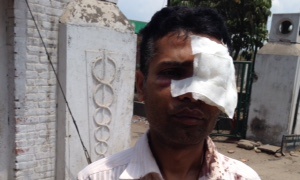
The Guardian spoke to Rupak Aryal as he was discharged from Bir Hospital, splattered in dried blood and with a large bandage over his eye:
“When the earthquake struck, I was building shook and I was so afraid... It was shaking vertically and horizontally... I couldn’t think properly and I just jumped out of the window. It was maybe 20 feet high.
Soldiers picked me up and brought me to this hospital. The doctors found I was wounded in my eye and foot. It was totally terrible. My mother says I am lucky to be alive.
Many people are going to die and even those who survive may be injured for life.”
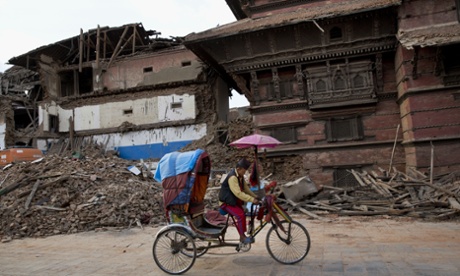
My colleague Ishwar Rauniyar has sent these pictures showing the destruction at Durbar Square Bhaktapur, the in eastern corner of the Kathmandu Valley.
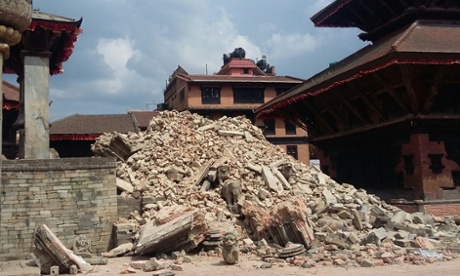
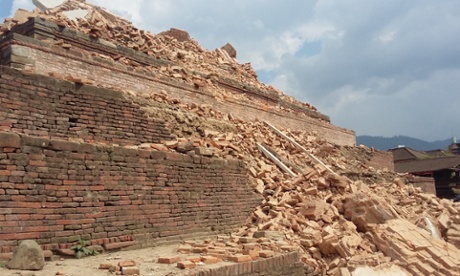
Reuters has this useful factbox on the number of foreigners in Nepal, which it put at a total of 300,000 at a busy time of year for the tourism-reliant country’s trekking and climbing season.
Austria: Foreign ministry says around 250 Austrians in Nepal, no reports so far on any casualties.
Bangladesh: Foreign ministry says no nationals in Nepal have been reported injured or killed. But four reported killed inside Bangladesh. Britain: No details released yet.
Belgium: Foreign ministry says not aware of any victims.
China: Xinhua news agency, quoting the Chinese Embassy in Kathmandu, reports four people confirmed dead and 10 seriously injured.
France: Foreign ministry says around 500 French nationals have been located and are safe, and has no information on any victims.
Germany: No details released yet.
India: Nearly 800 Indians have been evacuated from Nepal with more on the way home, according to the ministry of external affairs. No Indian casualties yet reported in Nepal, but 49 reported killed in India.
Indonesia: Foreign ministry says has 34 nationals in Nepal. Eighteen are living in Nepal and 16 are visiting. Says still trying to contact 18 of those nationals.
Israel: Foreign ministry says it estimates around 600 Israelis are in Nepal, and has secured contact with 400, most of them sheltering at the embassy in Kathmandu. These include 25 couples in Nepal to bring home babies born to surrogates.
Italy: No details released yet.
Japan: Foreign ministry says has no reports of Japanese killed or injured in the quake, but is still checking whereabouts of citizens. Some 1,100 Japanese living in Nepal are registered with the embassy, but no information on number of nationals travelling through.
Latvia: Local news agencies report around 41 people from Latvia in Nepal at the moment. Four are missing.
Lithuania: Foreign ministry says 25 Lithuanian nationals registered in Nepal are safe, but does not know yet of any unregistered travellers.
Malaysia: Foreign ministry says all citizens in Nepal are accounted for and safe. A team of Malaysian Everest climbers are safe at base camp.
Philippines: Two Filipino climbers are reported safe.
Poland: No news on any Poles affected.
Romania: Nineteen Romanians in Nepal, including mountaineer Alex Gavan and three others, all reported to be safe.
Russia: Tass news agency, citing emergencies ministry, says no casualties among Russians.
Sweden: Foreign ministry is aware of around 40 Swedes in Nepal but has no information about dead, hurt or missing nationals.
South Korea: Foreign ministry says three nationals injured in the earthquake. It estimates 650 residents and as many as 1,000 travellers were in Nepal at the time.
Updated
Key Event
Update - Reuters: Home ministry official says 618 people have died after an earthquake measuring magnitude 7.9 struck #Nepal
— Sky News Newsdesk (@SkyNewsBreak) April 25, 2015
Nepal’s Home Ministry has given an update on those injured and killed. The death toll has reached 2263 and 5580 people have been injured.
Pete Pattisson, based in in Kathmandu, has just sent this.
Kathmandu, for the most part, is still standing, defying predictions of catastrophic destruction in the event of a major earthquake.
On a half an hour journey from the far south to the far north of the city, I only saw a handful of destroyed or damaged buildings, including an ancient temple and Durbar high school, the first school to be built in Nepal. The roads are busy and plenty of shops are open.
But get off the main road to where the city meets the countryside and the damage is more extensive.
“At least 50 to 60 houses have been destroyed in my village. It’s all the old ones that have collapsed”, said a local teacher from Buddhanilkantha municipality on the northern edge of Kathmandu.
Around him, the whole community was just waking up to an uncertain day, having spent the night under canvas on the local football pitch, alongside their buffaloes and goats. “When the earthquake struck I just huddled down with my family, unable to move,” said the teacher. “It was terrifying.”
Summary
- The death toll from the 7.8 magnitude earthquake that struck Nepal on Saturday has risen to more than 2,200. More than 5,000 people have been injured. Powerful aftershocks today between Kathmandu and Everest unleashed more avalanches in the Himalayas and caused panic in the capital, where hospital workers stretchered patients out into the street as it was too dangerous treat them indoors.
- A state of emergency has been declared Many historic landmarks, including the Dharahara tower, have been reduced to rubble following the quake.
- Governments are scrambling to locate thousands of their nationals and relatives took to social media to find their loved ones. The international community has pledged support and aid packages to the stricken nation. The US secretary of state, John Kerry, has said the US will pledge $1m to the aid effort and will also assist with a disaster response team. Australia has also pledged a Aus$5m aid package, while Sri Lanka, the UK, China and others are all sending disaster response teams to assist in search and rescue. Pope Francis led prayers in St Peter’s Square for the dead and displaced in Nepal and surrounding areas.
- The quakes caused widespread damage to Nepal’s infrastructure which has further hampered search and rescue operations. Injured climbers at Mount Everest, where an avalanche struck following the quake, have been flown by helicopter to receive medical treatment.
Survivors from Everest base camp reach Kathmandu
AP reports that a first group has been taken to hospitals after at least 17 were killed in an avalanche yesterday. Those who arrived in the capital appeared not to have life-threatening injuries. Here are of the eyewitness accounts.
Pemba Sherpa, a 43-year-old guide with the right side of his face bandaged, was surprised he had survived.
He rushed from his tent when the earthquake hit and was standing in the open when “I heard a big noise, and the next thing I know I was swept away by the snow,” he said. “I must have been swept almost 200 metres.”
Later, he regained consciousness. “I was in a tent surrounded by some foreigners. I did not know what happened or where I was,” he said after being taken to Kathmandu Medical College Hospital.
Bhim Bahadur Khatri, 35, another survivor flown to Kathmandu, said he was cooking in a meal tent when the quake struck.
“We all rushed out to the open and the next moment a huge wall of snow just piled on me,” he said in a brief airport interview before being driven to a nearby hospital. “I managed to dig out of what could easily have been my grave. I wiggled and used my claws to dig as much as I could. I was suffocating, I could not breathe. But I knew I had to survive.”
When he finally dug his way out, gulping in fresh air, he was surrounded by devastation. Part of the base camp village was gone.
“I looked around and saw the tents all torn and crushed. Many people were injured,” he said. “I had lived but lost many of my friends.”
Some of the latest images showing the aftermath of the earthquake.
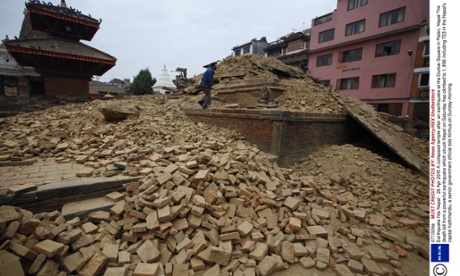
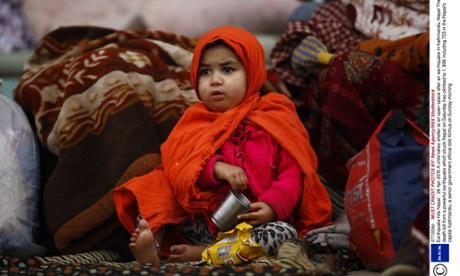
AFP reports on how Nepalese doctors working in a hospital car park have been overwhelmed by the number of patients. Here is an extract.
Doctors set up makeshift operating theatres in a hospital car park as they worked round the clock to treat the wounded from a monster quake that has also left morgues overflowing with bodies.
Samir Acharya, a doctor at Annapurna Neurological Hospital, described how medics were working out of a tent set up in a parking lot after being overwhelmed by patients.
Even if there was room, some were too scared to stay in the building, said Acharaya who together with his colleagues has been flat out ever since the earthquake struck on Saturday lunchtime.
“We have treated many people since yesterday, the majority children,” said Acharya.
“Most patients have head injuries or fractures. Two of our patients died, two are critical,” he said, as people wept outside the hospital while they waited for news of loved ones inside.
With the death toll from the disaster rising above 2,200, hospitals were also struggling to find places to store the bodies.
At the city’s oldest Bir Hospital, there were around a dozen dead bodies placed on the floor with relatives trying to swat away the flies.
A security guard said that around 100 bodies had been taken away for cremation since Sunday morning.
“In some cases, there was a delay as the relatives or immediate family members were also injured in the quake or couldn’t reach the city,” he said.
Death toll exceeds 2,000
An official in Nepal says at least 2,152 people are now confirmed dead in the massive earthquake that hit just outside of Kathmandu, AP reports
Astonishing video which shows amateur video shows large cracks down the middle of a road in Nepal after a devastating 7.9 magnitude earthquake hit the region on Saturday.
The British Embassy in Nepal has issued further updates and travel advice.
For further updates on #Nepal earthquake & travel advice:: http://t.co/d8RppW2Cuv #Nepal
— British Embassy (@UKinNepal) April 26, 2015
This from the British Embassy:
An earthquake has occurred at 11.45 local time in Nepal. Epicentre was 81kms west of Kathmandu. Aftershocks are continuing. There has been extensive damage to buildings. We advise people to stay in a place of safety and follow any advice provided by local authorities.
If you are a British national currently in Nepal and wish to inform the FCO of your whereabouts you should contact us by: - completing a form online at https://overseas-crisis.service.gov.uk/ - calling us on +44 207 008 0000; and - texting NEPAL to +447860010026. You’ll then receive a reply, please respond with your details. Text messages should be restricted to 160 characters. Reliability and cost of sending a text varies from country to country and is dependent on the networks within those countries.
Alternatively, if you need to speak to the FCO urgently, you can call +44 (0)20 7008 0000.
The BBC weather forecast for Nepal does not look good. Thundery downpours could hamper rescue efforts for the rest of next week.
#NEPAL #EARTHQUAKE Thundery downpours could hamper rescue efforts across the region for much of the new week. Stav D pic.twitter.com/5N8AgKKejY
— BBC Weather (@bbcweather) April 26, 2015
CARE International have been in touch to give details of their emergency operation on the ground in Nepal.
Emergency response coordinator in Kathmandu, Santosh Sharma, said earthquake survivors have spent the night gripped with fear due to severe aftershocks:
Almost everyone has slept outside and they are creating temporary shelters with what they have. I am seeing women and children suffering a lot…they are living outside their homes and fear going inside,” Mr Sharma said.
There is no electricity, and soon there will be a scarcity of water. People have been pooling their resources together, but there will soon be problems with food and with water.”
Mr Sharma said the needs in response to this catastrophe would be immense, and CARE staff on the ground were now putting plans in place to assist up to 75,000 people with temporary shelter, ready-to-eat meals, water purification and toilet construction.
More than 40,000 people are getting treatment in hospital, but there is no room inside the hospitals. Many are getting treated in the compound of the hospital. Medical supplies are an urgent need.
All of the particularly vulnerable – children, breastfeeding mothers, people with chronic diseases – they have been suffering a lot. It’s essential to get help to these people as quickly as we can.
More testimony from aid agencies. This from Unicef communication officer Rupa Joshi in Nepal:
The shake was like nothing I have experienced in my 57 years. It was strong and it shook for a long time. Many old monuments, including famous temples and stupas have come down. Many people fear Kathmandu will have very a high death rate. Fortunately, today is Saturday so schools were off and the quake came in the daytime.
When I went out in the evening, I saw many people preparing to camp out in the main open parade ground in the middle of the street. Relatives were crying in the main government hospital where the dead were being lined up in front of the hospital building.
People fear that other buildings will collapse. Many of the buildings and monuments here are made of mortar mixed with mud. This material is used a lot in mountain villages so we fear houses outside Kathmandu have come down.
My family is traumatised. We are 5 generations living under one roof - from a 100 year old grandmother to my 16 month old granddaughter. Strong aftershocks that are keeping most of us up!
Good resource on the Everest aspect of the earthquake inc up to date news from the British Mountaineering Council https://t.co/h23YAACxJS
— peter beaumont (@petersbeaumont) April 25, 2015
My colleague Peter Beaumont has more on the cause of the avalanche on Everest. This from him:
The source of the deadly avalanche on Everest appears to have been the collapse of a serac - or ice cliff - in the region of the peaks opposite Everest base camp – Pumori and Lintgren the latter of which has a line of prominent seracs along a prominent saddle.
Seracs are a glacial feature, slow moving, unstable and prone to collapse - in this case triggered by the earthquake.
According to climbers in the area in appears it was the collapse of part of the Lintgren serac that was responsible for much of the devastation in Everest base camp.
Dutch climber Eric Arnold climber – quoted by the Washington Post – as well as others confirmed the source. He gave this dramatic testimony:
11:45 lying in my tent, it seems like someone is shaking my tent … I think it’s a joke. Not much time later, the shaking of the tent turns into shaking of the ground and it gets harder and harder. I realize — earthquake !! When I open my tent zipper, I see three sides of the gigantic avalanche come down (from different peaks). Behind me, from Lingtren and from Pumori.
The avalanche from the Nuptse is gigantic. Not much later I realize that the base camp is getting hit. Arnold [fellow climber] beckons me to come to the mess tent. I run the 20 meters to the tent, midway through the avalanche skims me. I totally lost my sense of direction… Then I storm into the tent.
My ears are filled to the brim with snow. In five seconds, I look like the abominable snowman. It is now an hour after the avalanche. Details about the victims, I do not know. Our plan to walk to the Pumori base camp, the site of a huge avalanche, will not turn out.
My colleague Anna Codrea Rado has pointed out a significant and useful move from Viber, the smart phone and desktop programme that allows messages and calls to be made over the internet:
In response to the earthquake in Nepal we have switched off Viber Out billing so Nepal users can call any destination for free
— Viber (@Viber) April 26, 2015
@Viber We hope this will prove helpful to anyone trying to reach friends and family in this region.
— Viber (@Viber) April 26, 2015
As Anna points out this is genuinely useful to teams on the ground as telephone coverage is still very poor. “This is actually very helpful because wifi is coming back now,” she says.
Updated
We are receiving more eye-witness reports from aid workers on the ground in Nepal.
Caritas #Nepal staff distributing tarpaulins. Please keep all those affected in your prayers: http://t.co/YtSZR7QgTo pic.twitter.com/gWnuy17Chh
— CAFOD (@CAFOD) April 26, 2015
Lilian Chan, from CAFOD partner Caritas Australia, currently in Kathmandu:
There have been continued tremors overnight. A lot of people have been sleeping outside, and a lot have evacuated to open spaces in town, because they’re worried about continued tremors. We’ve just experienced another one, a large one. The mood here is sombre. Everyone is doing their best just to get through.
A lot of buildings have collapsed, especially in the town centre. Caritas Nepal has delivered immediate relief, providing tents to people who have evacuated, including those who have taken refuge in churches which are being used as evacuation centres.
Father Pais Perumana S.J., President of Caritas Nepal in Kathmandu:
It was the worst earthquake I have ever experienced in my life. The aftershocks are still strong. Lots of houses have fallen down and there are lots with cracks. Thank God it was during the day and on a holiday as many people were outside when the quake happened. Rescue is the first priority. Lots of people have lost their homes and are out on the street or in open spaces, so we will be looking to provide them with food and temporary shelter.
Kushal Neogy from CAFOD partner Catholic Relief Services, currently in Kathmandu:
Everybody had to spend the night outside and we got an advisory from the government as well to stay outside and we just went round to see people in neighbourhood locality.
It was quite cold, it was about 11 degrees centigrade, with the wind blowing, so it was quite difficult for people. But then they had no choice because aftershocks kept coming. In fact, we lost count, but we read in today’s newspapers that there were about 65 aftershocks altogether throughout the evening and late night. So there is a state of panic.
It has not happened for many years in Nepal, last time it happened was about 85 or 90 years back. It has been quite some time. Here on the outskirts of Kathmandu we can see there have been some landslides.
Our CEO @TanyaBarronPlan was there when #nepalquake hit & is now helping coordinate our response. Support our efforts http://t.co/e48dnE7Dn7
— Plan UK (@PlanUK) April 26, 2015
Aid agency Plan International tell us that they have reports of “widespread devastation” in remote districts west of yesterday’s huge earthquake. The charity - whose response is focused on the affected children - fears that poor quality buildings in rural areas - including homes and schools - will have been largely flattened in the districts of Parbat, Baglung and Myagdi, a short distance west of the epicentre.
CEO Tanya Barron, Plan’s UK chief executive, was in Nepal when the earthquake struck and says “it was one of the most shocking days of my thirty years in development.” She is leading the charity’s response:
We are hearing from colleagues on the ground that destruction in these areas is widespread. Homes and schools have been flattened.
Our hope is that the timing of the earthquake - Saturday lunchtime - may have helped limit the loss of life. But we’re concerned about the impact of the huge aftershock we’ve just felt.
As Plan has been in Nepal since 1978, we have an extensive presence in some of these more remote areas. These districts will be a priority as we scale up our response to this devastating quake.
The good thing is that we have made contact with these areas. That’s critical as we plan our response.
Roads blocked because of landslides and unreliable phone networks is hampering rescue and aid efforts.
Chandra Kayasthra, Plan’s unit manager in Baglung, reports that people are gathered outside - scared of re-entering buildings - and are sharing what food they have. The weather is “holding for” now, says the charity but “providing emergency shelter is an urgent priority.”
In the UK, Plan has launched an emergency appeal at www.plan-uk.org.
We’re continuing our rolling coverage of events in Nepal as the search and rescue effort continues. I’m about to hand over our coverage to my colleague Alexandra Topping in London. Here’s a summary of events as they stand at the moment:
- A state of emergency has been declared in Nepal after a 7.8 magnitude earthquake struck the country on Saturday. The death tolls now stands at almost 2000. More than 4000 people have been injured, and both tolls are expected to continue to rise. Many historic landmarks, including the Dharahara tower, have been reduced to rubble following the quake.
- The quakes caused widespread damage to Nepal’s infrastructure which has further hampered search and rescue operations. Injured climbers at Mount Everest, where an avalanche struck following the quake, are now being flown by helicopter to receive medical treatment.
- Aftershocks following the quake are continuing. The US geological survey recorded a 6.7 magnitude quake on Sunday afternoon, and there have been over 30 other smaller aftershocks since the quake struck.
-
The international community has pledged support and aid packages to the stricken nation. The United States secretary of state, John Kerry, has said they will pledge $1m to the aid effort and will also assist with a disaster response team. Australia has also pledged a $5m aid package, while Sri Lanka, the United Kingdom and China are all sending disaster response teams to assist in search and rescue.
My colleagues have just provided this extensive update on events as they stand now in Nepal, and the international responses to the disaster. You can read the full version here:
The death toll from the devastating earthquake in Nepal climbed above 1,900 on Sunday and was continuing to rise as officials struggled to gauge the full scale of the disaster and the world rushed to provide desperately needed aid.
Dozens of aftershocks jolted Nepal on Saturday and Sunday as people sheltered where they could. Nepalese authorities continually revised the number of dead upwards a day after the Himalayan country was shaken by a magnitude 7.8 quake that wrecked houses, flattened centuries-old temples and triggered avalanches onMount Everest.
More than 5,000 people had been injured, with the number of dead and injured expected to rise in the coming days. Nepalese police officials said more than 700 people died in Kathmandu alone.
An avalanche triggered by the quake struck a section of Everest’s base camp, killing at least 17 people and injuring 61 others, local reports said. Further up the mountain, about 100 climbers were safe but facing difficulty getting down as the route back to safety was damaged, with the situation of more people on other other routes on the mountain still unknown and rescue efforts under way.
Saturday’s earthquake, which originated outside Kathmandu, was the worst to hit Nepal, a landlocked nation sandwiched between India and China, in more than 80 years.
Thousands of residents in the capital, Kathmandu, and other regions struck by the quake spent an uncomfortable night sleeping in the open, too scared to return to homes that are vulnerable to strong aftershocks. Forecasts were for rain and thunder storms on Sunday, with temperatures around 14C adding to the difficult conditions for the displaced.
My colleague Anna Codrea-Rado in Nepal has just provided some further updates on the severity of the 6.7 magnitude aftershock that just hit 65km east of Kathmandu.
She said the quake felt “about the same strength as the original one but didn’t last as long.”
We’re waiting to hear on whether there has been further damage caused by this quite substantial aftershock.
Aftershocks continue in Nepal with further 6.7 magnitude quake, according to US Geological Survey
Nepal has been struck by a further aftershock of 6.7 magnitude. The US Geological Survey has reported that the epicentre was located 65km east of Kathmandu.
The Wall Street Journal reported there has now been 31 aftershocks that are continued since the first quake hit on Saturday:
There were 31 aftershocks recorded in Nepal during the 23 hours after the 7.8-magnitude quake on Saturday morning. All of them were magnitude 4 and above.
There are some devastating before and after photos from some of Nepal’s historic sites that were destroyed from the quakes. Here’s some of the images that are being circulated of the Dharahara Tower and other sites that have been reduced to rubble.
#Nepal’s Landmarks, Before and After #NepalQuake (Maju Deval & Dharahara Tower) pic.twitter.com/DSD6zhN00I
— Amichai Stein (@AmichaiStein1) April 26, 2015
Devastating earthquake reduces Nepal's historic landmarks to rubble http://t.co/FTv3KIu0EZ
— Huffington Post (@HuffingtonPost) April 25, 2015
Injuries now total 4629 while death toll rises to 1953, according to Nepal police spokesman
My colleague Ishwar Rauniyarish has just sent through another update on events in Nepal. The death toll has again risen, according to a police spokesman. The district of Bhaktapur has seen 219 people die, with hundreds of houses collapsing.
The death toll rose to 1953 and 4629 injured, according to Nepal police spokesman Kamal Singh Bam.
“We are lacking proper resources and equipments to deal with the rescue, we are trying our best though,” Bam said. “We don’t have enough crane[s] to dig out rapidly in all places - so it’s taking time to recover the buried.”
In Kathmandu’s neighbouring district Bhaktapur 219 people have died and hundreds of houses collapsed.
Deepa Adhikari, 27, a resident of Lokanthali in Bhaktapur said: “We spend our night outside yesterday in the street, today also we are not confident whether we will go back to our room.”
Regional Administrative chief Dinesh Kumar Thapaliya said that “Pokhara hasn’t witnessed any major casualties, two in the villages are reported death.”.
“Our main challenge now is to rescue in Gorkha district where the epicentre was - we are sending army helicopters in the area.”
A tourism lecturer Samir Baral, 36, said pokhara is quiet and normal.
“Shops are open as usual, though people are feared that it might happen again since we felt one in early morning but things are getting normal here,” Baral said. “I was scared yesterday as my wife was admitted to hospital for delivery, but things got normal now.”
Updated
My colleague Anna Codrea-Rado has just sent through another update from Kathmandu, where she’s been speaking to people in the aftermath of the quake:
David Stucky and David Csumrick, both 63, were in Kathmandu after returning from hiking to the Annapurna Base Camp. The friends said they were in a book shop, buying mountaineering books in anticipation of catching their evening flights home to Canada and Barbados, when the quake started.
They were in the Pilgrim’s Bookstore in the Thamel neighbourhood and said books were flying off the shelves. “Everyone fell to their knees within seconds,” Stucky said.
The pair said they took cover in the doorway, the recommended procedure for earthquakes, for what felt like a minute.
After it stopped, everyone ran out of the store but they convinced the shopkeeper to still sell them their books. “Which, looking at it now, was probably silly,” Csumrick said. The pair then headed back to their hotel, the Yak and Yeti, passing on the way fallen overhead cables, collapsed walls and crushed cars.
They stayed at the hotel over night and plan to try and leave on Sunday. They said their airline, Cathay Pacific, contacted them to let them know they have been rebooked on a flight scheduled to leave in the afternoon but are aware the situation at the airport will be hectic. “Patience will be key,” Stucky said. The pair both said they feel very fortunate.
They said they have been thinking back to all the places they traveled to during their 12 day visit to country and think their situation could be a lot worse. Csumrick said: “I’m very concerned about the people still up there [at Annapurna Base Camp]”.
Both men are seasoned climbers, having been to Nepal six times between the two of them on treks. “The hiking is out of this world in the Himalayas,” Stucky said.
This video from Associated Press is a useful summary of where events stand so far with the quake and the aftermath.
The Indian prime minister, Narendra Modi, has also spoken about the disaster that has struck Nepal. Here’s a short summary of what he said in a radio address from NDTV:
- We share the grief of our Nepali brethren.
- Nepal’s pain is India’s pain.
- I can easily imagine the horror of earthquakes.
- I have witnessed from close quarters the destruction of the 2001 earthquake in Kachchh.
- The first and most important task to bring out alive all those stuck under the rubble.
- We will spare no efforts to save the lives of as many people as possible.
Updated
There are now some incredible images coming from Mount Everest of the aftermath of the avalanche that struck following the quake. This photo shows the base camp, which has been partially buried under snow.

This next image shows one of the rescue helicopters that have been sent to retrieve the injured.

Death toll after earthquake reaches 1910, says Nepal home ministry
My colleague Ishwar Rauniyar said the Nepalese home ministry has now confirmed the death toll has again risen, and is now at 1910.
There is also now a major rescue effort underway at Mount Everest to try and reach the base camp with helicopters to transport wounded.
My colleague Peter Beaumont has more on the rescue attempts:
Mountain rescue helicopters braved poor weather to reach Everest base camp on Sunday morning to ferry out badly injured survivors from the avalanche that killed at least 17 at the encampment on Saturday.
The avalanche was triggered by Saturday’s huge earthquake that devastatedNepal, and sent blocks of rock and ice ploughing through the camp where expeditioners assemble to begin their assault on the world’s highest mountain.
The Nepal Mountaineering Association said on Sunday morning that about 100 climbers were stuck in camps one and two above the icefall and although they were safe and well, it would be difficult to evacuate them from the mountain because of the damage to the route.
The 22 survivors initially evacuated – among more than 60 who were injured – were flown to Pheriche, the nearest village with a clinic, after being treated at the base camp medical tent.
Details of the continuing rescue efforts around Everest base camp were reported by Ang Tsering of the Nepal Mountaineering Association.
More reports are beginning to come through from Mount Everest about the number of injuries and casualties. The latest reported figures bring the number of deaths to 17 on Everest, with 61 injured.
Evacuating those who were injured is proving to be a difficult task. My colleague Peter Beaumont has this update on events:
Climbers at the Mount Everest base camp – and others trapped higher on its slopes – were locked in a desperate effort to treat injured colleagues caught in a devastating avalanche that swept through the encampment after being triggered by Saturday’s powerful earthquake.
With at least 17 people believed to have been killed on Everest, and 61 injured, climbers in the camp sent frantic messages calling for helicopter assistance to evacuate the most badly wounded.
There are around 100 climbers at camps 1 and 2 on Mount Everest, above base camp, and all are safe after an earthquake set off an avalanche, the head of the Nepal Mountaineering Association said on Sunday.
Twenty-two of the most seriously injured at the base camp were taken by helicopter to Pheriche village, the nearest medical facility, Ang Tshering said on Sunday. However, bad weather and communications were hampering more helicopter sorties.
It will also be difficult to evacuate the climbers above base camp as the route back through the Khumbu Icefall was blocked, Tshering told Reuters.
The route through the Khumbu Icefall – which is fixed annually with ropes and ladders and gives access to the higher slopes – appeared to have been badly damaged.”
Updated
My colleague Anna Codrea-Rado has been speaking this morning with tourists who were visiting Kathmandu when the quake struck. Here’s a dispatch she’s just sent through:
Matthew Wojciechowski, 47, was in Kathmandu for a tattoo convention when the earthquake struck. “I thought it was a very loud helicopter landing at first,” he said.
Wojciechowski said he was walking towards the hall where the convention was being held when it happened, and he rushed towards it to find his girlfriend who was inside.
“People were stampeding and stepping over each other regardless of age. It was shocking to see people so frantic,” he said.
He and his girlfriend got out of the hall and took refuge in the grounds of Yak and Yeti hotel, where the convention was being held. They remained there for the night, sleeping outside under blankets.
Wojciechowski said he is planning on trying to leave as soon as he can, but doesn’t expect that to be for at least a few days to a week because his return flights were booked for Thursday.
“Nothing moves fast in Nepal anyway and it will be even slower now,” he said.
He said he is preparing to just wait out the situation with patience.
“I’m doing ok but last night I took a moment and sat in front of the Buddha statue and sobbed.”
Wojciechowski said he feels uncomfortable being in Kathmandu because he feels the situation to be what he described as “disaster tourism”, with people watching the devastation and then returning to their hotels.
He plans to help in the only way he can, which is to visit the local merchants and buy their wares. Wojciechowski said he has received no information from the US embassy or other official communication, including from his airline.
He also said the only way for him to communicate last night was via the Facebook app. When asked if he would return to Nepal, Wojciechowski said he really liked what he’d seen before the quake hit.
“There’s not much else I can do to help Nepal other than travelling here again.”
Updated
Australia pledges $5m aid package
Australia’s foreign affairs minister, Julie Bishop, has just pledged a substantial aid package to deliver assistance to Nepal.
Bishop said that although there were Australians in Nepal who were unaccounted for, there had been no reported deaths of Australians. Here is the full release:
The Australian embassy in Nepal is providing assistance to Australians and has confirmed the safety of over 200.
There are 549 Australians registered as travelling in Nepal and officials are working under challenging conditions to locate all those in the country.
While there are reports of extensive loss of life, at this point there are no reports of Australian deaths.
[The Department of Foreign Affairs and Trade has opened its emergency call unit and has updated the travel advice for Nepal. It notes disruptions to telecommunications, transport and tourist infrastructure, and advises Australians to follow the instructions of local authorities.
I urge Australians concerned for the welfare of family and friends in Nepal to attempt to contact them directly.
If unable to do so, they should call the Department of Foreign Affairs and Trade’s 24-hour consular emergency centre on (02) 6261-3305 or, within Australia, on 1300 555 135 (local call cost).
The Australian government will also provide an immediate package of life-saving humanitarian support to Nepal as it responds to the devastation caused by the magnitude 7.9 earthquake of 25 April.
An Australian crisis response team will travel to Nepal as soon as possible to assist in establishing the welfare of Australians unaccounted for after the earthquake on 25 April. Two humanitarian experts will also be deployed.
The Australian embassy in Kathmandu is working closely with Nepalese authorities and other donors to assess the full extent of the disaster. Australia’s $5m assistance will include:
. $2.5m to assist Australian non-government organisations;
. $2m to support United Nations partners; and
. $0.5m to support the Australian Red Cross.
Updated
My colleague Ishwar Rauniyar has sent through another update, this time on the situation at Mount Everest. He said there are a large number of injured people waiting to be moved.
Climbing guide Pemba Sherpa said at least 300 tourists are waiting at Lukla, the gateway to Everest.
“Many injured are being ferried to Lukla from Feriche and are getting treatment here, if not recovered will be sent to Kathmandu,” Sherpa said.
“Tourists are quarrelling with the airport officials for plane tickets as they want to go back.”
According to Sherpa there hasn’t been any flight so far. He was heading to Mount Everest but has cancelled his trip and came back to Lukla.
Updated
A large number of the Nepalese community have been displaced as a result of the earthquake. Many were forced to sleep outside on Saturday, after buildings were either reduced to rubble or simply too unstable to risk staying in. Aftershocks continued to reverberate throughout the night.

Updated
The quake triggered severe avalanches on Mount Everest that has led to at least 17 deaths, and severely damaged the base camp. One climber who was there on Saturday during the quake described to CNN the devastating scenes at Everest:
Jon Reiter is no stranger to Mount Everest –its world-record height, its prestige, its challenges.
And its dangers.
He learned that again shortly before noon on Saturday, after a monster magnitude 7.8 earthquake struck Nepal. It not only rattled cities like Kathmandu and Pokhara, but caused avalanches at Everest and nearby peaks.
Reiter was safe but shaken by the devastation. He told his wife, Susan, about putting one dead person in a sleeping bag and zipping it up, seeing others killed by the falling ice and collapsing snow, and doing all he could to help others fighting for their lives.
“It’s been a really rough day,” Susan Reiter told CNN. “Jon’s been comforting injured people that he doesn’t think will survive.”
Updated
China’s Xinhua news agency has posted a series of photos highlighting the rescue effort in Tibet.
While the epicentre of the quake was in Nepal, parts of Tibet have also been affected and are now being assessed as part of search and rescue operations.
Rescuers battle landslide debris to deliver relief supplies in quake-hit Nyalam County, SW China's Tibet #NepalQuake pic.twitter.com/wRVlpT67pb
— China Xinhua News (@XHNews) April 26, 2015
Official death tolls reaches 1,896 with 4,718 people injured, Nepalese home ministry says
My colleague Ishwar Rauniyar said the Nepal home ministry has again revised the death toll upwards to 1,896 people.
He’s also outlined there are further concerns about the medical care the injured will be able to receive, with hospitals overloaded and short on supplies.
Kumar Thapa, the head of Alka hospital in Lalitpur, said they are finding it difficult to cope with the numbers of injured people.
Shops are closed, it’s even difficult to manage food, water for the injured.
Updated
Foreign government are also trying to determine how many of their own citizens are missing in Nepal. This update outlines some of the international efforts that are ongoing to locate missing people:
Foreign countries were rushing to confirm the situation of their nationals in Nepalon Sunday after the massive earthquake when it levelled buildings in Kathmandu and caused deadly avalanches reaching the heights of Everest and surrounds.
In Australia officials, families and friends were appealing for information about a list of missing that could stretch into the dozens. Families put more than 60 names on the Red Cross Family Links website.
A teenager from the state of Victoria and his aunt were among those being sought. They were named as Liam Coburn Oliver, 18, and his aunt, Dianne Joy Coburn, 59, by the Australian Broadcasting Corporation.
Liam’s brother, Darcy Oliver, said on Twitter that he was searching for information about Liam, who had been travelling from Change, in Nepal’s east, to Dharpani, on the Annapurna Circuit. He was not sure where his aunt was when the quake struck.
Ballantyne Paige Forder, from Perth in Western Australia, was believed to have been working in an orphanage in Kathmandu at the time of the quake.
My colleague Ishwar Rauniyar has just sent through another update from Nepal.
The administrative chief of the Western Development Region, Dinesh Kumar Thapaliya, said Gorkha district is hard hit by the earthquake in western Nepal.
“So far 107 people have died in the district, and we haven’t been able to send more support to three village development committees,” Thapaliya said.
However, there are no news of fatalities in the Annapurna Base Camp Area (one of the popular destinations for trekking), according to Thapaliya.
“We haven’t even started to count numbers of houses as there are hundreds of houses collapsed in the district.”
AAP is also reporting that Sir Edmund Hillary’s son Peter was trekking in Nepal when the earthquake struck:
Sir Edmund Hillary’s son Peter was trekking in Nepal when the magnitude 7.8 earthquake struck.
“He’s fine,” his wife Yvonne Oomen told AAP on Sunday.
He was trekking with a group of 12 in the Gorak Shep region.
“They were all New Zealanders - they were a group of old school chums, Peter’s old school chums,” she said.
The group is now descending from where it was when the quake struck.
Sir Edmund, a New Zealander, and Tenzing Norgay made the historic first ascent of the highest mountain on earth, Mt Everest, on May 29, 1953. Peter Hillary was born 18 months later.
Peter Hillary grew up climbing mountains and his first summit of Everest was in 1990.
My colleague Ishwar Rauniyar has sent through this devastating image of one of Kathmandu’s oldest temples as he surveys the damage in the city. The temple – which previously was a resting place for the Nepalese – has been levelled by the quake.
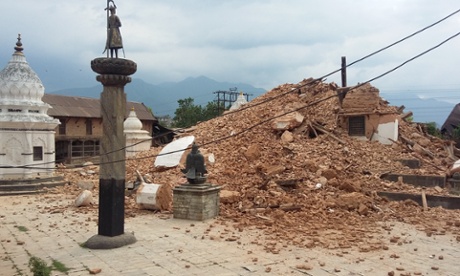
Updated
In a terrible prescience, an expert group met just one week ago in Kathmandu to discuss how the country could prepare for the next large earthquake. Associated Press spoke to one of the scientists who attended the meeting:
Nepal’s devastating earthquake was the disaster experts knew was coming.
Just a week ago, about 50 earthquake and social scientists from around the world came to Kathmandu, Nepal, to figure out how to get this poor, congested, overdeveloped, shoddily built area to prepare better for the big one, a repeat of the 1934 temblor that levelled this city. They knew they were racing the clock, but they didn’t know when what they feared would strike.
“It was sort of a nightmare waiting to happen,” said seismologist James Jackson, head of the earth sciences department at the University of Cambridge in England. “Physically and geologically what happened is exactly what we thought would happen.”
Updated
The United States agency for international development has also released a statement. It said the organisation would deploy a disaster response team and an initial $1m aid pledge:
Our thoughts are with the people of Nepal, India, and Bangladesh in the aftermath of the magnitude 7.8 earthquake that struck central Nepal today, affecting more than 6.6m people and causing widespread damage and destruction. USAID is deploying a disaster assistance response team (DART) to the region and is providing an initial $1m in emergency assistance as we assess humanitarian needs in cooperation with the government of Nepal.
USAID is also activating an urban search and rescue team to accompany disaster experts. The earthquake, which hit just north-west of Nepal’s densely populated capital, Kathmandu, has caused numerous buildings to collapse and made some roads impassable. It also triggered an avalanche in the Mount Everest region and aftershocks of a considerable magnitude. In addition to the DART, USAID staff based in Bangkok, Thailand and Washington, DC, are monitoring the situation closely in coordination with US mission disaster relief officers in the region.
Updated
The international community is beginning to pledge support to Nepal to help in the relief effort. At this early stage there have been few pledges of financial aid, with countries instead sending crisis personnel to assist in the major search and rescue operation that is under way.
The United States secretary of state, John Kerry, has said they will pledge $1m to the aid effort and will also assist with a disaster response team. The Sri Lankan health minister, Rajitha Senaratne, has announced the country will send a plane with doctors, engineers and other supplies to assist Nepal.
Britain is deploying a team of experts to assist in the search and rescue operation. A 68-strong team from China’s international search and rescue team has also been sent and is due to arrive on Sunday.
Updated
Tech companies have also been attempting to deploy their services to help with communications with those in affected areas of Nepal.
Google has launched its “person finder” tool that allows people to provide information if they are looking for someone, or if they have information about the whereabouts of a person. The tool is designed to help people find each other in the aftermath of a humanitarian crisis.
Facebook is also using a new tool called “safety check”. It’s a quick way for a user who is in an affected area to provide an update about their safety that will be pushed to their friends’ notifications on Facebook.
Mark Zuckerberg has written a post outlining the way the tool operates, and offering his condolences to those caught up in the quake.
Updated
The New York Times has published an illuminating analysis of the genesis of quakes in Nepal and surrounding countries. It provides some important context to how this quake occurred and why the devastation has been so widespread:
More than 25m years ago, India, once a separate island on a quickly sliding piece of the Earth’s crust, crashed into Asia. The two land masses are still colliding today, pushed together at a speed of 1.5 to 2 inches a year. The forces have pushed up the highest mountains in the world in the Himalayas and set off devastating earthquakes.
Experts had warned of the danger to the people of Katmandu for decades. The death toll in Nepal on Saturday was practically inevitable given the tectonics, the local geology that made the shaking worse and the lax construction of buildings that could not withstand the shaking.
GeoHazards International, a nonprofit organisation in Menlo Park, California, that tries to help poorer, vulnerable regions like Nepal prepare for disasters, had noted that major earthquakes struck that region about every 75 years.
In 1934 – 81 years ago – more than 10,000 people died in a magnitude 8.1 earthquake in eastern Nepal, about six miles south of Mount Everest. A smaller quake in 1988 with a magnitude of 6.8 killed more than 1,000 people.
Updated
This map from the United Nations office for the coordination of humanitarian affairs really highlights the sheer scope of the disaster unfolding in Nepal.
A substantial portion of the population was exposed to moderate to strong levels of shaking arising from the quake. The most violent shaking occurred in populated areas around central Nepal.
#Nepalquake: An estimated 4.6 million people were exposed to the #earthquake shaking pic.twitter.com/JfGkel2G0r
— UN OCHA Asia Pacific (@OCHAAsiaPac) April 25, 2015
Updated
My colleague Anna Codrea-Rado is in Nepal and has taken some pictures of the damage.
She saw many people sleeping in the streets this morning, with the risks of aftershocks and unstable buildings still causing serious concern among residents.
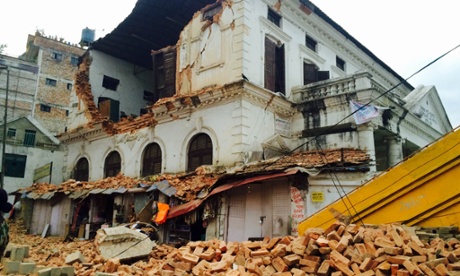
Updated
The harrowing images of the aftermath are continuing to come through. These pictures show the massive extent of the search effort that is under way in metropolitan areas of Nepal.


Updated
Death toll rises to 1,800, says Nepalese official
My colleague Ishwar Rauniyarish has just sent through this update from Kathmandu. He is speaking with community members on the ground and just heard this from a Nepalese government official:
A spokesman for the ministry of home affairs, Laxmi Prasad Dhakal, said that the death toll this morning was now at 1,805, with 4,700 injured.
There are still aftershocks going on – people are in a state of confusion about how long will it take.
Sushila Dhungel, 55, is seen taken out a gas cylinder and gas stove for cooking. “We still don’t have courage to go inside and cook as we are still feeling the tremors,” she said.
Updated
The latest United Nations situation report on the quake and its aftermath reports that there are serious hospital shortages in Kathmandu. It also said that the widespread damage to buildings means that most of the population has been displaced and is without shelter:
In Kathmandu Valley, hospitals area overcrowded, running out of room for storing dead bodies and also running short of emergency supplies. BIR hospital is treating people in the streets. There are reports that the hospital emergency stocks are depleting/used up and there is a need for a government decision on bringing kits from the military. Majority of population remaining outside houses due to fear of aftershocks and structural damage to buildings.
GON has held a meeting of their central natural disaster relief committee (CNDRC), followed by meetings with cabinet and the humanitarian community. An HCT meeting followed in the evening. Government reports that all hospital staff mobilised and are deploying small teams to hospitals in Kathmandu. Chitwan and Pokhara which both are well staffed are sending medical teams to worst affected areas – Gorkha and Lamjung. Government is intending to set up displaced camps in Kathmandu Valley and outside, where there are APF bases as these have established water supply and security.
Government is unclear on emergency food stocks. Government was requested to mobilise the construction sector for rubble removal. It is not clear whether GON will be setting up a response fund and there is still need to establish what resources government can mobilise.
Updated
This CCTV footage, although silent, paints an eerie picture of the moment the quake struck Nepal.
Vice has collated a series of videos and images like this one that show the extent of the damage.
This quake is likely to cause severe difficulties for Nepal. The country is one of the poorest in the world, and was listed 157th out of 187 countries in the United Nations Development Program’s Human Development report in 2013.
To put that in context, the latest data from the World Bank shows that 25% of the country lives below the poverty line. The economic forecast for the country was not promising, and predicted a decreasing GDP looking forward until 2017.
This BBC country profile also highlights Nepal’s precarious political situation:
Democratic politics was introduced in 1991 after popular protests, but was marked by frequent changes of government. The last king of Nepal, Gyanendra, twice assumed executive powers – in 2002 and 2005.
Maoist rebels waged a decade-long campaign against the monarchy, leaving more than 12,000 people dead and 100,000 people displaced, UN figures show.
When Gyanendra’s direct rule ended under public pressure in April 2006, the rebels entered talks with the parliamentary government on how to end the civil war.
A peace deal was agreed in November, although the Maoists continued to press for abolition of the monarchy.
Parliament agreed to the condition in December 2007, and the Maoists emerged as the largest parliamentary party after elections in April 2008.
The monarchy was abolished a month later, and a Maoist-dominated government took office in August.
But political instability has plagued Nepal since the end of the civil war. Politicians have yet to agree on a new constitution – a key part of the peace deal with the Maoists – and are at odds over proposals to divide Nepal into states, along ethnic lines.
Updated
The United States National Geographic Survey has posted a summary of the extent of the quake and provided some context about why the damage has been so widespread.
The summary said the fault line ran across very heavily populated areas. The epicentre of the quake was just 80km north-east of Kathmandu.
Seismic events of this scale are rare in the region. The survey said the largest known was a magnitude 8 quake in 1934 that event led to the death of more than 10,000 people:
Although a major plate boundary with a history of large-to-great-sized earthquakes, large earthquakes on the Himalayan thrust are rare in the documented historical era. Just four events of M6 or larger have occurred within 250km of the April 25, 2015, earthquake over the past century. One, an M6.9 earthquake in August 1988, 240km to the south-east of the April 25 event, caused close to 1,500 fatalities. The largest, an M8.0 event known as the 1934 Nepal-Bihar earthquake, occurred in a similar location to the 1988 event. It severely damaged Kathmandu, and is thought to have caused around 10,600 fatalities.
This map illustrates the scope of the quake in urban areas.
We are starting to see more and more images that highlight the extent of the damage caused by the quake. Buildings and temples across the country have been nearly levelled, and many Nepalese are helping in the major rescue and recovery operations that are still ongoing.
People aghast at the sight of their historic temples destroyed. Thousands walking home, chaos #NepalEarthquake pic.twitter.com/sSLGP6UsB5
— Siobhan Heanue (@siobhanheanue) April 25, 2015
Truly awful sight. Kathmandu's Darbar Square, a UNESCO World Heritage site, in ruins after today's earthquake. pic.twitter.com/AoAtbGhmPq
— Raghu Karnad (@rkarnad) April 25, 2015
Still can't believe what I witnessed in #NepalQuake today. History crumbling, a nation in despair. pic.twitter.com/sFcOj2vzVi
— Siobhan Heanue (@siobhanheanue) April 25, 2015
Updated
Welcome to our continuing coverage of events in Nepal after a major earthquake on Saturday. The country is waking up to the enormous damage caused by the quake and to continue search-and-rescue efforts for those who may be trapped or injured. Here’s a summary of events as they stand so far:
- A state of emergency has been declared in Nepal after a 7.8 magnitude earthquake struck the country on Saturday.
- The death toll is more than 1500 people, and that number is expected to rise. Widespread destruction has been reported in major metropolitan areas including Kathmandu, where the historic Dharahara tower has collapsed.
- The earthquake also triggered a major avalanche at Mount Everest, killing at least 10 people. Part of the Everest base camp was also destroyed.
- The United States has pledged $1m in aid to Nepal and will send a disaster response team. The secretary of state, John Kerry, said the US stood with the people of Nepal.
Updated