The village of Barkobot, in Sindhupalchowk district, is just an hour and a half on good roads from Kathmandu, but it may as well be on the other side of the country, writes Pete Pattisson.
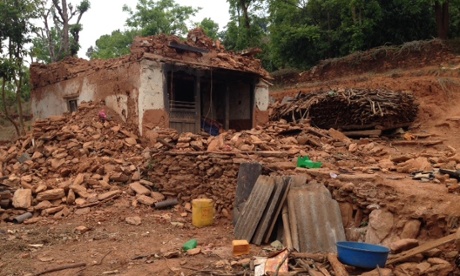
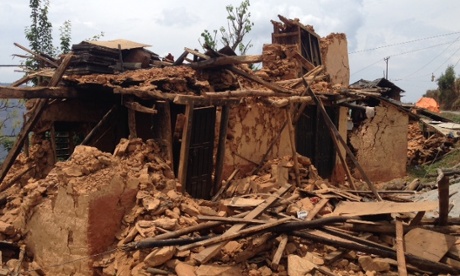
Every single one of the 75 houses in the village has been severely damaged or totally destroyed, and yet no one has received any help from the government.
Where neat stone and mud houses once stood, there are now just piles of rubble. The entire village is living outdoors, under canvas, corrogated metal sheets, or just the shade of a tree. “No one is coming to help us,” said Sangita Giri. “There is a child [buried] over there, but neither the army or police have arrived to help.”
Four year-old Muna Puri was playing outside when the earthquake struck. Her body lies crushed somewhere under the rubble, but nobody knows where. “I don’t even know where to look for her. We don’t know which house fell on her,” said her dazed mother. “When we asked the army and police for help, they told us to find her ourselves.”
Muna’s parents recently took out a 200,000 rupee ($2000) loan to build their house, but now they have lost everything. “Now I don’t have a house. I don’t have a daughter,” said her father. “This is what the world has become.”
Nearby two young men are digging through the rubble with a pick to extract any food or clothing they can find. “We don’t have any food or clothes, everything is buried here,” says one. “The government hasn’t deployed anyone here. All these homes have collapsed… but the government doesn’t help, so we’re struggling to do it ourselves.”
Kopila BK is another mother mourning the loss of her daughter, 16 month old Salina. “I had put my daughter to sleep upstairs when the earthquake struck. The house collpased and she was buried and died.” But Kopila’s immediate concern is how to feed her surviving two children. “We don’t have anything to eat, everything is buried, we couldn’t retrive anything… All the rice we had was buried in the earthquake.”
But when darkness falls, the villagers face a new danger. “Thieves have started coming at night... We can’t even stay securely in our shelter. How can we live like this?” said Sangita Giri. “We stay up all night with big sticks. I’m scared. All the wealth I have left is the gold I am wearing. If they cach me and take that, I have nothing left.” Like in so many Nepali villages, most of the young men from Barkobot have left for work overseas, leaving those who remain feeling particularly vulnerable.
The fate of Barkobot is repeated again and again across the district. Ram Chandra, a police constable in Dolaghat, half an hour down the mountain from Barkobot said, “There is nowhere for anyone to stay. 80 percent of homes have been destroyed. Almost everyone in the district has been displaced, except in the bazaars [towns]. No one in the villages are still in their homes. No aid has reached here. The first priority is to get tents and food. I have lost my own home and haven’t heard from the rest of my family yet.”
Some aid is beginning to trickle in, but it is not coming from the government. Ganesh Koju and three friends had come from Kathmandu with a car full of food for friends and family stranded up in the hills. “If the government was doing its job, we wouldn’t have to be here,” said Koju. “All the relief is still at the airport. The government haven’t done anything.”

Foreign Office investigating claims of British death
The Foreign Office is investigating claims a British national was killed by the Nepalese earthquake, Philip Hammond has said.
The as-yet unconfirmed report related to a Briton not living in this country, the Foreign Secretary said.
In a statement Hammond said: “We are urgently investigating unconfirmed reports of a non-UK resident British national having been killed and our teams on the ground will report back as soon as they have any further information on that.”
The Guardian’s picture desk has put together a gallery of images from Nepal four days after the earthquake struck.
Via friends of his I have been passed this email from Tom Greensmith, a British man in Nepal to study the Tibetan language, in which he describes some of the aftermath.
Although there are countless people dead and dying in Kathmandu city itself, it is the mountain regions of Nepal that are really suffering. As I write this I hear helicopters packed full of injured people being transported to the over-crowded and under-funded hospitals.
One hospital has even collapsed with the patients inside. Whisky is being used to sanitise open wounds and people are being left in the corridors to sit with their pain until hospital staff can attend to them. These staff themselves have likely lost their own homes, but still they continue...
I have heard from people that I met since the quake that whole villages have been laid to waste, and although the villagers are supporting each other, food is running out and water is contaminated. They are facing starvation unless we get help there.
A friend of mine has been making trips into the Yolmo Valley, as far as she can get, which is only to the mouth of the valley. Although she only has first aid training, she is practically acting as a doctor. She is making the harrowing decision on who is to be transported out via helicopter and who has to wait behind. Those left risk dying of infection and sit in pain...
My friends and I have been sleeping on a tennis court for the last three nights, with a makeshift tent above our heads. We are sleeping cheek by jowl with a multinational group. Behind me sleeps a seven-year-old recognised Tulku [a reincarnated Buddhist figure], everyone calls him Yangsi; to my right a Nepali family, to my left new found friends form all over the world; and, on the other side of the tent, groups of displaced Tibetan families, some of whom are refugees for the second time in their lives.
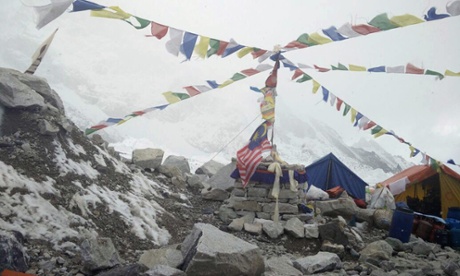
My colleague Peter Beaumont has written about the rescue of all the climbers stranded at camps high up Mount Everest, an effort he describes as “unprecedented in mountaineering history”.
Reuters is reporting that a post-quake landslide struck a village in the district of Rasuwa, north of Kathmandu, leaving up to 250 people missing. The area is a popular trekking destination and it is possible some foreign tourists were among those affected, said the district governor, Uddhav Bhattarai. Rain was hampering rescue efforts, he added.
In a new statement the UN’s World Food Programme says it is also concentrating a lot of its efforts in the Gorkha region:
The WFP is mounting an emergency operation to help survivors of the Nepal earthquake, with food trucks rolling today into the district of Gorkha, one of the worst-hit areas.
WFP plans to provide food for 1.4 million people in urgent need of assistance over the next three months at a cost of $116.5 million. Distributions of rice are expected to start tomorrow in Gorkha, using stocks that WFP already had in-country from its existing operations prior to the earthquake.
Trucks with WFP food are in Gorkha trying to reach the survivors, but landslides and poor roads are making conditions difficult. A helicopter will fly to the area to transport food onwards to more remote villages that are inaccessible by road. Emergency food supplies, including high-energy biscuits, are also being brought in by air from Bangladesh and Dubai in the next days.
A plane from the WFP-managed UN Humanitarian Response Depot in Malaysia arrived in Kathmandu this morning carrying field hospitals, medical supplies and aid workers.
“Our thoughts are with the people of Nepal at this terrible time,” said Pippa Bradford, WFP’s Country Director and Representative in Nepal. “Despite their own personal tragedies and difficult working conditions, our Nepali staff and their international colleagues are working flat out to help those in need of humanitarian assistance. Time is of the essence to get food to those who urgently needed it.”
Official death toll reaches 5,057
It was previously 4,349, although it was widely assumed this figure would rise.
#BREAKING Nepal quake death toll reaches 5,057: official
— Agence France-Presse (@AFP) April 28, 2015
This AFP photo emphasises the extent of the destruction in the Gorkha region, as described in the update below.
Earthquake in Nepal devastates rural communities -- the view from an Indian Army helicopter in the hills of Gorkha pic.twitter.com/l2j65bLx0Q
— AFP Photo Department (@AFPphoto) April 28, 2015
Heartbreaking individual stories continue to arrive from the quake scene. Reuters have filed this from a village in the Gorkha valley area, Jharibar.
Her husband away in India, Sunthalia worked alone for hours in the rubble of her house perched on a ridge near the epicentre of Nepal’s earthquake to pull out the bodies of her 10-year-old daughter and a son aged eight. Another son of four miraculously survived.
Three other houses in their remote settlement, an hour’s walk up the lush green Gorkha valley, had collapsed. It was deathly quiet after Saturday’s quake, she recalls.
“I could see my son’s fingers fluttering through the pile of stones. That’s how I could see him and save him,” Sunthalia said, sitting listlessly on the ground, her son by her side.
The stench of dead cattle still in the rubble of her home is overpowering. There is little government help so far; the only thing families such as hers have been given is a thin tarpaulin sheet to lie under.
Four days after the country’s most powerful quake in 81 years, authorities are struggling to determine the extent of the disaster in the Gorkha region and neighbouring Lamjung where the epicentre lay, let alone provide succour.
The Associated Press has also filed a report on the devastation in Gorkha.
Updated
AFP have filed this photo showing the scale of queues for petrol in Kathmandu today.
Nepalese people wait to get gas at a station in Kathmandu. #photo by @PrakashMathema pic.twitter.com/zraGd4Kjv7
— Agence France-Presse (@AFP) April 28, 2015
My colleague Lisa O’Carroll sends this eyewitness report from a US aid worker in Bhaktapur:
American aid worker Sean Casey, was on vacation from Liberia where he was heading up International Medical Corp’s Ebola response, when the quake struck and narrowly escaped death.
He and a friend were in Bhaktapur, the historic city 20k from Kathmandu, when it struck.
“We were walking around these narrow streets and the ground started to shake. We stood in the middle of the road and I said to Claire, ‘It’s an earthquake’.
“The buildings around us started to collapse and bricks started hitting me. We both kind of pulled each other around and got to a nearby square. It lasted about a minute. We stood in that square and there were some aftershocks,” he said.
“We then moved from square to square over the next couple of hours to find our way out of the old city which was destroyed.
“We got to the main road and walked for maybe two hours before we found a car to get is into Kathmandu. We went to our hotel which wasn’t collapsed but badly damaged and we camped outside on the lawn that night,” he said.
When daylight arrived, Casey scrambled a team of doctors and nurses and borrowed two vans to to Gorkha, near the epicentre of the quake.
They arrived there on Sunday night with medical supplies including antibiotics, analgesics, braces, slings and are working on sending more mobile teams to the northern villages in the Gorkha district which has been badly hit.
Updated
This is Peter Walker taking over from Matthew Weaver. It’s approaching dusk in Nepal, with huge numbers of people facing another night in the open or with minimal shelter, amid forecast heavy rain.
The UN’s humanitarian agency, the UNOCHA, has produced this handy tweet with links to the latest overall picture about the scale of the aid and recovery effort.
Latest information, materials, facts and figures on the #NepalQuake in one place: http://t.co/Ho4ohrgcwB pic.twitter.com/6aS6PhZ6TI
— UNOCHA (@UNOCHA) April 28, 2015
Summary
Here’s a summary of the latest developments:
- Nepal’s prime minister, Sushil Koirala, has warned that the number killed in the earthquake could more than double to 10,000 people. He also ordered rescue efforts to be stepped up and appealed for foreign supplies of tents and medicines.
- The official death toll for Saturday’s earthquake has currently stands at 4,349, with more than 6,500 injured, as the nation struggles to provide relief to thousands of survivors.
- In one village reached by the Guardian every home had been damaged or destroyed. Residents of Barkobot village in Sindhupalchowk district said they had had no aid despite being just an hour and a half on good roads from Kathmandu. But helicopters have begun ferrying wounded from Gorkha close to the epicentre of the earthquake.
- Heavy rain has added to the hardship of thousands of people forced to sleep rough for fourth night , after the earthquake destroyed their homes. Water, food and power are scarce, raising fears of waterborne diseases.
- The UN estimates that eight million people have been affected by the earthquake. The World Food Programme says 1.4 million people are in need of immediate help.
- A German geography professor has been named as one of the victims of the Nepal earthquake. Mathias Kuhle, 67, from Georg August University in Göttingen, had been travelling on a scientific expedition with 15 of his students.
- People are growing increasingly frustrated by what they say has been a slow government response. Koirala insisted the government was doing all it could.
- Private hospitals in Katmandu have been ordered to treat earthquake victims free of charge, after reports that they were turning away some people because they could not afford the fees. Private hospitals that refuse to treat earthquake victims will have their registration revoked, the government warned.
- Australia’s foreign affairs minister, Julie Bishop, said 1,150 Australian citizens in affected area had now been contacted, up from about 830 on Monday, and they were “safe and well”.
Stranded Everest climbers rescued
All of the 170 climbers who had been stranded at camps high up Mount Everest by a huge earthquake and avalanches have been helicoptered to safety, Reuters reports.
Taking advantage of Monday’s clear weather, three helicopters shuttled climbers all day from camp 1, above the impassable Khumbu icefalls, while others trekked back from camp 2 to be airlifted out.
Eighteen climbers at Everest base camp died in Saturday’s avalanche that destroyed half of the tents there, according to Nepal’s mountaineering association.
Canadian Nick Cienski said many of the returning climbers’ tent camps had been wiped out by the avalanche which, surging at speeds estimated at up to 300 km per hour, cut a swath through base camp, hurling gear, people and tents hundreds of feet.
Danish climber Carsten Lillelund Pedersen said his team had been trekking on Saturday down from camp 2, which is at an altitude of 6,400 metres, when it was caught in a whiteout and had to turn back. He eventually made it to camp 1.
Three helicopters shuttled 170 climbers from camp 1 to base camp on Monday. Because of the high altitude and thin air, the aircraft were only able to carry two climbers at a time.
“Everest, above base camp, is now empty,” Pedersen posted on his Facebook page. “A lot of gear, tents, oxygen, fuel etc is stashed a camp 2 ready to ‘rebuild’ later this season.”


An AFP photographer has recounted how he survived the avalanche on Everest triggered by the earthquake.
“We heard this most horrifying sound, it was like a train but came from so deep... and then finally there was this stillness, this complete stillness, and I knew I was alive,” Roberto Schmidt said.
Schmidt, AFP’s South Asia photo chief, and Kathmandu bureau chief Ammu Kannampilly had just reached Everest base camp on assignment Saturday when the avalanche occured.
After reaching the relative safety of Lukla town, the traditional gateway to Everest, they spoke of their recollections and recounted the scenes of carnage on the mountain where hundreds of climbers had gathered.
Schmidt said:
“We hadn’t been there more than 10 minutes we just felt this rumbling, this moan. Ammu said to me: ‘What’s that?’ I said it’s the earth moving, it’s an avalanche.
“We went out of the tent and then we heard this most horrifying sound. It was like a train but came from so deep, just so powerful.
“It was so cloudy, Ammu went into the tent and I remember looking to my left and suddenly saw this, this wave, with the rumble and I just thought ‘holy shit’. It was so big, the pictures don’t really do it justice.
“I grabbed the camera, just pressing the shutter, I got three shots and then it was right over us. I jumped in and went under the table.
“You have this wind and then it’s like a wave crashing, we were swept up, you don’t know if whether you are upside down or what. You are just tumbling.
“Finally I came to, resting on my back and then I felt this tack, tack sound of falling rocks and you know I just felt ‘this is it. I’m going to be buried alive’.
“They kept on piling on top of me and then finally there was this stillness, this complete stillness, and I knew I was alive. I knew I was conscious and I had to work out how I was going to breathe.
“You’re trying to clear everything away, trying to get some air... and then suddenly I felt this hand pulling me up and it was our sherpa Pasang.
“Ammu was bleeding and the nail on her left hand had been completely torn off.
“We were lucky as I think our tents were next to a rock which stopped us from being completely swept away.
“We went out of the tent and people then started appearing out of the blue, all very dazed. I started shooting and then you think, should I be taking pictures or helping people?
“In the next hour, you could hear more than half a dozen other avalanches in the vicinity. They were close but you couldn’t see them as it was so cloudy. The sound was very scary, very haunting, you didn’t know if it was coming your way.
“I started helping down a Nepalese guy who had been injured and I remember talking to him about our families and saying we would both see our sons again, it was a nice moment, a human thing, amid all of this...
“We walked to this Himex (tour group) tent and there was Ammu, all bandaged up.”

Wounded airlifted from Gorkha
Rescue helicopters have begun to reach survivors in Gorkha, according to AP.
Around noon, two helicopters brought in eight women from Ranachour village, two of them clutching babies to their breast, and a third heavily pregnant.
“There are many more injured people in my village,” said Sangita Shrestha, who was pregnant and visibly downcast as she got off the helicopter. She was quickly surrounded by Nepalese soldiers and policemen and ushered into a waiting van to be taken to a hospital.
The little town of Gorkha, the district’s administrative and trading center, is being used as a staging post to get rescuers and supplies to those remote communities.
Some villages were reachable only by air after landslides blocked mountain roads.
Some women who came off the helicopters were grimacing and crying in pain and unable to walk or speak, in agony three days after being injured in the quake.
Sita Karki winced when soldiers lifted her. Her broken and swollen legs had been tied together with crude wisps of hay twisted into a makeshift splint.
“When the earthquake hit, a wall fell on me and knocked me down. My legs are broken,” she said.

Updated
More reports are emerging of damage to remote areas in the Sindulpalchowk district north of Kathmandu.
Homes and roads have been destroyed in the area according to AFP.
Nepalese nanny Sukamaya Tamang, whose parents and brothers are stranded in one of the worst-hit districts, said families there had been left to fend for themselves, with no government help reaching them so far.
Tamang’s family is stranded in Sindulpalchowk, some 100 km (65 miles) from the epicentre of the quake, where homes and roads have been destroyed.
“There are a cluster of nine villages and they have been all flattened out,” said Tamang, who managed to speak to her brother over the phone at their village.
Tamang, 25, said the village has been banding together to care for the injured and help to cremate the dead.
“My husband and cousins are leaving by air today (Tuesday) with supplies to see if they can reach our village,” she told AFP.
“It makes me shudder to think what my family members must be going through with no one at hand to help them out.”
Earlier the Guardian’s Pete Pattisson reported that all the homes in one village in Sindulpalchowk had been destroyed or damaged.
Jason Burke reports a similar scene on the edge of the district.
Borders of sindulpalchowk district, Nepal. Five houses, five brothers, 50 people homeless. pic.twitter.com/e95BA8tuIK
— Jason Burke (@burke_jason) April 28, 2015
A German geography professor is among the victims of the Nepal earthquake, his university has confirmed, writes Kate Connolly in Berlin.
Mathias Kuhle, 67, from Georg August University in the central German city of Göttingen, was travelling on a scientific expedition with 15 of his students and another geographer north west of Kathmandu when the earthquake struck.
The specific circumstances of his death are not known, but it is believed he died of injuries sustained during the quake. Some of his students were injured, but none of them seriously.
The group had been trekking on the sacred pilgrimage trail of Tsum Valley towards Arughat Bazar when the quake occured.
They immediately took refuge in a safe part of the valley and waited for help. It is understood that it was here that Kuhle died of his injuries. The group was later flown to safety and is due to return to Germany on Wednesday.
According to the local newspaper, the Göttingen Tageblatt, Kuhle was a renowned geomorphologist and had led many similar expeditions. He was also an expert on the Himalayas who since the 1970s had made repeated trips to the region as a researcher and passionate mountaineer.
Updated
Some members of staff in Nepal from the US based aid agency Mercy Corps are among those who have lost their homes.
The agency has 90 staff in Nepal, including some who have reported that their homes, or the homes of their relatives, have been completely destroyed.
In email, spokeswoman Amy Fairburn said: “We are hearing from friends and relatives of staff (but some staff have lost their homes) about villages that are impacted, and from there we hear about more villages.”
She added: “We know at least three staff members homes were destroyed, out of the 30 or so that live in Kathmandu. But the majority are not sleeping in their homes – one of our driver’s families is living in a tent in the yard.”
Kiran Adhikary, Mercy Corps operations manager in Kathmandu, said: “Some expats are evacuating, but where would we go? I live on the fifth floor and my building is cracked so I don’t want to stay inside it. The news says not to stay inside cracked buildings, but all the buildings are cracked. So where do we go?”
Kiran’s family has been forced to sleep rough in the yard outside the building. He says he is afraid to go up and get things.
Fairburn said Mercy Corps had identified four immediate needs in Nepal:
- People aren’t able to wash their hands before eating, women who are menstruating have no feminine supplies. Even when people have toilets, they are getting clogged up or over used.
- People who have lost everything are sleeping outside in the rain. Women and children, the very old the very young. The old buildings that have collapsed may cause a lot of potential respiratory issues. The air in Kathmandu isn’t great to begin with.
- To reach people who have not been reached is the priority for Mercy Corps. We are going into more rural areas to conduct assessments. Close coordination with other NGOs is needed so we cover full spectrum.
- The heavy equipment for search and rescue, etc. is having trouble getting through the narrow roads in Kathmandu Valley.

Updated
The British rescue dog Bryn is about to start sniffing for survivors north of Kathmandu, according to this video from Britain’s Department for International Development.
Bryn is part of a specialist team of that flew out to Nepal on Sunday. It includes more than 60 search and rescue responders and medical experts.
The US aid agency USAid introduces us to Racker, one of Bryn’s American colleague.
Meet Racker, one of the canine members of the DART team deployed to Nepal to assist w/ relief & recovery. #NepalQuake pic.twitter.com/pFHj2bpykG
— USAID Nepal (@USAIDNepal) April 28, 2015
Updated
Private hospitals ordered to stop turning away victims
Private hospitals in Katmandu have been ordered to treat earthquake victims free of charge, after reports that they were turning away some people because they could not afford the fees.
Nepalese journalist Kanak Mani Dixit translates an order from the Nepalse government as saying: “Private hospitals that refuse to treat earthquake victims will have their registration revoked.”
"Private hospitals that refuse to treat earthquake victims will have their registration revoked." https://t.co/V2shbHD14A
— Kanak Mani Dixit (@KanakManiDixit) April 28, 2015
On Monday, Washington Post correspondent Anup Kaphle, reported that Kathmandu Medical College hospital was turning away victims because they couldn’t pay for treatment.
Kathmandu Medical College hospital is returning earthquake-injured people because they can't pay fees. #Nepal https://t.co/0p3d6voIhL
— Anup Kaphle (@AnupKaphle) April 27, 2015
He also flagged up the government’s notice.
#Nepal govt issued notice on Sunday saying all hospitals should treat injured free of cost. Anyone seeing otherwise, contact +97714200258.
— Anup Kaphle (@AnupKaphle) April 27, 2015
Updated
The Guardian has published a guide to some of the main Nepal appeals that have opened that open up. It shows various ways you can donate.
The actor Ewan McGregor, Unicef UK ambassador, has added his voice to calls for the British public to back Unicef’s appeal. He said:
I don’t think anyone seeing the news over the weekend could fail to be moved by the devastating situation in Nepal. I was able to visit this beautiful country with Unicef, so I know that the team on the ground will be doing everything in their power to help children and their families in danger.”
The children I met in Nepal left a lasting impression on me and now hundreds of thousands of them are facing a third night out in the elements. It’s absolutely heart-breaking to think that some of the children I met have now been left with nothing. The earthquake has not only destroyed their homes and their schools, but left millions of children scared and in danger.
Heavy rain has been hampering relief efforts and adding to the hardship of thousands facing a fourth night sleeping rough, according to reporters in the disaster zone, including the Guardian’s Jason Burke.
An hour into hills outside Kathmandu. V cold and hard rain falling. V tough for homeless. Fourth night outside for many tonight.
— Jason Burke (@burke_jason) April 28, 2015
Amazing resilience. Stall busy selling South Asian elixir of life: scalding hot chai. #NepalQuake
— Jason Burke (@burke_jason) April 28, 2015
Pouring with rain and vertiginous mountain track like an ice rink #NepalEarthquake pic.twitter.com/9qXOnyxeoc
— Dan Rivers (@danieljerivers) April 28, 2015
It's raining in Kathmandu now - more misery for the hundreds of thousands camping out in the open #NepalEarthquake
— Sanjoy Majumder (@BBCSanjoyM) April 28, 2015
UN says 8 million people affected
The UN estimates that eight million people have been affected by the earthquake.
The situation report, from the office for the UN Resident and Humanitarian Coordinator for Nepal makes grim reading. It says:
According to initial estimations and based on the latest earthquake intensity mapping, 8 million people in 39 districts have been affected, of which over 2 million people live in the 11 severely affected districts.
The estimated number of affected people was calculated using data from the 2011 Census and Government guidance that 50 per cent of the total population in affected districts is affected.
This includes the number of households living in poor quality and vulnerable homes with outer walls and/or foundations made of substandard material.
The number of households affected was further estimated based on the intensity of the earthquake as it was estimated to have been felt in each location ...
According to early indications, 1.4 million people are in need of food assistance. Of these, 750,000 people live near the epicenter in poor quality housing. Impact on agriculture based livelihoods and food security is expected to be extremely high.
Immediate needs for health include medical tents, medication, surgical kits and body bags.
In the Kathmandu Valley, public life remains quiet. While small grocery shops have opened their doors today, large businesses remain closed. With fuel reserves running low, cars and trucks are lining up at gas stations in town. Banks remain closed. While automatic banking machines are functional, replenishment is not occurring.
Mobile networks in Kathmandu remain functional. At the same time, network outage and overloads are still common ...
Power throughout the city is limited with most households and offices mainly relying on generator power.
A Humanitarian Staging Area (HSA) in Kathmandu International Airport has been set-up to avoid congestion at the main entry points of affected areas and ease the flow of life-saving commodities, where large-scale relief activities are being undertaken. While main feeder roads are open, many side roads remain blocked and inaccessible.
Meteorologists have predicted rainfalls for the coming ten days.

Updated
More extraordinary drone footage has emerged showing the extent of the damage in Bhaktapur, east of Kathmandu.
The footage, shot by Umesh Shrestha and uploaded by journalist Salokya, also shows rescue workers digging for survivors.
Stills from the film were uploaded by Sakokya on Monday, but this appears to be the footage itself.
Updated

Reuters has a little more detail on its interview with the Nepalese prime minister Sushil Koirala in which he predicted that the death toll could more than double to 10,000 people.
It quoted him saying: “The government is doing all it can for rescue and relief on a war footing. It is a challenge and a very difficult hour for Nepal.”
Koirala did not say on what he was estimating the leap in the death toll, but the government has said it is still to establish contact with some remote regions.
“The death toll could go up to 10,000 because information from remote villages hit by the earthquake is yet to come in,” he said.
Updated
The World Food Programme says 1.4 million people are in need of immediate help.
WFP emergencies officer Geoff Pinnock says it has identified eight places that are in need of critical help and “our focus is on relief operations in those places.”
Those areas all in the Gorkha district near the epicentre of the quake, are: Ghyachol, Saurpani, Warpak, Larpak, Gundra, Lapa, Kashigaun and Kerauja.
There are unconfirmed reports of missing Norwegians in Swayambhu north west of Kathmandu, Nepalese journalist Salokya reports.
Local told me: 2 Norwegian missing frm this area, Swayambhu. They suspect few ppl buried here. #NepalEarthquake pic.twitter.com/07Gk1MDlbg
— salokya (@salokya) April 28, 2015
Around 200 Norwegians were known to be Nepal at the time of the earthquake. All but a handful has since been accounted for, according to Norway’s foreign ministry, Norway’s English language news site the Local reports.
Updated
More on the plight of survivors in the remote village of Barkobot, from Pete Pattisson.
Villagers say they have been threatened by robbers in the aftermath of the earthquake. And like in many villages in Nepal, most of the young men are away, working overseas.
Updated
The head of Britain’s Disaster Emergency Committee has insisted that aid is getting into to Nepal and will be stepped up over the coming days.
In an interview for BBC Radio 4’s Today programme DEC’s chief executive, Saleh Saeed, said: “Always after these disasters there is a degree of chaos and confusion, but aid is getting in. Over the next few days we are going to see increased activity to ensure that all those people who need help are being reached.”
He said the 13 leading charities which make up DEC are working with the Nepalese government and the UN to coordinate the relief effort.
As Pete Pattisson in Barkobot can testify, Saeed added: “Entire villages have been wiped out.”
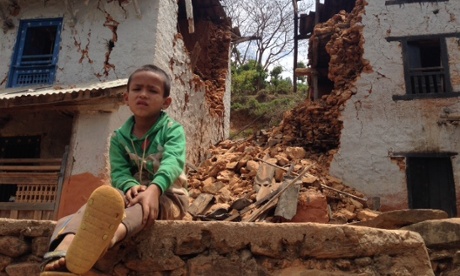
The Guardian’s correspondent in Nepal, Pete Pattisson, has reached a village close to the epicentre of the earthquake. He writes:
Every single home is either severely or totally destroyed in Barkobot village in Sindhupalchowk district, People here have received no aid at all, despite being just an hour and a half on good roads from Kathmandu.
Updated
Thousands of the people have continued to flee Kathmandu, as this new Guardian video reports.
Buses and trucks leaving the city are grossly overloaded with passengers keen to leave. Shortages of drinking water, food and electricity, as well as the threat of disease, have also triggered panic.
Updated
Summary
Here’s a summary of the latest developments:
- Nepal’s prime minister, Sushil Koirala, has warned that the number killed in the earthquake could more than double to 10,000 people. He also ordered rescue efforts to be stepped up and appealed for foreign supplies of tents and medicines.
- The official death toll for Saturday’s earthquake has currently stands at 4,349, with more than 6,500 injured, as the nation struggles to provide relief to thousands of survivors.
- A mass exodus of Nepal’s capital city, Kathmandu has seen lines of frustrated foreign nationals waiting outside airline booking offices, while some bus operators have been raising fares and charging for perilous seats on rooftops
- Thousands of Nepalese citizens are sleeping on pavements, roads and in parks, many under makeshift tents, while hospitals are full to overflowing. Water, food and power are scarce, raising fears of waterborne diseases.
- People are growing increasingly frustrated by what they say has been a slow government response.
- Australia’s foreign affairs minister, Julie Bishop, said 1,150 Australian citizens in affected area had now been contacted, up from about 830 on Monday, and they were “safe and well”.
- Bishop confirmed Melbourne woman Renu Fotedar died in the avalanche at the Mount Everest base camp.
- Facebook has rolled out a donation button across the social media platform for contributions to victims of the earthquake, offering to match donations up to $2m.
- Financial aid, supplies and rescue teams are flying in from around the world to assist rescue efforts, including more than 1,100 shelter kits and 1,700 solar lanterns from a British airbase.

Updated
PM says death toll could reach 10,000

Nepal’s prime minister, Sushil Koirala, says the number killed in the earthquake could reach 10,000.
The current official death toll stands at more 4,4000. Koirala also ordered rescue efforts to be stepped up and appealed for foreign supplies of tents and medicines.
“The government is doing all it can for rescue and relief on a war footing,” Koirala said in an interview. “It is a challenge and a very difficult hour for Nepal.”
Nepal PM tells Reuters earthquake death toll could reach 10,000
— Reuters India (@ReutersIndia) April 28, 2015
On Monday an aid worker told the Guardian that he feared that as many as 15,000 people have been killed. Lex Kassenberg who is directing Care International’s response to the disaster, said: “My fear, and that of the international community, is that these numbers will really go up ... and it will go up over the 10,000, 15,000 [level].”
Updated
A new Guardian report says for survivors “despair has turned to anger” at the government’s slow response to the humanitarian crisis unfolding in the country, with food, water and other essentials in desperately short supply:
Health workers said they feared a major health crisis was unfolding among survivors of the quake who are living in the open or in overcrowded tents with no access to sanitation or clean water.
“There are people who are not getting food and shelter. I’ve had reports of villages where 70% of the houses have been destroyed,” said Udav Prashad Timalsina, the top official for the Gorkha region, close to the epicentre of Saturday’s magnitude 7.8 quake.
The UN said more than 1.4 million people need food assistance, including 750,000 who live near the quake’s epicentre in poor quality housing. Tens of thousands are thought to have been left homeless.
Monica Tan signing off and handing over to my colleague, Matthew Weaver.

One of the most striking aspects of the photos coming from Nepal is the country’s many beautiful heritage buildings that have been decimated by the earthquake.
Guardian’s arts correspondent Mark Brown wrote a story about the Dharahara, a 60-metre white minaret tower built in 1832 and the Kasthamandap, a three-storey wooden temple in Durbar Square that has also been reduced to piles of wood and rubble.


While it is too early to know the extent of the loss, it would appear four of the seven Unesco world heritage sites in the valley have been severely damaged.
Experts remain hopeful some of the buildings can be restored and point to the Dharahara Tower, which was reconstructed after earthquakes in 1833 and 1934.
#Nepal’s Landmarks, Before and After #NepalQuake (Maju Deval & Dharahara Tower) pic.twitter.com/DSD6zhN00I
— Amichai Stein (@AmichaiStein1) April 26, 2015

A story at the Globe and Mail includes a look at the mass exodus occurring in Nepal’s capital city of Kathmandu:
Fears of more shaking have played out on a much wider scale as people flee even safe homes, turning Kathmandu into a city under plastic, with seas of tents spread across public spaces, wedged into road islands and stuffed onto narrow sidewalks. Even Nepal’s President Ram Baran Yadav has slept outside since the Saturday quake. All but a few shops and restaurants stand shuttered behind metal rolling gates, many of their owners either dead or fleeing the city.
At the city’s main bus nexus in Kalanki Chowk, thousands crowd onto sidewalks waiting to leave town. Operators have raised fares six-fold and begun charging the same rates for perilous seats on the roof. They are still selling out, leaving nothing for Ishwor Chalise, a 26-year-old English student looking to go to his home nearly 400 kilometres away, where the earthquake caused no damage. “To be safe, I want to go there,” he said.
Ram Chandra, a police constable in Dolalghat, Kavre District one hour’s drive east from Kathmandu spoke to journalist Pete Pattisson and said:
There is nowhere for anyone to stay. 80% of homes have been destroyed. Almost everyone in the district has been displaced, except in the bazaars (towns). No one in the villages are still in their homes. No aid has reached here. The first priority is to get tents and food. I have lost my own home and haven’t heard from the rest of my family yet.
This infographic posted by Agence France-Presse reveals the severity of damage in different parts of the country:
#INFOGRAPHIC Overview of the situation in Nepal on Tuesday pic.twitter.com/SfKEFIgc4c
— Agence France-Presse (@AFP) April 28, 2015
Sanitation a major concern as rescue efforts continue
Melissa Davey signing off and handing over to my colleague, Monica Tan.
To recap, thousands of people are still waiting for assistance, with water, food and power still scarce in many areas, raising fears of waterborne diseases.
Media agencies in the region are reporting people are growing increasingly frustrated by what they say has been a slow government response. Widespread damage to roads and infrastructure, as well as communications being down and fears of further tremors, continue to hamper efforts to reach people.
Meanwhile aid organisations are helping by setting up makeshift hospitals where they can and providing essential supplies. But locals are calling on the government to provide more substantial and ongoing relief.


Updated
According to the Twitter account of a group of Nepali journalists based in Kathmandu, journalists have been working from makeshift offices amongst the rubble to file their stories.
2 leading media houses that publish 4 dailies working frm makeshift offices; office buildings damaged in #NepalQuake https://t.co/u3rf3E2ioq
— Nepali Journalists (@jhyal) April 28, 2015
One of those journalists is Siromani Dhungana, who has been staying in a tent with his wife since the earthquake struck. He told Guardian Australia that anger was building amongst those people sleeping in the streets, who were still too fearful to return to their homes which were destroyed or susceptible to damage from further tremors.
Dhungana said he was most worried about the lack of sanitation.
“In many places we can smell the stink of the dead bodies as they are buried in the rubble, and rescue work is so much slower than expected,” he said.
“There is nowhere for people to defecate.
“People are still waiting on assistance from the government, some of them are still deprived of any assistance, in some places roads are destroyed and government officials have openly admitted there is a failure to co-ordinate assistance effectively among government organisations.”
'Another crisis will hit Nepal capital today – sanitation’ http://t.co/rMmokFUj2U pic.twitter.com/CVjkiEAfd5
— Times of India (@timesofindia) April 26, 2015
He said of about a dozen newspapers in Nepal, only two had been able to publish print editions. Phone lines, electricity and the internet was down for the first two days following the earthquake, he said, making it impossible for journalists to work.
About 60% of the city had electricity restored, Dhungana said, while people could make phone calls for free.
“The government has provided free phone service for people in Kathmandu,” he said.
He and his wife had been in their kitchen at home when the earthquake struck. Their building was still not secure, and although their home had not suffered major damage, there was a crack in one of the walls.
Support our #NepalEarthquake appeal as we help restore vital #water and #sanitation services: http://t.co/b41Jwlue6y pic.twitter.com/3GXIy7oswh
— WaterAid UK (@WaterAidUK) April 27, 2015
“We felt this tremor, like someone was pushing and pulling us at the same time,” he said.
“We were confused about what to do or where to go. As the tremor got softer we felt it was okay to go outside. There was high panic among people, many walls were broken down, people were running aorund with their family and looking for their family and many old buildings were crumbled down.
“Until yesterday night we have been feeling tremors again and again, so while some people are slowly moving back into their homes if they can, many of us are still in tents.”
Updated
Drone footage has emerged revealing the extent of the devastation.
Incredible images of Nepal's fallen monuments, flattened houses and cracked roads have emerged in drone footage pic.twitter.com/0c4iZnmMB7
— Nine News Perth (@9NewsPerth) April 28, 2015
While the earthquake shifted the earth beneath Kathmandu by up to several metres south, the height of Mount Everest likely stayed the same, AFP reports. It remains unclear whether the shifts had been large enough to warrant adjustments to high-precision world maps, experts told AFP;
According to early seismological data obtained from sound waves which travel through Earth after an earthquake, the ground beneath the capital Kathmandu may have moved about three metres (10 feet) southward, University of Cambridge tectonics expert, James Jackson, said.
His analysis was similar to that of Sandy Steacy, head of the physical sciences department at the University of Adelaide.
“It’s likely that the earthquake occurred on the Himalayan Thrust fault, a plate boundary that separates the northern moving Indian sub-continent from Eurasia,” Steacy said.
You can read the full story here.
Updated
People are so scared of more tremors that they are sleeping out in the open in spite of rain, writes Niranjan Koirala for the Times of India.
As NGOs struggle to distribute emergency relief, Koirala writes it should be the government, not aid organisations, doing the bulk of the relief work and implementing longterm strategies to rebuild those affected areas;
Government cannot let NGOs walk all over the relief effort, providing only quick fix solutions. This is the time for sustainable, democratically-inspired long-lasting development work, not NGO band aid.
Very worrying concerns about lack of water & sanitation in aftermath of #NepalEarthquake http://t.co/aVxZwZcKUs pic.twitter.com/zqz92QzY19
— End Water Poverty (@EndWaterPoverty) April 27, 2015
This is the time for government to come up with holistic solutions that will bring relief for the present and be a preventive for the future. Quick fix patchwork solutions may make for good media presentation, but they are not enough.
The role of NGOs is important but after the last aid workers have deposited their bags and gone, it is government that is answerable to the people. It is for this reason that democratically representative government has to be assertive within its domain, at this time.
Updated
A series of satellite images have been released which show Nepal before and after the devastating earthquake, via the BBC.
Angry Nepalis wait for help
As people across Nepal slept rough for a third night after their homes were destroyed or continued to be too unsafe to sleep in, Reuters reports that many are angry at what they said was their government’s slow response to the crisis.
Thousands are sleeping on pavements, roads and in parks, many under makeshift tents, while hospitals are full to overflowing. Water, food and power are scarce, raising fears of waterborne diseases.
Reuters reports;
A series of aftershocks, severe damage from the quake, creaking infrastructure and a lack of funds have slowed the disbursement of aid to those most in need.
The head of neighbouring India’s National Disaster Response Force (NDRF), one of the first foreign organisations to arrive in Nepal to help in the search and rescue effort, said finding survivors and the bodies of the dead would take time.
NDRF director general, O.P. Singh, said heavy equipment could not fit through many of the narrow streets of Kathmandu.
#NepalEarthquake Nepal Army guiding IAF to locations for rescue/relief operations. A story in 4 Pic. pic.twitter.com/HSVwvAaaJl
— Sitanshu Kar (@SpokespersonMoD) April 28, 2015
“You have to remove all this rubble, so that will take a lot of time ... I think it’s going to take weeks,” he told Indian television channel NDTV late on Monday.
With aid slow to reach many of the most vulnerable, some Nepalis were critical of the government.
“The government has not done anything for us,” said Anil Giri, who was with about 20 volunteers looking for two of his friends presumed buried under rubble. “We are clearing the debris ourselves with our bare hands.”
Officials acknowledged they were overwhelmed by the scale of the disaster.
“The big challenge is relief,” said chief secretary Leela Mani Paudel, Nepal’s top bureaucrat.
“We urge foreign countries to give us special relief materials and medical teams. We are really desperate for more foreign expertise to pull through this crisis.”
Updated
AFP has filed this report from London;
A military transport plane laden with supplies and dozens of Nepalese Gurkha soldiers is to take off from a British air base on Monday headed for their homeland.
The Boeing C-17 transport plane will carry more than 1,100 shelter kits, including plastic sheeting and rope, and 1,700 solar lanterns, the department for international development said in a statement.
A British defence ministry spokesman told AFP there would be “dozens” of Gurkha engineers on board to assist relief efforts after a devastating earthquake that killed more than 3,800 people.
The Gurkhas are soldiers from Nepal who serve in the British army and around 2,700 are currently enlisted.
They are renowned for their ferocity, loyalty and razor-sharp kukri fighting knives. They first served as part of the army in British-run India in 1815.
Gurkha veterans have been involved in a long campaign to demand better pension arrangements. It is only since 2007 that they have had the same pay and conditions as British soldiers.
An aid plane from Britain carrying medics and rescue experts landed in Nepal earlier on Monday.
“A swift and effective UK response to the Nepal earthquake means help is already reaching all those affected by this terrible disaster,” international development secretary, Justine Greening, said.
“But as the devastating scale of the crisis becomes clearer, we are stepping up our efforts.”
Updated
Facebook has rolled out a donation button across the social media platform for contributions to victims of the earthquake, offering to match donations up to $2m.
All proceeds would go to International Medical Corps and their response efforts.
“People are coming together to support those affected by the earthquake that struck Nepal and impacted the populations of Nepal, India and Bangladesh,” Facebook said in a blog post.
“During times of crisis, we have seen people turn to Facebook to learn about what’s happening, share their experiences and support one another.”
Facebook has also activated its ‘safety check,’ a system which allows people in the disaster zone to notify friends and family if they are safe.
Nepal has rejected an offer from Taiwan to send a rescue team, Agence France-Presse reports.
Nepal does not recognise Taiwan, considered by China as part of its territory, but Taiwan’s foreign minister, David Lin, denied the rejection was for diplomatic reasons.
The Nepalese told us that it would first accept such aid from neighbouring countries like India and Pakistan, considering the chaotic conditions in Nepal, and to take advantage of the golden window for rescue operations.
Officials in Nepal have told the BBC that almost the entire army and police have joined the rescue and recovery operation.
They report nine out of 10 Nepalese troops are said to be involved in search and rescue operations.
Chief of Nepal’s tourism agency, Tulsi Gautam, told the BBC about 60 climbers had been brought to safety by helicopters by Monday night, but they were only ferrying two people at a time because of the risk of flying at such a high altitude.
Updated
Here is what some of the aid organisations are reporting from Kathmandu, via Twitter.
Nearly 1m children require urgent humanitarian assistance in aftermath of #NepalEarthquake: http://t.co/ET1rJtLYYC pic.twitter.com/2kGIQ1eipF
— UNICEF (@UNICEF) April 27, 2015
Terrified Nepalis sleep outside after a series of after-shocks http://t.co/VA9MwBbNfU #NepalQuake pic.twitter.com/2EiCej5WHV
— British Red Cross (@BritishRedCross) April 27, 2015
Updated
South Asia correspondent for the Guardian, Jason Burke, has filed this report from Kathmandu.
He writes;
What all these casualties share, like almost all the 3,729 dead and nearly 7,000 injured confirmed by late Monday afternoon, is that they are poor. Though many had predicted that an earthquake in Kathmandu would bring the newly constructed cement apartment blocks tumbling down, it was the older, brick and wood homes that, almost exclusively, were reduced to rubble. Anyone who stayed in these could not afford better.
Médecins Sans Frontières says six more of their emergency teams are expected to arrive on Tuesday, with one already in Kathmandu and another in Gorkha, 70km northwest of Kathmandu.
A cargo plane left Bordeaux this morning, with an inflatable hospital on board, as well as medical supplies and relief kits.
A surgical team left Brussels on Sunday for Kathmandu, but was stuck in Doha airport on Monday. The team will set up a surgical unit as well as run mobile clinics aimed at reaching affected people in remote areas, Médecins Sans Frontières says.
Doctors volunteering their services, Red Cross workers and World Heath Organisation officials were hoping to ward off the spread of disease that can move into disaster zones, the CBC reports.
Unicef has said nearly one million children in Nepal were severely affected by the earthquake, warning the conditions are paving the way for waterborne and infectious diseases.
Updated
Temba Tsheri Sherpa, who runs Dreamers Destination Trek and Expeditions, has told Guardian Australia that Melbourne woman Renu Fotedar, who died in the avalanche at the Mount Everest base camp, was one of his climbing members.
“We lost her right at Everest base camp. Her body [has] already [been] brought to Kathmandu,” he said.
“She was one of my Everest climbing members. She was a very nice woman.”
Sherpa said he was exhausted, and that he had lost five of his friends in the disaster.
“I am sorry for the family and friends,” he posted to his Facebook page.
“All injured team members and staff are brought to Kathmandu and being treated in different hospitals.”
Updated
Welcome back to the Guardian’s ongoing coverage of the devastating 7.8 magnitude quake near Kathmandu and its aftermath, with one aid worker telling the Guardian he fears as many as 15,000 people may have been killed.
Thousands of people have spent a third night sleeping rough, with buildings and homes in tatters and rescue efforts hampered by aftershocks, the most devastating of which hit the Mount Everest base camp on Sunday, causing a massive avalanche.
On Tuesday morning the Australian government said more Australians listed as missing after the earthquake had been accounted for.
The foreign affairs minister, Julie Bishop, said 1,150 people had now been contacted, up from about 830 on Monday, and they were “safe and well”.
On Monday night, she confirmed Melbourne woman Renu Fotedar died in the avalanche at the Mount Everest base camp.
Australia is sending more humanitarian supplies and personnel to Nepal, where more than 4,000 people are now confirmed dead and more than 6,500 injured.