Summary
This will be the last post for this blog, as it is nearly 1am local time in Kathmandu, Nepal. Here’s a look at the latest development:
- The US Geological Survey said the 7.3-magnitude earthquake struck 52 miles (83km) east of Kathmandu, close to Mount Everest. Tuesday’s quake was one-fifth as powerful as the magnitude-7.8 that struck last month.
- As many as 66 people from Nepal, India and Chinese Tibet are believed dead as a result of the tremor.
- At the last government estimate, more than 1,100 are believed to be injured. Both estimates are expected to climb as hard-hit rural villages contact officials.
- A US Marine Corps helicopter went missing near Charikot, near one of the most earthquake-stricken regions in Nepal. Six US Marines and two Nepalese soldiers were onboard, but the US military has called off the search in the dark, rugged territory.
- The quake has caused landslides, as captured in dramatic video footage. The upcoming monsoon season from June to September could bring more.
- Many families are planning to spend the night outside, in tents and some even in large concrete pipes, afraid to go inside should there be another aftershock.
Several landslides have been reported Tuesday in Nepal, following the 7.3-magnitude earthquake east of Kathmandu.
Some experts are now are pointing to increased landslide risk with the upcoming monsoon season.
Risk of disastrous landslides in #Nepal after the #earthquake will linger for years http://t.co/wBJfLB8nC4 pic.twitter.com/bo0IrdOXT0
— Nature News&Comment (@NatureNews) May 12, 2015
Experts say some areas with a risk of the worst landslides are west of Kathmandu, near the Trishuli river where there are large annual rainfalls, according to the journal of Nature.
“It looks to be quite risky there at the moment,” Nick Rosser, a landslide expert at Durham University told Nature. “This will be the area of biggest impact when the monsoon starts, as rainfall totals there are among some of the highest in the country.”
Pentagon press officials have provided the Guardian with more information about the missing UH-1 Huey helicopter missing in central Nepal.
The aircraft was supporting disaster relief in the Charikot area, in central Nepal, in Operation Sahayogi Haat when it was declared missing at about 10pm local time.
Six US Marines and two Nepalese soldiers were in the helicopter, according to Reuters, but a search for the aircraft has been called off because of the dark and rugged terrain. It’s not past midnight in the area.
Joint Task Force personnel are investigating the missing helicopter.
Essentially what we have right now is truly a missing helicopter. We simply don’t know its location,” Colonel Steve Warren told Reuters.
The number of dead continues to rise as a result of the 7.3-magnitude earthquake centered east of Kathmandu.
Reuters reports that 66 people were killed as a result of the tremor, including 17 in India and one in Chinese Tibet.
The death official toll could continue to rise as rural towns east of the capital find and report deaths.
A search for the Huey UH-1 Marine Corps helicopter missing in one of the most quake-stricken areas of Nepal has been put on hold by US military officials, Reuters reports.
The investigation is being hindered by darkness in the area – it’s almost midnight in central Nepal, where the helicopter was conducting relief operations.
Six US Marines and two Nepalese soldiers were aboard the aircraft, according to Reuters.
Reuters is now reporting that six US Marines and two Nepalese soldiers were aboard the Huey UH-1 helicopter that went missing Tuesday afternoon in Nepal.
The helicopter was providing aid to one of the worst hit parts of Nepal, near Charikot. US military officials have said the incident is being investigated.
New details are emerging on the US Marine Corps helicopter reported missing.
The Associated Press reports that the helicopter was conducting disaster relief operations near Charikot, Nepal.
The area is about 131 kilometers from Kathmandu in central Nepal, and is one of the areas worst hit by Tuesday’s 7.3-magnitude quake. Reuters identified the aircraft as a UH-1 Huey helicopter.
The aircraft is part of the Marine Light Attack Helicopter Squadron 469, according to a US Navy captain, AP reported.
Officials would not say how many people were aboard the aircraft, and said they are investigating the incident.
Updated
A US Marine Corps helicopter that was supporting the Nepalese relief effort is missing, Reuters reports citing US Pacific Command. It’s unclear how many people were aboard the helicopter.
The Guardian is waiting to hear from a Department of Defense spokesperson for more information.
We’ve just received a report from one of the Guardian’s reporters, Ishwar Rauniyar, in Dolakha district.
Damage is reportedly extensive in rural villages there, where some say all the buildings in the community have collapsed following Tuesday’s 7.3-magnitude quake.
A local official in a remote village Jhume in Dolakha district said the situation is worst there. “One hundred percent of the houses are collapsed in the village, but luckily only three people died, as all the people had gone to field for planting maize,” Krishna Kumar Karki, accountant of the Jhume Village Development Committee said.
“Today, we were assessing the left houses, whether it can be usable or not, as engineers from Kathmandu had arrived here when the earthquake struck. Even our engineers had minor injur[ies],” Karki said.
Hundreds of people are still living outside the houses in the open field with no electricity and proper food and water, according to him – only a few are sitting under the tarpaulins. There were at least 100 houses in the area.
Rajendra Manandhar, a local journalist at Dolakha headquarters Charikot said, “None of the houses are standing in the area, all of them have turned to rubbles.”
He and his family is now taking shelter at school ground. “The headquarter Charikot was saved during the first earthquake but now ... it’s gone.”
As people are likely attempting to sleep in Kathmandu, it is now about 10pm local time there, we’ve seen reports of people sleeping outside, in tents and even these pipes.
Many are too scared to stay indoors, as compromised buildings could collapse in aftershocks.
#NepalEarthquake again. photo: Laxmi Prasad Ngakhusi pic.twitter.com/Jg0OFjjTh0
— John Nr. Parajuli (@johnparajuli) May 12, 2015
As we reported earlier, many people are too scared to sleep indoors tonight following the aftershocks. Some are trying to make the best of a scary situation.
Brother making popcorn for an impromptu movie night in a tent. Aama picked #Piku. All praying laptop battery lasts. #NepalQuake
— Tsering Dolker (@Chenreeyang) May 12, 2015
Other journalists have taken to reporting from outdoors.
. @Ujyalao airing radio and updating online from Mobile VAN, Ground Floor #NepalQuake2 pic.twitter.com/27fSBRg3R8
— Krishna (@kguragai) May 12, 2015
Here’s some more information released by Nepal on search and rescue teams.
Search & Rescue Team mobilized till May12: 34 International Team:4050 individuals 129 CANINE 87 International Medical Team:1400+ individual
— EarthquakeNepal-MoHA (@NEoCOfficial) May 12, 2015
Updated
Nepal’s National Emergency Operation Centre has just updated the number of search and rescue teams mobilized around the country, including army personnel and medics.
Search & Rescue Team mobilized till May12:persons Nijamati 22500 Nepal Army 65016 Nepal Police 41776 APF 24775 Gov med 9500 Private med 4000
— EarthquakeNepal-MoHA (@NEoCOfficial) May 12, 2015
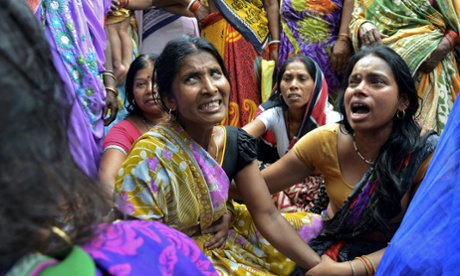
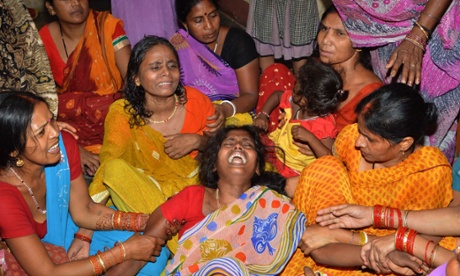
India’s Ministry of Home Affairs says that 17 people have died in the earthquake in northern India.
Some devastating images have emerged from the Bihar state capital Patna, a town on the southern bank of the Ganges. Sixteen of the casualties are people from that state, with one person killed in Uttar Pradesh.
Video footage captures the moment the earthquake struck the Nepalese parliament chamber, causing the politicians to flee the building as it swayed.
The camera judders as the speaker looks around, and MPs start to leave their seats before running from room, as the lights go out.
Updated
The Nepalese government’s National Emergency Operation Centre has revised the death toll from the second quake, and is now reporting 37 people have been killed, with 1129 injured.
Obviously, the situation on the ground moves rapidly and rescue workers have only just begun to search the rubble of newly collapsed buildings.
Death May12 Earthquake 5:55pm Kathmandu 4 Lalitpur 1 Sunsari 1 Sindhupalchwok 5 Dolkha 19 Dhanusha 1 Sarlahi 1 Sindhuli 2 Rautahat 1 cont'd.
— EarthquakeNepal-MoHA (@NEoCOfficial) May 12, 2015
Death May12 Earthquake 5:55pm Ramechhap 1 Gorkha 1 Total death toll 37 Injured 1129
— EarthquakeNepal-MoHA (@NEoCOfficial) May 12, 2015
Updated
Summary
Here’s a summary of the latest developments:
-
More than a thousand people have been injured and many dozens killed in Nepal after it was hit by a second strong earthquake. The Nepalese government said 42 people had been killed and more than a thousand injured.
- The US Geological Survey said the second quake had a magnitude of 7.3 and struck 42 miles (68km) west of the town of Namche Bazaar, close to Mount Everest. Today’s quake was about a fifth of the power of the 7.8-magnitude quake that struck the country on 25 April according to seismologists.
- Nepal’s prime minister Sushil Koirala called for “courage and patience”. Speaking after an emergency meeting of his cabinet, he said: “At an hour of a natural disaster like this, we have to face it with courage and patience.”
- A number of landslides have hindered rescue efforts and attempts to assess the scale of damage. Dramatic video footage and aerial photographs showed whole mountain sides slipping away.
- Aid agencies have expressed concern about the fate of thousands more people forced to sleep rough. Unicef pointed out that 1.7 million children were already in need of emergency assistance before today’s quake.
Updated
Earthquakes are typically defined by the amount of physical destruction they cause, but in Kathmandu the real damage is mental, writes Pete Pattisson in Nepal’s capital.
“It’s like living in a horror movie. Anytime, any place, anything can happen,” said Dr Rumina Malla Joshi, standing outside her home in a residential area of Patan in the south of the city. “We’re prepared to run at any time. It’s constant fear and the unpredictability makes it even more terrifying.”
As the capital has been hit by scores of aftershocks and earthquakes since April 25, people here have become perpetually tense and jittery. A strong gust of wind, the loud squawking of crows or a distant thunderstorm is enough to put people on edge. Even minor tremors have sent people rushing outside. Today’s earthquake has only intensified those fears.
“I’m very scared. I feel like the earth is still moving. It’s like being on a boat,” said Amrit Bhattarai, sitting at a tea stall near the engineering campus of Tribhuvan University where he studies. His friends are playing chess, but Bhattarai says he cannot concentrate – “my mental state is totally out of order.”
Bishal Pudasaini, who is sitting next to him agrees, “We were just beginning to live normally again and sleep inside, but now it feels like I’m about to have a heart attack.”
Updated
“I had just come out of a house in Lamosanghu in Sindhupalchok district when it started shaking,” writes Ishwar Rauniyar.
Within a few seconds it collapsed. I took a long breath. People started running out of their houses, screaming and weeping.
Some were searching for their loved ones. The scene was really chaotic.
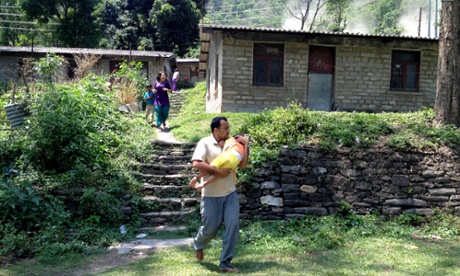
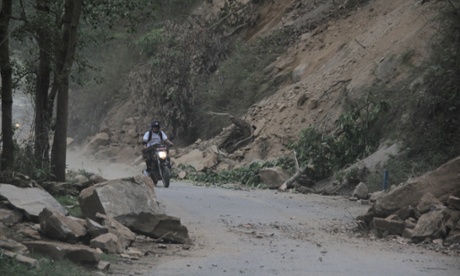
I could see landslides in the hill just above the camp where hundreds of survivors from last year’s landslides were still sheltering.
“The houses in the Lamosanghu bazar started falling down. I could see clouds of dust coming from various parts of the hills and even from the market. Stones were rolling down the slopes. People were shouting fearing they would be buried under the debris.
“People were terrified. One woman continuously crying for help. “My granddaughter is in the home, I don’t see her around, please find her,” she said.
“Police Officials were trying to reassure people.
“While driving back we crossed many landslides areas. The houses that were still standing only a few hours back had been turned to rubble. Police officials were looking for anyone trapped below.
“The road was blocked for more than an hour as before security officials cleared the way.
Updated
Nepal is gripped by fear of future quakes, a local youth charity leader has told Lisa O’Carroll.
Ravindra Shakya, Nepal director of Restless Development, said: “People are really really nervous here in Nepal. Lots of people will sleep outside tonight. They are really afraid.
“It seems a very sad situation as people in Nepal thought it was slowly getting back to normal. There have been 80, 90, maybe 100 tremors since April 25 and it was slowing down, so now people just don’t know if and when another big one will strike,” he said.
The charity is working in Dolakha, a rural district at the centre of the quake. Shakya said he had direct reports of 22 dead and 300 injured, higher than previously reported in the area.
There were also reports of a multi-story hotel in the district capital of Charikot collapsing.
He said there had been landslides and with only one road to Kathmandu, search and rescue was a challenge as night falls.
“There are small hospitals and medical centres, but they are already over-worked,” he said.
Updated
PM calls for courage and patience

Nepal’s prime minister Sushil Koirala has called for “courage and patience”.
Speaking after an emergency meeting of his cabinet, he said: “At an hour of a natural disaster like this, we have to face it with courage and patience.”
Koirala was heckled by the survivor’s of last month’s earthquake after the government struggled to cope with the scale of the disaster. His government acknowledged that it was overwhelmed by the challenge.
The districts of Dolakha and Sindhupalchok, two of the worst affected by the original quake last month, bore the brunt of the damage once more, AFP reports.
“Many houses have collapsed in Dolakha, many houses have collapsed and there is a chance that the number of dead from the district will go up,” said home minister Bam Dev Gautam.
The Red Cross said it had received reports of large-scale casualties in the town of Chautara in Sindhupalchok, where its Norwegian branch is running a field hospital.
“Now hundreds of people are pouring in. They are treating dozens for injuries and they have performed more than a dozen surgeries,” said Red Cross spokeswoman Nichola Jones.
Patrick Fuller, another Red Cross spokesman, said there also had been reports of landslides in Tatopani, near the Chinese border.
Save the Children said two major buildings had collapsed in Kathmandu’s Balaju Nayabazar area while many more multi-storey buildings were showing large fissures.
The Gorkha region had also been hit by landslides and many key roads were blocked, the British charity added.
Updated
Rescue workers have begun hunting new piles of rubble for survivors of the second quake.
.@USAID's DART assess the situation on the ground in KTM, & is coordinating w/ GoN to provide more support, if needed pic.twitter.com/mWLxNZpF30
— USAID Nepal (@USAIDNepal) May 12, 2015
Here's a house that fell today at Bagdol, Kathmandu. Rescue workers still looking for people. #Nepalquake pic.twitter.com/RFuzhfYFWK
— Shiwani Neupane (@ShiwaniNeupane) May 12, 2015
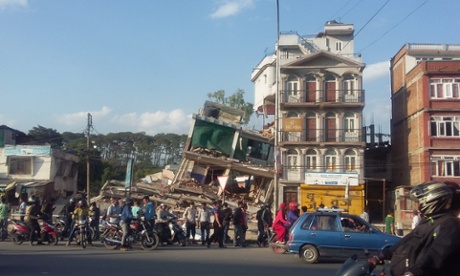
The Guardian’s stringer in Kathmandu, Ishwar Rauniyar, emails a photograph of a five storey building that collapsed in Sallaghari, in the Bhaktapur district. Helicopters have started ferrying injured people to Kathmandu, he reports.
Updated
As night falls just ahead of monsoon season, families across Nepal face a grim plight sleeping in the open, Paul Dillon from the International Organisation for Migration told the Guardian’s Lisa O’Carroll.
He was driving in from the logistics centre at Kathmandu international airport when the quake struck.
“The earthquake was in a synchronous wave. All of the telephone poles were rising and falling as if we were on the ocean. And the electrical cables were dropping to the street and rising up again.
“I watched watching hundreds and hundreds of terrified people pour from their homes into the park area, women with children, one man with a towel around his waist and soap in his hair just ran out and collapsed. He was inconsolable,” said Dillon.
He said he spoke to one extended family of 14 who had spent seven days in the park and had now returned to the same spot.
“The monsoon normally doesn’t start till June but for the past three days we’ve had a exceedingly heavy rainfall. My concern is these people are going to be under the tarpaulin again huddled with their children and other relatives. We are in for an awful night,” he said.
He said he feared for the lives of those in Chautara town in Sindhupalchok district which had become a base for international charities.
“Roughly 90% of the buildings there were razed to the ground on April 25. One of our staff did a walk around immediately after the earthquake and saw at least 10 buildings fallen down.
“The main street is along a ridge with buildings of four or five stories high. If people were in them, we can expect the casualty rate to rise in the next few hours.”
He said a group of Swedes and about 100 Nepalese police, armed with pick axes and other tools, had immediately mounted a search and rescue operation in the town.
Updated
Yet more people will be forced to sleep rough after today’s quake, the UN has warned.
Too scared to go home: Many people expected to stay outside tonight as they fear further #NepalQuake aftershocks pic.twitter.com/K7J97k8kdu
— UN OCHA Asia Pacific (@OCHAAsiaPac) May 12, 2015
A child helping out in pitching tent at Galkopakha #NepalQuake pic.twitter.com/j5F4CX4mE6
— Anurag Acharya (@Anurag_Acharya) May 12, 2015
The British embassy in Nepal is offering help to any Britons caught up in the aftermath of the second quake.
Our staff are visiting hospitals, hotels, areas popular with tourists looking for British nationals who may need assistance #NepalQuake
— British Embassy (@UKinNepal) May 12, 2015
On Saturday, the Foreign Office confirmed that British backpacker Matthew Carapiet was among the those killed in last month’s earthquake.
The US embassy in Nepal has issued emergencies telephone numbers for those concerned for US citizens in Nepal.
Write to: NepalEmergencyUSC@state.gov for questions on US citizens affected #NepalQuake. Or call: 18884074747 or +12025014444
— U.S. Embassy Nepal (@USEmbassyNepal) May 12, 2015
Updated
World Vision chief executive Tim Costello is desperately worried for the fate of locals and his staff in Nepal, the Australian Associated Press reports.
He is yet to make contact with his 200 aid workers on the ground or receive any damage assessments because communications are down.
Reverend Costello, who was in Nepal in April following the first quake, was not surprised there was a further quake and described the aftershocks as terrifying.
Oxfam’s Nepal country director Cecilia Keizer said two of their vehicles were being used to ferry casualties to medical centres.
“Our team in Nuwakot also saw a building collapse, and reported a landslide on slopes above them,” Ms Keizer told AAP in a statement from Nepal.
“The Gorkha team reported building collapses in Gorkha, the epicentre of the previous earthquake.”
Updated
Death toll reaches 42
The death toll continues to rise ominously quickly. It has now reach 42, according to official figures.
Nepal’s National Emergency Operation Centre has a regional breakdown of the casualties.
Dead: Sindhupalchowk(9); Dolakha(19);Kathmandu(4); Lalitpur(1); Sindhuli(2);Sunsari(1); Rautahat(1); Sarlahi(1);Dhanusha(1); Ramechhap(3)
— EarthquakeNepal-MoHA (@NEoCOfficial) May 12, 2015
Updated
In one of her first statements since being reappointed as the British development secretary, Justine Greening said the UK will continue to help earthquake survivors in Nepal.
Terrible to hear news of today’s earthquake in #Nepal. The UK will continue to help those affected.
— Justine Greening (@JustineGreening) May 12, 2015
Updated
Thirty-six dead
The official death toll has now risen to 36, with 1,117 injured, according to the National Emergency Operation Centre
May 12 Earthquake Death 36 Injured 1117
— EarthquakeNepal-MoHA (@NEoCOfficial) May 12, 2015
This picture showing clouds of dust kicked from a shaking mountainside was taken from a helicopter flying above Namche, the epicentre of today’s quake, according to Doctors for Nepal. The photographer, Dr Lalit, described seeing lots of landslides around the area.
Shocking images from Dr Lalit flying over Namche as big #EarthquakeInNepal happens today pic.twitter.com/hs3R91uTKc
— DOCTORS FOR NEPAL (@DoctorsForNepal) May 12, 2015
Dr Lalit was in air with MSF heli above namche (#EarthquakeAgain ) "trying to land; Saw houses broken, landslides:lots of landslides.. "
— DOCTORS FOR NEPAL (@DoctorsForNepal) May 12, 2015
Rebecca Stewart from Save the Children described the scene as she travelled through a rural part of the Nepal. She told colleagues on the phone:
We were driving through the village of Shipaght in Sindhupalchok District to the east of Kathmandu when the quake hit.
People started running from their homes screaming and shouting as the ground shook. Animals went crazy too. Everyone was terrified and are now too afraid to stay indoors. There are a lot of landslides but we’ve managed to avoid big rocks landing on the road.
Updated
Rescue workers are attempting to save a woman buried under rubble in a Kathmandu bus park, according to reports. A four-storey building has also collapsed at a bazaar.
This building collapsed in Naya Bus Park today's quake; Nepali security forces working to rescue elderly woman inside pic.twitter.com/B1W4yW5rJc
— Kashish Das Shrestha (@kashishds) May 12, 2015
A four-storey building collapsed in Nayabazar following the earthquake. Pics: @Dambarks #NepalEarthquake pic.twitter.com/USgAJPN8Dc
— Nepali Times (@nepalitimes) May 12, 2015
Clarification: Earlier we mistakenly reported that Naya Bazaar and the Naya Bus Park were at the same location. Apologies and thanks to reader Rachel Moles for putting us right.
Updated
This is Damien Gayle taking over the blog from Matthew Weaver for an hour or so. First, an explanation of the differences between the two earthquake magnitude explainers given so far.
Richard Luckett, a seismologist with the British Geological Survey, said the Richter scale, referred to in the first explainer, is a synonym for local magnitude. It doesn’t really apply to earthquakes of greater than magnitude-6, he said. Earthquakes of greater than six are measured according to the Moment Magnitude Scale.
The first explainer suggested a single digit increase in the power of an earthquake would release “32 times more destructive energy”, while the second said such an increase would result in an earthquake ten times more powerful.
That latter figure applies to the amplitude of the earthquake, Luckett said, which is the distance the ground moves. The former figure applies to the speed the ground is moving during the earthquake, so could well be a better estimate of destructive potential.
Updated
Extraordinary video from the Red Cross shows a landslide near Dhunche, north of Kathmandu, triggered by today’s earthquake.
Here's a video we have just received from @redcrosscanada near Dhunche, #Nepal, after today's #NepalQuake. pic.twitter.com/R82VlU4PLs
— IFRC (@Federation) May 12, 2015
The official death toll has risen to at least 19, though there are unconfirmed reports that 29 people have died.
Nepal's Home Ministry says at least 19 people killed and 981 injured in latest earthquake.
— Jason Burke (@burke_jason) May 12, 2015
29 reportedly dead, more than 1,000 injured in #May12 #NepalQuake. I feel my body shaking in #SriLanka.
— Ujjwal Acharya (@UjjwalAcharya) May 12, 2015
Updated
There are chaotic scenes in Kathmandu, according to Goal Global’s country director in Nepal, Dr Raj Singh:
People are not permitted to enter buildings at the moment and we have had three aftershocks since the quake, one of which was very pronounced.
“We were working inside when the earthquake struck. Tables and chairs started to shake violently, doors were opening and closing and people started to panic. We got out as soon as we could and we saw buildings swaying as the shaking continued. The earthquake lasted approximately 30 seconds. It was chaotic; people here are extremely scared
“From where I am standing, I can see cracks in several buildings and there is a real fear of buildings collapsing.
“We’ve been delivering aid to extremely vulnerable families in four of the most-affected districts around Kathmandu. The latest quake will undoubtedly complicate and frustrate this work.

Updated
Catherine Cowley, from the aid agency Cafod, provides another account of the moment the earthquake hit. Writing from in Bakrang in Gorkha district, one of the worst hit districts from the first quake, she says:
There was a large group of us meeting outside when the earth started shaking. Everyone started pointing at the trees and running. The earthquake lasted quite a while and there have been several aftershocks since then. Many houses in the villages here had already been destroyed by the last earthquake, but we saw one that had only been cracked collapse. Across Nepal, a lot of houses which were already partially damaged could fall down.
“The impact could be immense. But the biggest impact is fear. Everyone is desperately trying to contact their families to make sure they’re safe. Everyone is scared that more buildings will collapse. When we started the car to leave the village, a woman screamed because she thought the engine noise was another aftershock. People are traumatised and panicking. Driving through the countryside you can see people gathered outside, scared to go indoors.

Updated
Sixteen dead
The official death toll has risen to 16, according to the National Emergency Operation Centre, as more reports of casualties from regional officials emerge.
May 12 Quake Update-Injured details: Total Death(16); Injured(335)
— EarthquakeNepal-MoHA (@NEoCOfficial) May 12, 2015
my colleague @RauniyarIshwar just spoke to top bureaucrat of Sindhulpalchowk. says 8 dead, 100 + injured #NepalQuake
— Jason Burke (@burke_jason) May 12, 2015
Twelve people killed.
Nepal’s government says 12 people have died in today’s quake. Its National Emergency Operation Centre said eight of the casualties were in Dolahkha district.
May 12 Quake Update Death tolls: Chautara(2);Dolakha(8); Sindhuli(2)
— EarthquakeNepal-MoHA (@NEoCOfficial) May 12, 2015
Reuters said at least nine people have been killed and further 300 injured.
At least four people were killed in Chautara town in Sindhupalchok district, north of the Nepali capital Kathmandu, a spokesman for the International Organisation for Migration said.
Police in the Himalayan nation confirmed at least three deaths, as the government struggled with patchy phone lines to gather information. It wasn’t immediately clear if they were referring to the same people.
Four people were also killed in Indian states bordering Nepal, one in Uttar Pradesh and three in Bihar, officials said.
One person died in Tibet after rocks fell on a car, according to Chinese state media.
Updated
The latest earthquake in Nepal – measured at 7.3-magnitude – is about a fifth of the power of the 7.8-magnitude quake that struck the country on 25 April, writes Damien Gayle.
These days earthquakes are measured by the US Geological Survey according to the Moment Magnitude Scale (MMS), which succeeded the Richter scale in the 1970s. MMS measures the size of the waves generated by an earthquake on a base-10 logarithmic scale, such that there is a ten times difference in power between a magnitude-1 quake and a magnitude-2 quake.
Richard Luckett, a seismologist with the British Geological Survey, said: “It’s a logarithmic scale, so magnitude-4 is ten times bigger than magnitude-3.” In the case of the latest Nepal earthquake, Luckett said, “because it’s about half a magnitude smaller it’s about a fifth of the size”.
The magnitude is describing the the energy generated by the movement of tectonic places, Luckett said, but that doesn’t necessarily equate to the effects felt by people affected.
“The magnitude is the actual energy of the earthquake itself. How that effects you will depend on how deep the earthquake was, how far away it was from you, what the land you are standing on is like and even what kind of building you are in.
Updated
There are concerns that many children have been injured in a school in the Solukhumbu region, writes Carole Cadwalladr in Kathmandu.
Reports from the Everest region say many children have been hurt. There are also reports of mass casualties and buildings destroyed in Dolokha according to the local radio.
One of the Everest climbers who was at base camp during the avalanche last month said a helicopter evacuation had been ordered. Jamie Melgaard, an Australian climber, had gone out to a very remote villages with a Norwegian medical team and they have requested helicopters been sent to ferry the severely injured from Thimbu.
An MSF team are working outside my hotel. Nobody is going back indoors. A spokesman said have no information as yet on scale of devastation.
The good news is that I’ve heard that Nakul’s parents are safe. And five people have been rescued alive from a building close by in Kathmandu, according to Nepali radio.
The UK’s Disasters Emergency Committee has confirmed that its Nepal Earthquake Appeal will allow its member agencies to provide support to people affected by today’s earthquake. Donations to the appeal will be accepted until the end of May.
Chief executive Saleh Saeed said:“DEC member agencies are now urgently seeking to assess the needs of those worst affected by today’s quake. They are also taking stock of any disruption that may have been caused to existing aid efforts.”
So far the DEC’s Nepal appeal has raised £50m.
Here is a Guardian version of the video showing the moment the earthquake shock a cafe in Kathmandu.
Updated
Unicef has expressed concern for the fate of children caught up in Tuesday’s quake.
Rose Foley, from Unicef Nepal, gave this first hand account of the moment the quake hit:
We dived under tables in the Unicef building as it rocked from side to side. The shaking seemed to go on and on. We got out to safety as soon as possible. Sitting out in the open it felt like I was on a boat on rough seas as aftershocks hit. We are thinking of every child in Nepal who has already been through so much. We are very concerned about the impact this new quake could have on children who are already very vulnerable. 1. 7 million children are in urgent need of humanitarian assistance after the 25 April earthquake, requiring clean water, shelter, sanitation.
“Unicef has been working round the clock to get life-saving aid to children since the first quake hit – including tents, safe drinking water, hygiene kits, medical supplies and vital counselling to help children come to terms with their experiences. We have teams on the ground in every affected district.
“Our focus is now on how children may have been impacted by this new earthquake – both in terms of their immediate humanitarian needs and the devastating emotional impact that this new shock could have. Unicef will do everything possible to keep children safe.

Updated
Kathmandu is a city on edge, writes Pete Pattisson in Kathmandu.
The moment the earthquake struck, thousands of people dashed out into any open space they could find. The roads quickly became clogged as many rushed home, apparently to check on houses and families.
Within minutes of the earthquake, I saw people in a community on the northern edge of the city hauling canvas sheets over bamboo frames in preparation for more nights out in the open.
It’s all a grim reminder of the earthquake that struck on 25 April. Since then, the city has outwardly returned to normal, but the trauma of that quake has left everyone anxious and hyper-sensitive to further shocks.

Updated
“Everyone is still outside – extremely scared to go back in for fear buildings may once again collapse,” says Dr Pranav Shetty from the International Medical Corps in Nepal. In an email he adds:
I see many families with young children sitting outside in the very hot sun. Hotel workers are passing out water and biscuits. One team immediately went to Patan hospital, where we had already been providing medical care, to offer our help. Another team is doing a helicopter assessment. Aftershocks are continuing to rattle nerves.

Updated
Jimmy Nadapdap, earthquake response manager from the NGO World Vision, describes on GuardianWitness the moment the earthquake struck:
I could see in the eyes of the people who experienced the first quake – they were just terrified. We all managed to get outside to safety. We are now trying to locate our staff – many are in the field working on our relief operations today. It is a reminder of how challenging this situation is for us all.”
Updated
Although Tuesday’s earthquake of 7.3 in magnitude was weaker than last month’s earthquake, which registered at 7.8, it still has the potential to cause widespread damage writes Caelainn Barr.
The Richter scale is a base-10 logarithmic, or non-linear, scale that indicates the strength of the earthquake. It means an earthquake that registers 7 on the scale has ten times more ground motion than one measured at a 6 magnitude. As a result a single digit increase on the scale can cause a much stronger event, releasing 32 times more destructive energy than a lesser earthquake.
Earthquakes between 7 and 7.9 on the Richter scale are classed as a major quakes and there are an average of 15 per year worldwide according to the US Geological Survey.

Kathmandu airport is reportedly closed.
The earthquake sent hundreds of people fleeing terminal buildings on to the tarmac at Kathmandu airport, according to this video from journalist Jack Board.
Hundreds of people running of out of Kathmandu airport. Scary shaking from aftershock #NepalQuake pic.twitter.com/XiIdB0BCCS
— Jack Board (@JackBoard) May 12, 2015
People still standing out on tarmac at KTM airport, a lot of them on the phone #NepalQuake pic.twitter.com/mPHchGiXVI
— Jack Board (@JackBoard) May 12, 2015
Meanwhile, there are reports of several buildings collapsing or threatening to collapse.
This 4-story block went down in Kathmandu, pedestrians thought to be underneath. #NepalQuake @Dambarks pic.twitter.com/tS1NgGxDXS
— Kunda Dixit (@kundadixit) May 12, 2015
Himalayan Bank inTribhuvan Univ Teaching Hospital compound is about to collapse security has cleared the surrounding areas. #NepalEarthquake
— U.S. Embassy Nepal (@USEmbassyNepal) May 12, 2015
Several buildings in the town of Chautara #Nepal have collapsed-IOM's Paul Dillon told @ReutersWorld http://t.co/iBvp2NJlLS #NepalEarthquake
— IOM (@IOM_news) May 12, 2015
Updated
There have been aftershocks every day or so since last month’s earthquake but this immediately felt different, writes Carole Cadwalladr in Kathmandu.
There were massive tremors and the staff at the hotel I’m at started shrieking and running for the garden.
I’d just arrived back from a six hour drive from a remote mountain village and followed them down the steps. Chefs were motioning me to crouch down in the brace position.
It went on for what felt like a good couple of minutes ... a bit like being on the sea. Next to me, a woman burst into tears. “My mother is on the third floor,” she kept on saying.
Up on the terrace, there’s a view over the city and we could see several plumes of dust rising, presumably from collapsed buildings. There was another couple of biggish aftershocks that had everyone running again but it looks – on very initial impressions – as if Kathmandu has been largely spared. But the epicentre is in Sindhupalchok, which was devastated by the last quake.
It’s very close to where I went last weekend to write about the aftermath for the Observer. And I’m very worried about the people I met there. I went to find Nakul who works in the hotel laundry and who took me to his village, where I met his parents and brothers, but he can’t get through to them on the phone.
The temporary shack they had built was directly beneath the very precarious remains of their house. I’m very much hoping they had time to run down the hill.

Updated
Two deaths in India
The Times of India reports at least two deaths in the eastern Indian state of Bihar.
One person died at Anand Bazaar in Danapur area, about 12 km west from the state capital, as a wall fell on him, while a second person, a girl, was killed near Mahua in Vaishali district while fleeing after the first tremor.
Updated
'Several dead'
The Norwegian Red Cross says several people have been killed, citing reports from its field hospital.
Nytt kraftig skjelv rammer #Nepal. Mange skadde, flere omkomne. Feltsykehuset til @rodekorsnorge har allerede fått inn pasienter.
— Røde Kors Norge (@rodekorsnorge) May 12, 2015
Updated
First hand accounts from Nepal describe the moment the earthquake struck and what has happened in the immediate aftermath.
Another #NepalQuake just hit: a 7.4. I'm fine but a little nauseous. Dismounted from my bike without falling. http://t.co/RNeESxG6qX
— Robert Penner (@robpenner) May 12, 2015
Unlike last month’s quake, which hit at lunchtime on a Saturday when many people were away from schools and offices, this one occurred during a weekday.
BuzzFeed’s Anup Kaphle said many people in Kathmandu were at work when the earthquake hit.
Most people in Kathmandu were in offices when the quake struck. Everyone bolted toward streets. #NepalEarthquake pic.twitter.com/NH1V3ykNAf
— Anup Kaphle (@AnupKaphle) May 12, 2015
Older homes that tilted two weeks ago are crumbling in Lalitpur countryside, local radio station says. #NepalEarthquake
— Anup Kaphle (@AnupKaphle) May 12, 2015
IOM staff comfort terrified people in Chautara after #EarthquakeAgain in #Nepal pic.twitter.com/PU4vERtPBF
— IOM (@IOM_news) May 12, 2015
Updated
Grim reports are emerging of bodies being recovered from ruins and injured people being brought to hospitals.
“Buildings down in Chautara … Bodies being brought out of buildings,” the International Organisation of Migration, a United Nations agency, said on its Twitter feed.
Three major landslides were reported in Sindhupalchowk district, with at least 12 people hurt, a district official told Reuters.
Sindhupalchowk was the region that suffered the most reported deaths in the 7.8 magnitude earthquake that devastated Nepal on 25 April. The epicentre of Tuesday’s quake was in a remote conservation area between Kathmandu and Mount Everest.
Video from Kathmandu shows a cafe shaking the moment today’s quake struck:
Updated
Opening Summary
Welcome to our live coverage of the aftermath of a second powerful earthquake to hit Nepal, just over two weeks since a devastating tremor killed more than 8,000 people and destroyed hundreds of thousands of homes.
The US Geological Survey initially said the quake had a magnitude of 7.1 and struck 42 miles (68km) west of the town of Namche Bazaar, close to Mount Everest. The quake was upgraded to a magnitude of 7.4 minutes later, and then downgraded to 7.3. Shockwaves were felt as far away as the Indian capital, Delhi.
Tuesday’s quake came from a depth of 11.5 miles, deeper than the 9.3-mile depth of the quake on 25 April. More shallow earthquakes tend to cause more damage at the surface.
Shockwaves were felt across northern India and as far away as Delhi, where buildings swayed for more than a minute and people scurried into the streets.
Hundreds of people running of out of Kathmandu airport. Scary shaking from aftershock #NepalQuake pic.twitter.com/XiIdB0BCCS
— Jack Board (@JackBoard) May 12, 2015
Updated