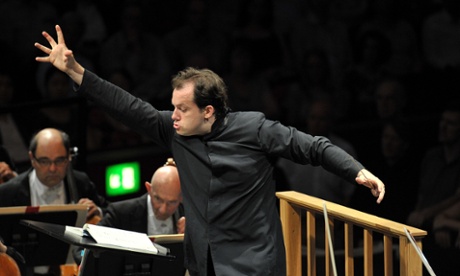
I’ll be honest. I didn’t see that one coming: the Leipzig Gewandhaus Orchestra has announced that Andris Nelsons will take over as their Music Director from 2017. The news comes with astonishing speed - it’s not even a week since Riccardo Chailly’s departure from the Leipzig job – four years earlier than his contract stipulated – was also announced.
Confused? I’m not surprised: add to this mix of intra-conductorial coincidences the fact that Chailly is taking over the Lucerne Festival Orchestra from next year (admittedly, the Lucerne ensemble only performs in the summer), a job for which Nelsons was previously hotly tipped, and you have the makings of either a remarkable piece of maestro-swapping serendipity, or the fulfilment of a lot of behind-the-scenes bargaining that have clearly been a long time in the planning.
The Gewandhaus orchestra has simultaneously revealed an ambitious cross-continental collaboration with Nelsons’ other orchestra, the Boston Symphony, with whom he’s just extended his term until 2022. Aside from a set of orchestral obligations on either side of the Atlantic that would tax even Wotan and his overloaded spear, Nelsons says that Boston and Leipzig will work together in future seasons, presenting a week of each other’s repertoire in their respective cities and collaborating on co-commissions (they’ve already said they will perform a new work by Jörg Widmann in the 2017-18 season). Christoph Wolff of Harvard University has been appointed “artistic advisor to the new coalition”, as the New York Times reports.
Beyond the awesome (in both sense of the words) responsibilities that Nelsons now takes on his 36-year-old shoulders, while there are many precedents for the whole one-maestro, two-glamorous orchestras situation, what’s less common is having to lead such high-profile and high-pressure institutions at such an early stage in a career. Being in charge of either one of these orchestras at any point of your musical life would be a dream come true for most maestros, but running both at the same time risks turning potential collaboration into artistic dilution. Instead of distinctive and differently weighted projects with both orchestras, there’s the danger that Nelsons could end up working on the same ideas, making the same kind of sound in the same kind of repertoire, on both sides of the ocean.
There are also the brutalities of fact of being in a position of having to run frenetically hard just to catch up with your schedule, and the grim realities of jet-lag when you’re a servant to two orchestral masters, let alone focusing on your artistic development and immersion in new repertoire. Nelsons obviously feels he has the energy and the vision to “to pass a great heritage into the future, but also to create the future, to create the opportunity for composers to compose and to play their pieces, but not to lose, not to forget – which you can’t forget – [the] great masters”, as he tells the New York Times. His performances at this summer’s Proms convinced many of how powerful his leadership of the City of Birmingham Symphony Orchestra was, and how it could be with the Boston Symphony (although Andrew Clements had doubts about the success of his Boston project so far). Only time and trans-continental connections will tell if this is an inspired appointment, or an orchestra too far.