Dr Neil DeGrasse Tyson, an astrophysicist and director of New York’s Hayden planetarium, researches some of the most complex areas of the cosmos. Star formation, dwarf galaxies, and the structure of the Milky Way are just some of the areas of his work.
That he can talk about these dense topics on stages in sold-out venues normally reserved for philharmonic orchestras or Broadway musicals is thanks to his ability to communicate science in a compelling and relatable way.
Part of his appeal is that he applies as much humour, curiosity and academic rigour to the arguably less highbrow areas related to his field, such as UFOs and science-fiction, answering questions in a manner that is enthusiastic and never dismissive.
“There are ways to do time travel that are astrophysically legitimate,” Tyson tells listeners in a recent episode of his podcast Star Talk, a show where science, pop-culture and comedy frequently collide.
He then launches into an interview with Christopher Nolan, the director of science fiction film Interstellar, and the pair debate the use of wormholes for travel through space and time, discuss the possibility of alternative realities, and reflect on how film can be used to explore these.
“One does not have to be mathematically fluent to bask in the majesty of the cosmos,” Tyson reassures his listeners, before unpacking which film is more scientifically realistic: Interstellar or Star Trek?
Ahead of his upcoming Australian tour, Tyson says that as a world-renowned scientist and science communicator, his role is to encourage curiosity in whatever form it appears. That thousands of people fill arenas to hear him do this says more about them than it does about his talent or intellect, he says.
“It tells me that everybody – and if not everybody, certainly most people – has an inner passion for curiosity,” Tyson, a Harvard University physics major, says.
“I’m delighted to be a participant in fueling this passion, because I think it’s real, and I think it’s irreversible. And that’s a good thing, especially at a time where there are many anti-scientific forces out there.”
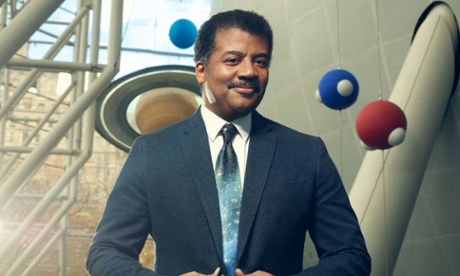
But Tyson is more than a participant. He’s at the forefront of a swelling appetite for science, and his descriptions of the world and how it works are compelling. His way with words is thought-provoking and he provides pithy analogies to make complex theories relatable, often combining them with a sharp wit.
No topic bores Tyson when he appears before an audience, even if he has been questioned about it many times before. He happily goes off on tangents, making rapid mathematic calculations on the spot to determine, for example, how long it would take to travel to a star 10 light-years away. He comes up with new questions that he ponders aloud, and that even he can not answer.
Importantly, he comes across as approachable despite an intellect which has seen him awarded countless honorary doctorates and scientific awards. He is not afraid to admit what he does not know. He is also not shy about putting his excitement for science and infinite curiosity on display.
And it’s contagious.
Tyson collaborates with people in fields like the arts and technology to share this enthusiasm through as many mediums as he can embrace. He has appeared on shows like the Colbert Report and the Daily Show with John Stewart, and on his radio show interviews leading scholars as well as celebrities about their views on the universe.
Last year, he paired up with Family Guy creator, Seth McFarlane, to produce the multi-award-winning Fox network documentary series Cosmos: A Spacetime Odyssey. A high-tech revamp of the landmark 1980s series Cosmos: A Personal Voyage, hosted by astronomist and astrophysicist Carl Sagan, Tyson worked closely with Sagan’s widow, Ann Druyan, to create the modernised version of the show.
Druyan said at the time that part of her motivation for working with Tyson on the updated series was a need to “make the case for science and for the wonder of the universe revealed by science” at a time when scientific skepticism abounds.
Science deniers and how to respond to them is a topic Tyson is frequently pressed on during live Q&As, and one that he often brings up himself. His view is that science education and, more importantly, science literacy, should be encouraged from an early age to counter the effects of pseudoscience.
“For me, this began with a visit to the Hayden planetarium at age nine,” he says.
“There were people at the planetarium who were influential on the kind of person I might want to become. They were educators who made learning so much fun, and scientists who knew so much. I couldn’t imagine knowing that much. How long would it take me? That’s the kind of knowledge I wanted.”
Tyson says now that he has acquired this knowledge, he has little interest in arguing with people who reject science. Especially politicians. There are more important people to target, he says.
“It’s been quite the pastime for people to complain about their representatives and their politicians, speaking of their ignorance or their blind action in terms of legislation,” Tyson says.
“But I have no interest in speaking to politicians because, at one level, they’re representing an electorate. So your complaint is not with the politician, it is with your fellow countryman who voted these politicians into office.
“As an educator, I feel compelled to bring these ideas and this empowerment to the public so that I don’t have to keep running back to parliament to try to train politicians about what science is. Because the people who elect them will know that from the beginning.”
Tyson says he would rather spend his time encouraging people to become enthused about science and curious about the world. It is something he will focus on during his upcoming Australian live shows.
“Maybe that curiosity is an ember that needs to be fanned, that needs to reignite its flames,” he says.
“Or maybe for some people, it was extinguished long ago. But I see it as my task to fan that flame, to make it bright, or to reignite it if you’ve forgotten that it’s there in the first place.
“It’s not me lecturing you. It’s me empowering you to think for yourself. So hopefully, you can walk away from my show saying, ‘I am now closer to the universe than I have ever been before’.”
- An evening with Dr Neil DeGrasse Tyson takes place at the Plenary in Melbourne on 7 August, then the Courier Mail Piazza in Brisbane on 16 August, Hordern Pavilion in Sydney on 22 August, Llewellyn Hall in Canberra on 23 August.