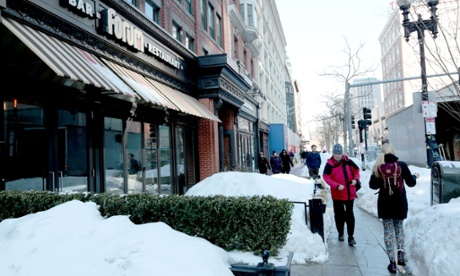
On 15 April 2013, on the day of the Boston Marathon, the second of two pressure cooker bombs detonated at 2.49pm outside a Boston restaurant called the Forum. Today, the restaurant is closed. Outside it, the snow is piled four feet high, hiding the place of the detonation.
Last week, in a federal courthouse less than two miles from this spot, prosecution lawyers showed for the first time harrowing footage taken from the Forum’s security cameras on the day of the bombing.
The prosecution paused the film to highlight a figure in a white baseball cap turned backwards. This, they contend, is Dzhokhar Tsarnaev, the surviving brother of the two siblings accused of perpetrating the devastating attack, which killed three people and injured more than 250.
The video started again, showing a crowd of heads snapping left, following the noise of the first bomb detonating up the street. Then the second bomb, placed just outside the restaurant, is detonated. The video is silent, but the devastation is clear, immensely shocking and immediate.
Today, under ice and snow and behind the crowds of shoppers and tourists, little evidence remains of the terror – though on a metal railing on the pavement outside the Forum, a sticker shows a yellow and blue ribbon – the colors of the marathon finish line – and the post-attack slogan “Boston Strong”.
The inside of Marathon Sports, the shop at the spot where the first bomb detonated, is decorated with hand-drawn posters carrying variations on the same theme. A yellow and blue band, made from pipe cleaners, hangs on the door, and outside a shrine to the four victims carries the hand-painted message: “We will never forget them.”
In a Starbucks next door to the shuttered Forum, Tim Richmond tells the Guardian it is important that – despite four separate motions and two appeals by Tsarnaev’s defence team to try to have it moved – the case is being tried here in Boston.
“A lot of people are holding on to this trial,” he says. “People want to see it followed through.”
Richmond and Susan Hailey live in nearby Cambridge, and are both runners – Richmond has run the Boston Marathon himself three times, though neither were running in 2013. In 2012, the year before the bombing, they had watched the runners finish from right here on Boylston Street.
For Hailey, the uncertainty that followed the bombings turned into a general sense of unease that never quite dissipated. “I think that, after this trial, that uncertainty can subside,” she says.
This is the highest-profile trial of an alleged terrorist on American soil since that of Timothy McVeigh, the Oklahoma City bomber, in 1997. In that case, a judge allowed a motion for the trial to be moved – he was tried, and eventually convicted and sentenced to death, in a federal court in Denver, Colorado.
Part of the soul-searching involved in a trial of such magnitude is the search for meaning. Is this trial about vengeance? WillWould a conviction finally bring closure in a city where, ashas been noted in court, almost everyone has a link to someone who was there that day? Would a death sentence?
Hailey is against the death penalty. “Personally, I think there’s something to be said for someone having to sit and think about what they did, for the rest of their eternity,” she says.
But Richmond isn’t so sure. “It seems clear that he did it, given the defence position,” he says. “Now we have to pay for him to live for 50 or 60 years?”
Both agree that for them, the death penalty phase of the trial – a sort of trial within a trial, where if Tsarnaev is convicted jurors will hear evidence as to whether to execute him, something for which the vote must be unanimous – will be the most important part of the proceedings.
Lisa Laplante is associate professor at the New England School of Law and a lifelong Boston resident; her work looks at the relationship between justice and closure. She says trials don’t usually offer much closure for victims, but thinks that this one might be different. “If [Tsarnaev] testifies, maybe it’ll allow people to understand him a little.
“I think for a sense of rule of law, it’s better to try him here than send him to Guantánamo,” she says. “This way, you can see accountability. If it had been elsewhere there might not be that closure.”
Lisa Freudenheim, a friend of Laplante and a mother of two, who lives a block from where the bombs went off, said that while typically she is against the death penalty, “I cannot fathom feeling like that wouldn’t be justice in this case.”
She says that her kids, who are now nine and 11, experienced the events as a traumatic disruption of their sense of safety. “Now they’re catching bits and pieces on the news, and it’s coming up again, and they’re re-experiencing it,” she says.
“It is certainly churning up memories and feelings. For children it will, I think, force them to relive something that was hard for them.”
In Marathon Sports, all of the staff are new now – none were working here the day of the bombing. The Forum is now closed down, not because of the bombing, but because of rising commercial rent prices. And in just a few weeks, runners in “America’s Marathon” will once again run past this very spot to the finish line.