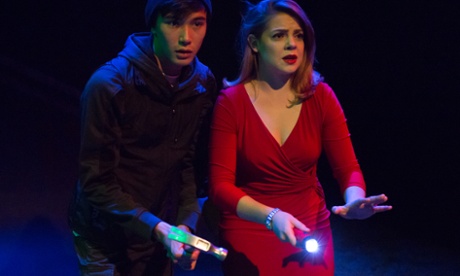
What has the internet ever done to Jennifer Haley? The Nether offered a chillingly astringent take on life online and the seeming anonymity with which we can conduct it. Her vision of virtual reality is hardly rosier in Neighborhood 3: Requisition of Doom, an exciting if less demanding play, written earlier, but only now making its New York debut, under the direction of Hollywood veteran and theater tenderfoot Joel Schumacher.
The surrealistic Neighborhood 3 imagines a suburban community whose teenagers are in thrall to a game with elements of both a MMORPG and a first-person shooter, although here the rampaging zombies aren’t offed by guns, but by DIY domestic accoutrements such as barbecue forks and hedge clippers. Adolescents play the game obsessively, wither together at each other’s houses or on their own, communicating via headset.
This game play alienates them from their parents, who don’t understand the fascination and who worry over their increasingly antisocial behaviour. Clearly the game is a metaphor for a generational divide, but in Haley’s play metaphors won’t stay figurative. The line between the game and the neighbourhood outside starts to blur and the horrific acts within the game play may have corollaries in life. How else do you explain all the sirens, the caution tape, the seemingly sinister activities of the neighborhood association?
As one teen girl says, in a knowing speech early in the play, it “sounds like something out of a horror movie like you’re about to play this video game and you think it’s just a game but actually it’s real but these teenagers don’t know it but the audience knows it”.
Schumacher has directed suspense movies and action movies, but whatever he has brought to this Flea, it isn’t a Hollywood budget. Here the trees are cardboard, the grass plastic. Schumacher has cast the play with the Bats, the Flea’s resident unpaid acting company and this is something of a problem, too. The script was originally written for four actors and there’s relatively little harm done in expanding the cast to 17, the better to serve the eager players (a slight loss of thematic resonance, a more significant one of actorly acrobatics). But the play indicates a significant gulf between teenagers and their parents. Here they are all played by twentysomethings, which flattens some of the play’s critique, though Haley’s vision of gaming gone wrong remains more sensational than it is complex.
At one point a live-action zombie game which would have romped through Tribeca’s streets was announced as an accompaniment to the show, but it was later scrapped for lack of funding. Perhaps that’s not such a bad thing. At the performance I attended, a woman seated in front of me had placed a coat or a bag too near a floor light and it began to smoke, very nearly catching fire. That was a reality better left virtual.