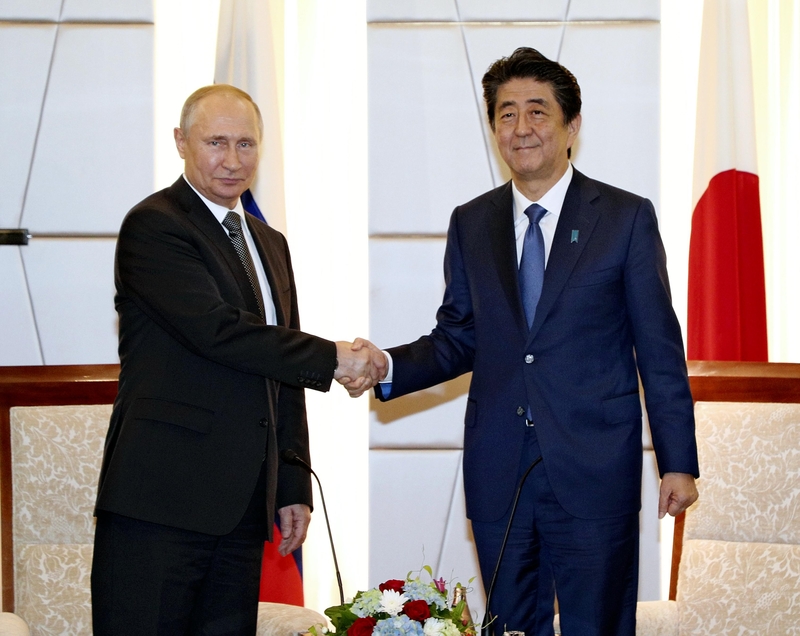
Dec. 15 marks the third anniversary of talks between Prime Minister Shinzo Abe and Russian President Vladimir Putin in Nagato, Yamaguchi Prefecture, where they agreed to start negotiations on joint economic activities in the northern territories, aiming for the conclusion of a peace treaty.
Foreign Minister Toshimitsu Motegi will visit Moscow for the first time from Dec. 17 to meet with his Russian counterpart, Sergei Lavrov, in a bid to break the deadlock in the treaty negotiations. The bilateral meeting is scheduled to take place on Dec. 19.
"I think we'll have plenty of time. I want to start concrete talks to resolve the territorial issue and conclude a peace treaty," Motegi told a news conference on Dec. 10.
During the three years since the Nagato summit on Abe's home turf, the two countries have made progress on five-point joint economic activities, including sightseeing tours and measures against garbage. A pilot project for tourism was held this autumn. Former residents of the northern territories visited ancestors' graves by air for three consecutive years from the summer of 2017.
Confidence-building between Tokyo and Moscow, which is necessary to promote treaty negotiations, can be said to have progressed somewhat.
In the United States in January 2017, the administration of former President Barack Obama, who strongly distrusted Russia, was replaced by that of Donald Trump, who has a keen interest in improving U.S.-Russia bilateral relations. This change was expected to be a tailwind for the treaty negotiations.
However, there are no signs of progress in the negotiations.
In September 2018, at the Eastern Economic Forum in Vladivostok, Putin proposed to Abe that their nations forge a peace treaty by the end of the year without setting any preconditions.
At a Japan-Russia summit meeting in Singapore in November 2018, the two countries agreed to speed up negotiations based on the 1956 Japan-Soviet Joint Declaration specifying that the Habomai group of islets and Shikotan Island would be handed over to Japan. The Japanese side has effectively shelved its policy of seeking the return of all four islands.
Instead, it has decided to proceed with negotiations centering on the return of the two islands. which looks likely to be realized. Japan was trying to reach a broad agreement before a summit meeting in Osaka in June 2019.
However, in negotiations that began in January, Russia insisted on the sovereignty of the four islands in connection with its perception of history. With deteriorating relations with Washington in the background, Russia has been using the Japan-U.S. alliance as a bargaining chip, with Moscow openly expressing concern over the possibility of U.S. military deployment in the event the northern territories were to be returned to Japan. The treaty talks have reached a stalemate.
"We have good chemistry," Motegi said, referring to Lavrov, whom he has met twice in the past. "Negotiations are by no means easy because we are dealing with issues that have not been resolved for more than 70 years since the end of World War II."
Read more from The Japan News at https://japannews.yomiuri.co.jp/