Sunday marked four years since the Bank of Japan introduced its negative interest rate policy (see below).
Intended to encourage borrowing to stimulate the economy, the policy has had a transient impact on some lending, such as for home mortgages.
However, negative effects are becoming evident now that the policy has been in place for several years. These include deterioration in bank profits.
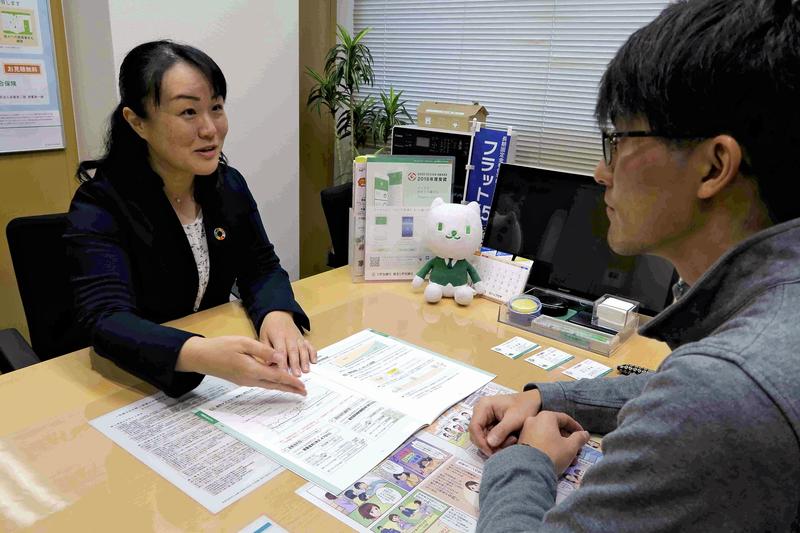
In mid-February, a 36-year-old company employee from Yokohama was visiting a housing loan office run by Resona Bank Ltd. near JR Yokohama Station.
"Interest rates are low, which lowers the hurdle for buying a home," he said, describing why he decided to move from a condominium to a single-family home.
The adjustable rate mortgages that many borrowers choose are affected by short-term interest rates. Resona's adjustable rate in January 2016, before the negative interest rates were introduced, was 0.60% per year for a regular contract, but recently this has dropped to 0.47%.
Still, this does not necessarily lead to a dramatic drop in interest payments; and with demand seeming to have run its course, the effects of low interest rates are fading.
According to the Japan Housing Finance Agency, domestic lending for new mortgages peaked at 24.6 trillion yen in fiscal 2016 and has since declined, falling to 20.9 trillion yen in fiscal 2018.
The policy has also not had the anticipated impact of encouraging companies to make capital investments.
Corporate bond issuance and bank borrowing have increased, but internal reserves have grown over the last four years, reaching 100 trillion yen in fiscal 2018. Some analysts have pointed out that companies are merely procuring cash at low interest rates and then sitting on it.
Meanwhile, financial institutions' profits are visibly deteriorating. With the margins between deposit and lending rates narrowing, total net business profits, an indicator of core business performance, at the three megabanks have declined by about half in four years.
This has prompted banks to increase fees at convenience store ATMs and for money transfers at bank counters in an attempt to shift the impact onto individual customers.
Returns on government bonds, which many banks purchase, have also declined. Some banks are increasing their holdings of less creditworthy financial instruments, which, while potentially offering higher returns, could be a risk in the future.
This has also had negative impacts on individual asset management, such as in lower interest rates on savings-type insurance products.
"The profitability of financial institutions is steadily deteriorating due to shrinking margins and operational difficulties. It is important to examine the state of monetary policy without prejudice," said Japanese Bankers Association Chairman Makoto Takashima, who is also president of Sumitomo Mitsui Banking Corp.
The BOJ has so far appeared unwilling to break away from negative interest rates.
At a press conference after a monetary policy meeting in January, BOJ Gov. Haruhiko Kuroda said, "At this time, we believe the effects of the policy are outweighing the costs."
The BOJ is worried that if it ends negative interest rates, it will lead to appreciation of the yen, which would harm the performance of export-orientated businesses. In general, currencies with higher interest rates tend to be bought.
The lack of inflation has also made it difficult for the BOJ to change its policies. The year-on-year increase in the National Consumer Price Index, which does not include fresh food, was only 0.6% in 2019, far below the BOJ's target of 2%.
However, even some BOJ insiders are starting to point to the bad effects of negative interest rates. Amid multiple central banks around the world starting to reexamine the effects of monetary policy, a BOJ policy board member said at a meeting in January that "it may be necessary to review Japan's monetary policy as well."
"I think the BOJ actually wants to end negative interest rates," said Takahide Kiuchi, a former BOJ policy board member and current executive economist at Nomura Research Institute Ltd.
Negative interest rate policy:
A policy in which some of the deposits private banks keep with the Bank of Japan are subject to negative interest rates. In effect, this serves as a "service fee" for depositing money. It is intended to encourage private banks to lend to businesses and individuals.
Read more from The Japan News at https://japannews.yomiuri.co.jp/