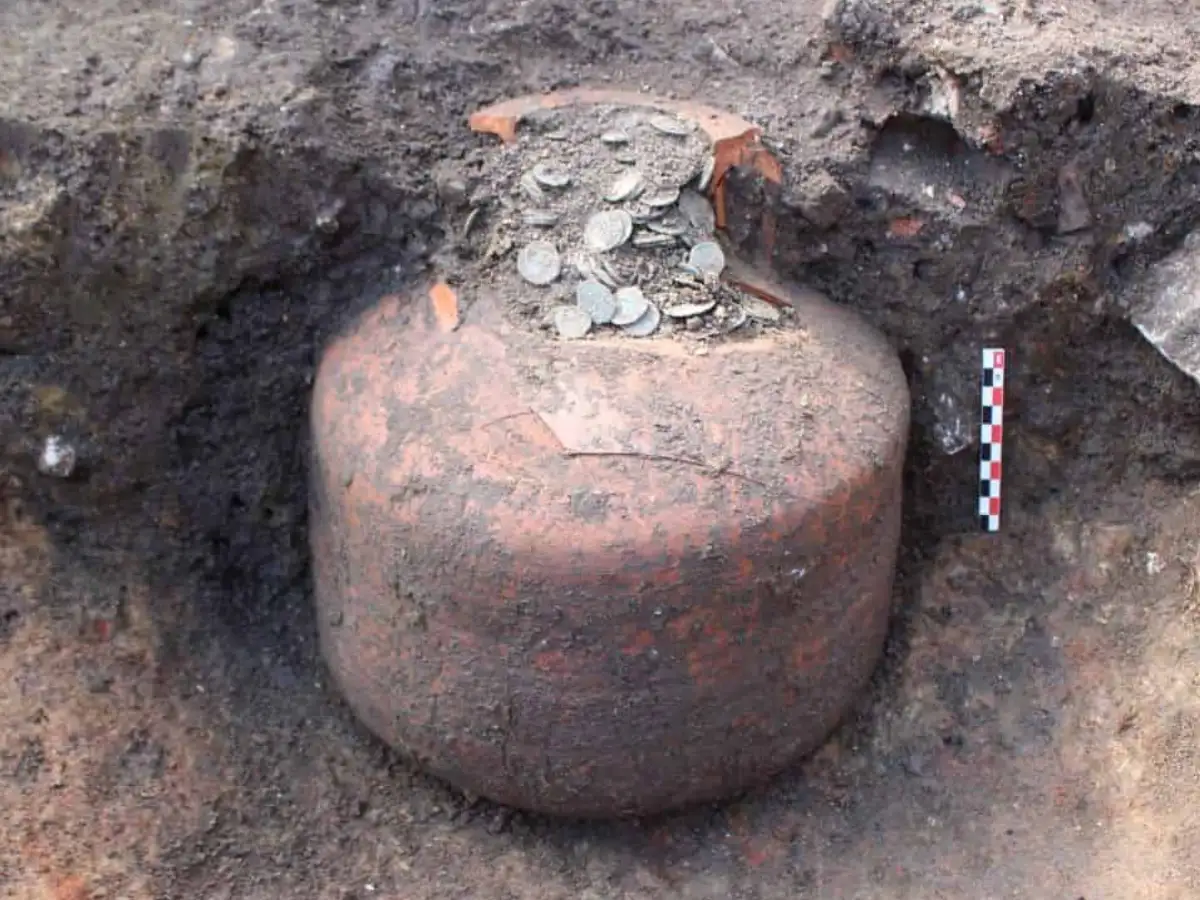
If you thought hiding cash in a mattress was a modern move, just wait until you hear about the folks in Roman-era France. Archaeologists excavating beneath the small village of Senon, in northeastern France, just unearthed three ceramic jars, or amphorae, that could contain more than 40,000 Roman coins, all dating back some 1,800 years, according to a Live Science report. How the jars were buried suggests something more interesting than a family hiding savings in a panic before fleeing danger. It looks like a real working household bank account.
The dig is being led by INRAP, or the National Institute for Preventive Archaeological Research, a government agency that intervenes whenever construction threatens to disturb a historical site. The official statement from INRAP says the dig is about 1,500 square meters and was triggered by routine construction work.
The excavation has already turned up a remarkably dense sequence of remains, from Gaulish postholes and ditches to at least three Roman houses, two paved streets, and an estimated dozen limestone quarries, some nearly 3 meters deep. According to INRAP, the preserved layout even shows the district expanding over time, with homes later enlarged and rebuilt in stone around courtyards and cellars.
Meet the neighborhood that time forgot
Senon was a busy little settlement way before Rome showed up. Archaeologists had to contend with postholes, pits, and ditches so densely packed that some zones had more than one structure per square meter, according to INRAP. Even 2,000 years ago, this was prime real estate, when the area was home to the Mediomatrici, a Celtic tribe.
But once Julius Caesar conquered Gaul, everything was different. By the end of the first century CE, Senon had grown into a full-blown Roman town, with paved streets and stone houses, underfloor heating and courtyards used as workshops. The well-built houses and everyday objects found at the site suggest residents who were relatively well-off, probably artisans or merchants, according to INRAP.