PUNE: The National Crime Records Bureau’s ‘Crime in India — 2020’ report notes that cybercrime in Pune saw a decline in 2020 compared to the previous year. But this is far from an accurate assessment of ground reality, according to data available with the Pune police.
As per the NCRB eport, 238 cybercrime cases were reported in Pune city in 2020, down from 309 in 2019. “These figures are based on registered FIRs. In reality, Pune police received 14,400 cybercrime complaint applications in 2020 — double the 7,742 applications received in 2019,” inspector D S Hake of the Pune cyber police said.
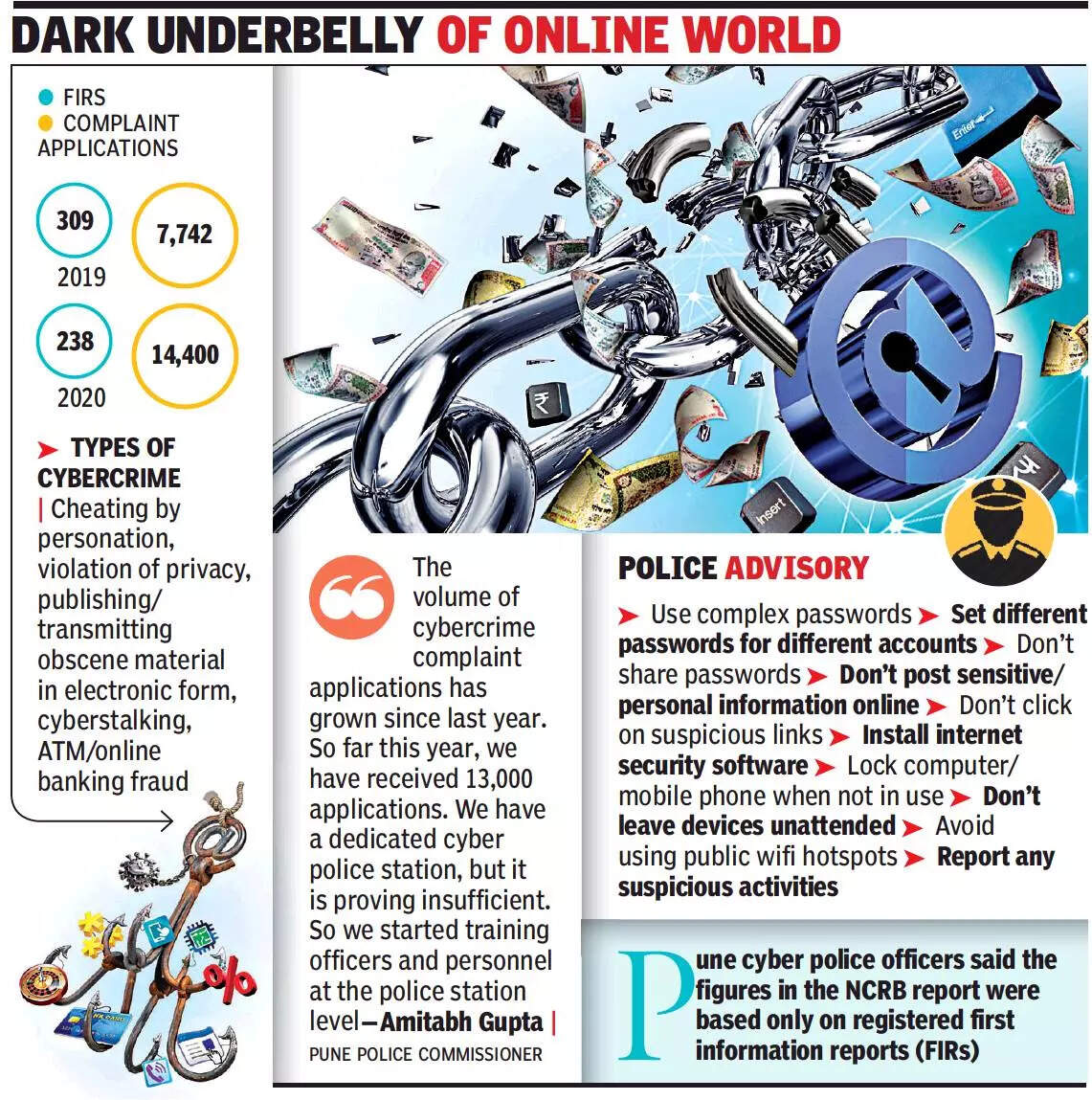
Hake said police have already received over 13,000 applications this year. “This clearly shows the extent to which cybercrime has increased in the city since 2019,” he said.
Most instances of cybercrime involved revenge, anger, extortion, defamation, pranks, sexual exploitation, political motives, and incitement of hatred.
“Cybercrime has gone up because of increased use of internet during the lockdown, as most people were dependent on online services,” Hake said. “Cybercrooks exploited vulnerabilities in online systems. By the time these loopholes were plugged, users were already targeted,” he added.
Hake explained that one of the most widespread methods of online fraud was the use of fake websites offering services or products. “Many users are unaware or cannot distinguish between secure and unsecured sites and get cheated,” he said.
Further, Hake said 70% of the complaints they get involve netbanking fraud. “Such complaints have increased as banks/mobile phone companies are slow in updating their customers’ details — crooks use the KYC update trick and siphon funds from people’s accounts,” he explained.
The inspector said investigating such complaints consumes time as they are heavily dependent on technical information to be handed over by service providers, which would help identify where (IP address) and how the fraud was committed, as well as details of the victims.
Cyber expert Gaurav Jachak said delay by service providers in giving police this information lead to a delay in the registration of FIRs. “In most cases, people duped of small amounts are unwilling to pursue the matter. In some instances, banks settle disputes with consumers. This could be why the number of FIRs is lower,” Jachak said.
Sapna Deo, an academician specialising in cyber law, said it was important for people to be eductaed in cyber security measures. “Most incidents occur due to negligence as many people don’t know on how to use computers/mobile phones. Instances of blackmail have increased with the increase in video-calling; photos posted on social media are morphed,” Deo said.
Jachak said the lockdown-induced circumstances were partly to blame. “Many people lost jobs and started looking for ways to earn money. Cybercrooks would target such people, offering them fake jobs abroad or loans at an attractive rate of interest. The crooks would thus gain access to sensitive financial information/bank accounts and cheat them,” he said.