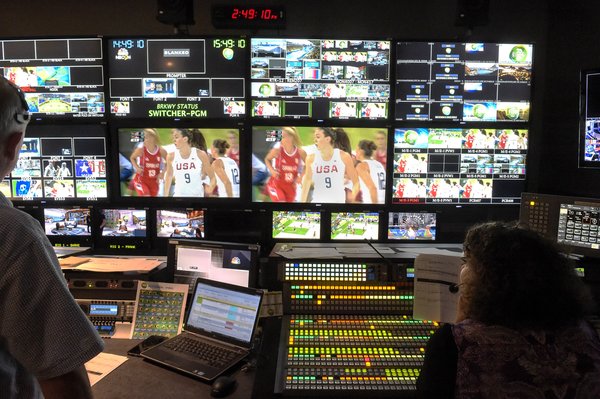
STAMFORD, Conn. _ Most eyes were glued to a large projection screen inside Stamford's NBC Sports Group headquarters, where Japan's Kohei Uchimura performed a near-perfect high bar routine.
But one employee did not even glance up from his computer screen in the complex's Highlights Factory. A former international-caliber fencer-turned-intern was tasked with watching hours of Olympics fencing coverage broadcast live from Rio.
"The idea is that in here, we don't miss anything," said Eric Hamilton, director of digital/video production for the Olympics. "There is something interesting in every single sport. We can find them and bring them out."
Hamilton oversees the Highlights Factory, a windowless room inside the 300,000-square-foot facility where about 40 staffers watch and log every moment of every sport, putting together between 220 and 240 videos every day. Viewers can see the results of their labor in the short videos on the NBC Olympics Facebook page or on the NBC Olympics app like swimmer Michael Phelps staring down fellow swimmer Chad le Clos, which, as of press time, had nearly 1.8 million YouTube views.
This is the 15th Olympics produced by NBCUniversal and its ninth consecutive, including the winter Olympics. It is, however, the first summer games produced from the company's new International Broadcast Center in Stamford, which opened in July 2013 as one of the original large companies lured to add jobs in Connecticut under Gov. Dannel Malloy's First Five program.
To date, NBC Sports has spent $184.7 million in Connecticut, thereby earning $40.3 million in tax credits through the program, said George Norfleet, director of Connecticut's Office of Film, Television and Digital Media.
The new facility has a giant newsroom, six on-air studios with control rooms, 50 graphics suites and more than 50 editing rooms. More than 700 employees work at the facility year-round, but during the Olympics, that number almost doubles.
The influx of bodies is obvious even outside of the complex. An extra cantina has been added outside to supplement the facility's large cafeteria, and shuttle buses idle near the entrance, poised to take staffers to the nearby Hilton at all hours of the day.
Though the action ends on TV by midnight, staffers work at the Blachley Road complex around the clock.
Over 17 days, NBCUniversal is scheduled to produce 6,755 hours of Olympic coverage across its networks and digital platforms _ the most ever for an Olympic Games, an NBC spokesman said. If the 6,755 hours ran on one channel, it would take 281 days to finish airing.
The company paid $4.4 billion for the rights to all four Olympic games from 2014 through 2020.
Coverage is presented across 11 channels _ two broadcast networks (NBC and Telemundo), seven cable networks (Bravo, CNBC, Golf Channel, MSNBC, NBC Sports Network, NBC Universo and USA Network), and two specialty channels, one each for basketball and soccer.
But in the Highlights Factory staffers work to find moments that often won't be broadcast on primetime, or happen outside of the views of the lead camera.
Hamilton recalled a moment he witnessed, as U.S. swimmer Nathan Adrian was completing the last leg of the men's 4x100-meter freestyle relay. As Adrian swam to clinch a first place finish, veteran Phelps put his arm around newcomer teammate Caeleb Dressel and said, "This is going to happen for you," Hamilton said.
"It's about capturing the moments," said Kenneth Goss, senior vice president of remote operations and production planning. "It's about enriching the viewer's experience."