The bones of an infamous Nazi doctor are being used by medical forensic students in a Brazilian university to piece together information about his life on the run.
Known as the “Angel of Death”, German doctor Josef Mengele drowned off the coast of the state of Sao Paulo nearly 40 years ago after spending years in hiding.
For more than 30 years, Mengele performed horrific experiments on Jews held in the Auschwitz concentration camp and sent thousands to their death in gas chambers.
After his death, his bones lay unclaimed inside a blue plastic bag in Sao Paulo's Legal Medical Institute.
But in 1985, Dr Daniel Romero Munoz and his team identified Mengele’s remains and he saw an opportunity to put them to good use.
And Dr Munoz said he had just been given permission to use the Nazi doctor’s bones in his forensic medical courses, with his students now learning their trade by studying Mengele’s remains and connecting them to his life story.
"The bones will be helpful to teach how to examine the remains of an individual and then match that information with data in documents related to the person," Dr Munoz said.
"For example, examining Mengele's remains, we saw a fractured left pelvis. Information found in his army record said that he fractured his pelvis in a motorcycle accident in Auschwitz.
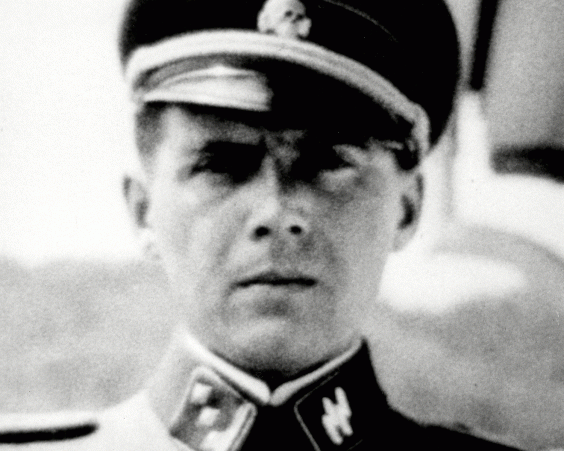
A small hole in Mengele's left cheekbone also suggest the German doctor suffered from long-term sinusitis and he is believed to have been treating dental abscesses himself with a razor blade.
Cyrla Gewertz, a 92-year-old Holocaust survivor, said the thought of Mengele’s bones being studied brought back painful memories.
"I already have too many painful memories of him and what he did to me and others at Auschwitz. These are memories I cannot erase from my mind,” she said.
Originally from Poland, Gewertz was a prisoner in Auschwitz, where she came face to face with Mengele on several occasions.
"He was an evil, perverse man. He was a torturer,” she said.
She recalls an occasion when Mengele killed a newborn baby girl by throwing her off the roof of the camps’ barracks.
Mengele fled to Argentina, when leading members of Nazi leader Adolf Hitler’s Third Reich were put on trial for war crimes in the 1950s. He arrived in Sao Paulo in 1960 and received shelter from a German couple.
Professor Maria Luiza Tucci Carneiro, a historian at the University of Sao Paulo, said she hoped the classroom learning went beyond the science to history and ethics.
“Students should also learn how physicians, psychiatrists and other leading scientists were in the service of the Reich, lending their knowledge to exclude the ethnic groups classified as belonging to inferior races," said Professor Carneiro.
"An exclusion that culminated in genocide."